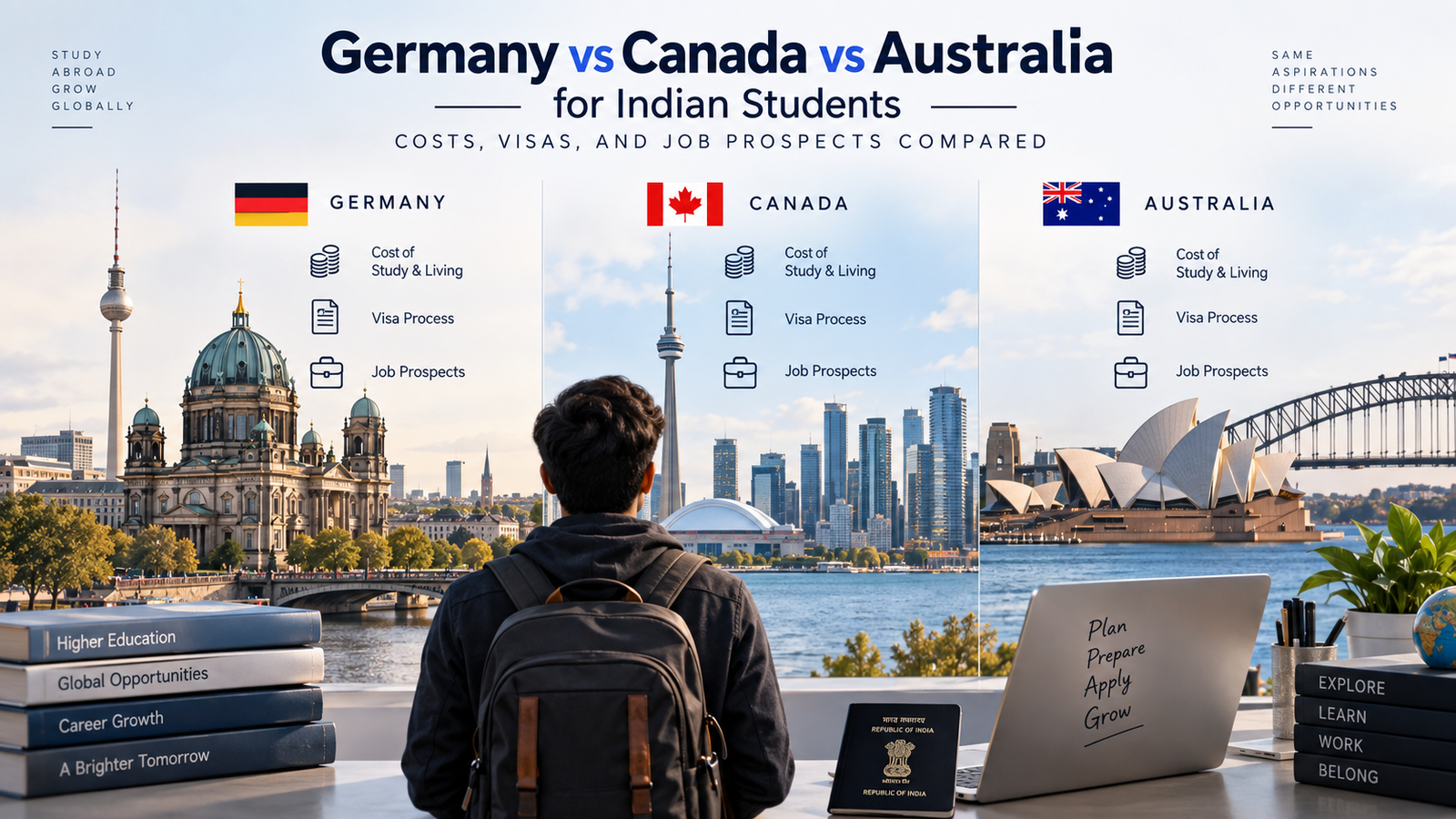
If you are an Indian student in 2026 weighing Germany, Canada, and Australia, you already know the brochures don’t tell you much. Everyone says “world-class education” and “great career opportunities.” What you actually need is real numbers, honest trade-offs, and a clear answer about where your rupees stretch furthest and your degree opens the most doors. This three-way comparison is built for that. For the wider picture of every major destination, our complete country-by-country study abroad guide for Indian students is a solid starting point, but this post zooms in on the three names that dominate every counsellor’s shortlist.
Quick Snapshot: Germany, Canada, and Australia at a Glance
Before we dig into the details, here is the short version most Indian students want first.
- Germany — Cheapest tuition (often zero at public universities), lower living costs, strong engineering and tech job market, 18-month post-study job-seeker visa.
- Canada — Higher tuition, generous work rights during and after study, clear PR pathway, up to 3-year post-graduation work permit.
- Australia — Premium tuition and lifestyle, highest average starting salaries of the three, 2 to 4-year Temporary Graduate visa depending on qualification and region.
Now let’s break each factor down properly.
Tuition Fees: Where Your Money Actually Goes
Germany
Public universities in most German states charge no tuition, even for international students. You pay a semester contribution of roughly 150 to 350 euros, which covers admin fees and often a public transport pass. Baden-Württemberg is the exception and charges around 1,500 euros per semester for non-EU students. Private universities and some English-taught master’s programs charge 10,000 to 20,000 euros a year, but they are the minority.
Canada
Tuition sits between 20,000 and 45,000 CAD per year for undergraduates, and 15,000 to 55,000 CAD for postgraduates. Business schools and STEM at top universities like Toronto, UBC, and McGill sit at the higher end. Community colleges are cheaper at 12,000 to 20,000 CAD and remain a smart pick if PR is the end goal.
Australia
Expect 30,000 to 50,000 AUD a year for a bachelor’s or master’s at Group of Eight universities. Regional universities can drop that to 22,000 to 30,000 AUD, plus they offer extra migration points. In rupee terms, Australia is comfortably the most expensive of the three on tuition alone.
Living Costs: The Number Everyone Underestimates
Tuition is one thing. Rent, groceries, transport, and health insurance quietly eat the bigger chunk of your budget.
- Germany — 950 to 1,300 euros per month, roughly 8.5 lakh to 11.5 lakh INR per year. Berlin and Munich sit at the top; smaller cities like Leipzig and Aachen are notably cheaper. Health insurance is mandatory at around 120 euros a month.
- Canada — 1,200 to 1,800 CAD per month, or 7.5 lakh to 11 lakh INR per year. Toronto and Vancouver are the pain points. Provincial health cover varies, and most students pay separate insurance.
- Australia — 1,800 to 2,500 AUD per month, roughly 10 lakh to 14 lakh INR per year. Sydney and Melbourne pull the average up. Overseas Student Health Cover (OSHC) is compulsory and costs around 600 AUD a year.
Add tuition and living together and the picture flips. A two-year public master’s in Germany might cost you 22 to 26 lakh total. The same two years in Canada lands around 45 to 60 lakh, and in Australia often crosses 70 lakh.
Student Visa: Rules, Costs, and Approval Odds
Germany Student Visa
You apply for a national visa (D-visa) at the German embassy. The core requirement is a blocked account with 11,904 euros for the year, plus proof of admission and health insurance. Fees are around 75 euros. Processing takes 6 to 12 weeks. Approval rates for genuine applicants with clean documents are consistently strong.
Canada Study Permit
Canada tightened rules in 2024 and 2025, and 2026 continues that trend. You need a Provincial Attestation Letter, a Guaranteed Investment Certificate of 20,635 CAD, and proof of tuition paid. Fees run 150 CAD plus biometrics. Approval rates for Indian applicants dropped noticeably after the cap, so college choice and financial documentation matter more than ever.
Australia Student Visa (Subclass 500)
Australia introduced the Genuine Student test in 2024, replacing the older Genuine Temporary Entrant rule. You need proof of 29,710 AUD in savings for the year, plus tuition and travel funds. The visa itself costs 1,600 AUD. Processing usually takes 4 to 8 weeks. Australia is stricter on intent than either Germany or Canada right now, so your Statement of Purpose has to hold up.
Work While You Study
All three countries let you work part-time, but the rules differ.
- Germany — 140 full days or 280 half days per year. Minimum wage in 2026 is around 12.82 euros an hour.
- Canada — 24 hours per week during sessions, full-time during scheduled breaks. Provincial minimum wages range from 15 to 17 CAD.
- Australia — 48 hours per fortnight during term, unrestricted in breaks. Minimum wage is 24.10 AUD, the highest of the three.
Australian hourly rates are the strongest, but higher living costs cancel some of that lead. Germany’s low cost of living means part-time work actually funds a meaningful chunk of your monthly expenses.
Post-Study Work Visa: The Real Deciding Factor
Where you can stay and work after graduation is often the difference-maker. If you’re still figuring out whether the field you’re picking will even hold value abroad, take a detour through our take on which degrees actually matter in 2026 before committing to a program.
Germany — 18-Month Job Seeker Visa
After graduation, you can stay 18 months to look for work related to your degree. Once you find a role, you switch to an EU Blue Card or standard work permit. The Blue Card can lead to permanent residency in 21 months if your German is B1 level, or 27 months without.
Canada — Post-Graduation Work Permit (PGWP)
Length matches your program duration, up to 3 years. Recent rule changes tie PGWP eligibility to programs on Canada’s in-demand fields list, so course choice matters more than it used to. From PGWP, you can apply for PR through Express Entry or a Provincial Nominee Program.
Australia — Temporary Graduate Visa (Subclass 485)
Two to four years depending on qualification level and whether you studied in a regional area. Bachelor’s and master’s holders typically get 2 to 3 years; PhDs get 4. Regional graduates get bonus years and extra migration points toward PR.
Average Starting Salaries After Graduation
Here is what fresh graduates realistically earn in 2026, converted to INR for easier comparison.
- Germany — 45,000 to 60,000 euros a year in engineering, IT, and finance. That’s roughly 40 to 55 lakh INR. Non-technical roles start lower at 35,000 to 42,000 euros.
- Canada — 55,000 to 75,000 CAD in tech, engineering, and healthcare. Around 34 to 47 lakh INR. Toronto and Vancouver pay more, but rent eats most of the extra.
- Australia — 65,000 to 90,000 AUD in engineering, tech, nursing, and accounting. About 36 to 50 lakh INR. Mining and specialised healthcare push much higher.
Germany often wins on take-home value because of low living costs and cheap health cover. Australia looks best on paper but taxes and rent trim the advantage. Canada sits in the middle with the clearest PR runway.
Which One Should You Pick?
There’s no universal answer, but the pattern is usually this:
- Pick Germany if your budget is tight, you’re in engineering, IT, or research, and you’re willing to learn some German.
- Pick Canada if permanent residency is the main goal and you want maximum flexibility in program and location.
- Pick Australia if you have the funds, you want the highest starting salary, and you don’t mind stricter visa scrutiny.
Before you commit, cross-check your shortlist against our broader comparison of the best countries to study abroad in 2026, which covers scholarships and settlement pathways in more detail. Then look at the specific universities inside your top country, not just the country itself. A mid-ranked program in a strong city often beats a top-ranked program in the wrong location for your career.
Final Word
Germany, Canada, and Australia are all excellent choices for Indian students in 2026, but they solve different problems. Germany rewards frugal, technically strong students. Canada rewards planners who want to settle. Australia rewards those with capital and confidence in their field. Match the country to your goal, not the other way round, and you’ll spend the next two years building a life instead of second-guessing the decision.