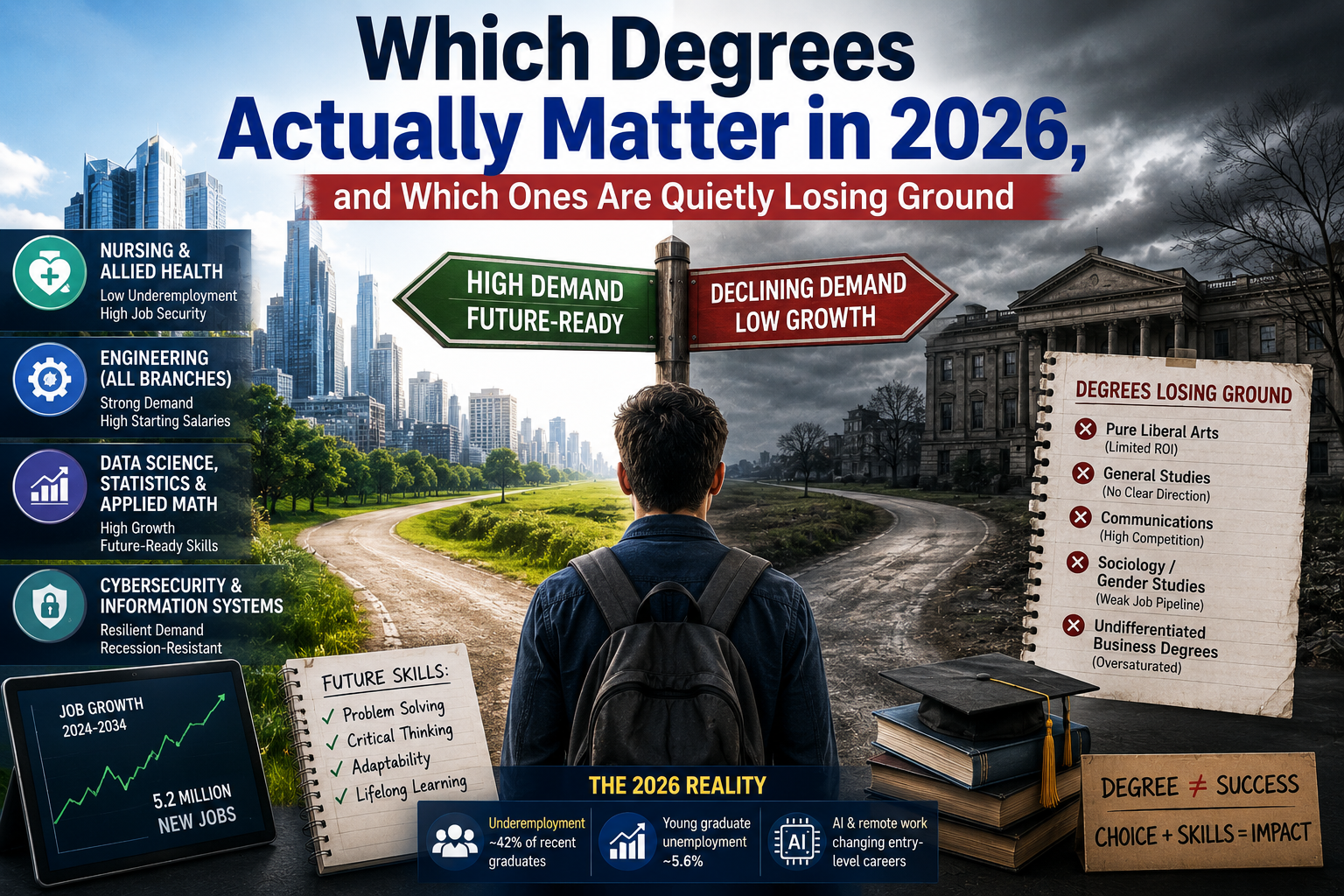
For about 40 years, the advice given to teenagers was simple. Get a degree, any degree, and the job market will sort out the rest. That advice has stopped working the way it used to, and 2026 is the year the numbers made it obvious.
This is not an argument against higher education. Graduates still earn more over a lifetime than non graduates in almost every economy that tracks the data. But the gap between a well chosen degree and a poorly chosen one has widened into something that looks less like a preference and more like a fork in the road. Here is what the evidence says about which side of that fork is which.
The uncomfortable starting point
The Federal Reserve Bank of New York tracks how recent graduates aged 22 to 27 are doing in the American labour market. Through the second quarter of 2026, unemployment for that group sat at roughly 5.6 percent, above the national average. Underemployment, meaning graduates working in jobs that do not typically require a degree, edged up to around 42 percent.
Sit with that second figure for a moment. It is not the unemployed graduates who tell the real story. It is the ones who are employed, paying off loans, and doing work they did not need a degree to get.
The causes are debated. Some analysts point to artificial intelligence eating the routine entry level tasks that used to serve as a training ground. New York Fed researchers have argued the effect is smaller than the headlines suggest, and that the shift to remote and hybrid work explains a much larger share of the rise in young graduate unemployment, because distributed teams are harder places to train and mentor a beginner. Both things can be true at once. Either way, the bottom rung of the career ladder has become harder to reach, and the degrees that still come with a built in ladder are the ones holding their value.
Where the demand actually is
The US Bureau of Labor Statistics projects the economy will add about 5.2 million jobs between 2024 and 2034, growing 3.1 percent. That headline number is unremarkable. The distribution underneath it is not.
Healthcare and social assistance is projected to be the fastest growing sector at 8.4 percent, driven by an ageing population and rising rates of chronic illness. Professional, scientific and technical services follow at 7.5 percent, pushed by demand for AI systems, data work and consulting. Within occupational groups, healthcare support roles are projected to grow 12.4 percent and computer and mathematical roles 10.1 percent, more than 3 times the economy wide rate.
That gives us a rough map. Below are the fields where the map and the graduate outcome data agree.
1. Nursing and allied health
Nursing consistently records the lowest underemployment rate of any major the New York Fed tracks. The reason is structural rather than magical. Nursing students complete clinical rotations inside real hospitals, which function as extended job interviews, and the credential is licensed, so an employer cannot substitute an enthusiastic amateur. The same logic extends to physician assistants, physical and occupational therapy, radiography, and respiratory therapy.
The trade off is honest work that is emotionally and physically demanding, with pay ceilings that are solid rather than spectacular. If that suits you, this is arguably the safest bet on the board.
2. Engineering, especially the unglamorous branches
When researchers scored majors on unemployment, underemployment and early career pay together, engineering subfields took 8 of the top 15 places. Computer engineering graduates recorded the highest median early career pay at around 90,000 dollars.
The interesting movement is in the branches that spent 2 decades being overshadowed by software. Electrical engineering is being pulled by grid modernisation, chip fabrication and electrification. Civil and structural engineering is being pulled by infrastructure spending. Chemical, industrial and mechanical engineering are being pulled by the reshoring of manufacturing. These fields also have a demographic advantage that nobody planned: a large share of their senior workforce is close to retirement.
3. Data science, statistics and applied mathematics
Data scientist ranks as the 4th fastest growing occupation in the BLS projections. The demand comes from a simple asymmetry. Organisations now generate more data than they can interpret, and AI tools have made interpretation cheaper without making judgement cheaper.
One caution. A degree that teaches you to run a model is worth much less than one that teaches you why the model is wrong. Programmes heavy in statistical theory, experimental design and causal inference are ageing far better than programmes that are essentially tool training with a university logo on top.
4. Cybersecurity and information systems
Attack frequency and regulatory pressure both keep climbing, and neither is sensitive to the business cycle in the way that discretionary tech hiring is. Security work also resists automation more than most computing work, because the adversary is a human being who adapts. Degrees that combine technical depth with governance, risk and compliance literacy are unusually well positioned.
5. Accounting, business analytics and actuarial science
Accounting made the top 15 majors list alongside the engineering fields, which surprises people who assume software has hollowed it out. It has not, for 2 reasons. The profession is licensed, and there is a genuine shortage in the pipeline as senior accountants retire faster than juniors qualify. Business analytics benefits from the same quantitative premium as data science with a lower barrier to entry.
Note the pattern. General business management does poorly. Specific, quantitative, credentialed business fields do well. The word business on a diploma tells an employer almost nothing on its own.
6. Education, particularly special education and STEM teaching
Special education appears in the top 15 majors by labour market outcomes, which tells you how acute the shortage is. Teaching degrees have a hidden advantage that mirrors nursing. Student teaching placements are long, supervised, and frequently convert directly into offers from the same district. The pay is the well known drawback. The employment certainty is the underrated benefit.
The case that is more complicated than the headlines
Computer science deserves its own paragraph, because the discourse around it has become unhelpfully binary.
The February 2026 outcomes data showed computer science graduates at 7.0 percent unemployment and computer engineering at 7.8 percent, both above the average for recent graduates. That is a real reversal for fields long treated as guaranteed. But the same graduates recorded the highest early career earnings of any field, and low underemployment once employed.
What that combination suggests is not collapse. It suggests a market that has become selective and slower to absorb entrants, where the graduates who land do very well and the ones who do not wait longer. A computer science degree in 2026 is a high variance choice rather than a bad one. Treat it as something that requires a portfolio, internships and specialisation to convert into a job, not as a credential that does the converting on your behalf.
Where the ground is softest
The fields with the highest unemployment and underemployment among recent graduates cluster in the humanities, arts, general social sciences and broad vocational fields such as criminal justice, performing arts, anthropology and general business management. In the Federal Reserve household survey, half of graduates from social science, humanities and arts programmes said they would choose a different major if they could start again, the highest regret rate of any group.
Two honest caveats belong here. First, these fields produce excellent thinkers and writers, and the skills genuinely transfer. The problem is that they transfer into a job market that no longer has an obvious entry point for a generalist, which is precisely the entry point AI and remote work have squeezed. Second, mid career earnings narrow the gap for many humanities graduates who eventually add a professional qualification. The pain is front loaded, not permanent.
If you love these fields, the practical answer is rarely to abandon them. It is to pair them with something the market can price, whether that is a statistics minor, a professional certification, a language, or a serious internship record.
The 4 things that actually decide whether a degree pays
- A pipeline, not just a syllabus. Nursing, teaching and accounting all embed supervised placements that convert into offers. Degrees without a placement structure ask the graduate to build the bridge alone, in the worst market for beginners in over a decade.
- A licence or a legal moat. Where a job legally requires a specific credential, competition is bounded and AI is a tool rather than a substitute.
- Quantitative depth. Not coding for its own sake, but the ability to reason about uncertainty, causation and measurement error.
- Experience before graduation. Employers in the 2026 NACE survey rated internship experience as the single most important hiring factor. Nothing on this list moves the needle more, and it is the one factor entirely within a student control.
5 questions worth asking before you commit
- Does this programme place students into supervised, real world work, and what share of them get offers from those placements?
- Is the credential required by law or by professional standards for the jobs I want?
- What did graduates of this exact programme, not this broad field, earn 3 years out?
- If AI absorbs the routine tasks in this field, what is left, and does the curriculum teach that part?
- Can I acquire the same capability through a shorter or cheaper route, such as an associate degree, apprenticeship or licensed technical programme?
That last question matters more than most prospectuses would like. Several of the fastest growing occupations in the projections, including wind turbine service technicians and solar installers, need no bachelor degree at all. They are small fields in absolute terms, so growth rates overstate the number of openings, but the principle holds. For some careers, the degree is the expensive route to a destination with a cheaper road.
The bottom line
The question is no longer whether to get a degree. It is whether a particular degree comes with a route into work attached. In 2026, the fields that keep their value are the ones where the credential is required, the training is supervised, the maths is real, and the work is difficult to hand to software.
Everything else can still be worth studying. It just needs a second thing attached to it.
Note on the data: the graduate outcome and projection figures cited here come from United States sources, which are the most detailed publicly available. The underlying patterns, particularly the premium on licensed and placement based fields, appear in most advanced economies, but readers elsewhere should check their national statistics office or higher education regulator for local figures before making a decision.