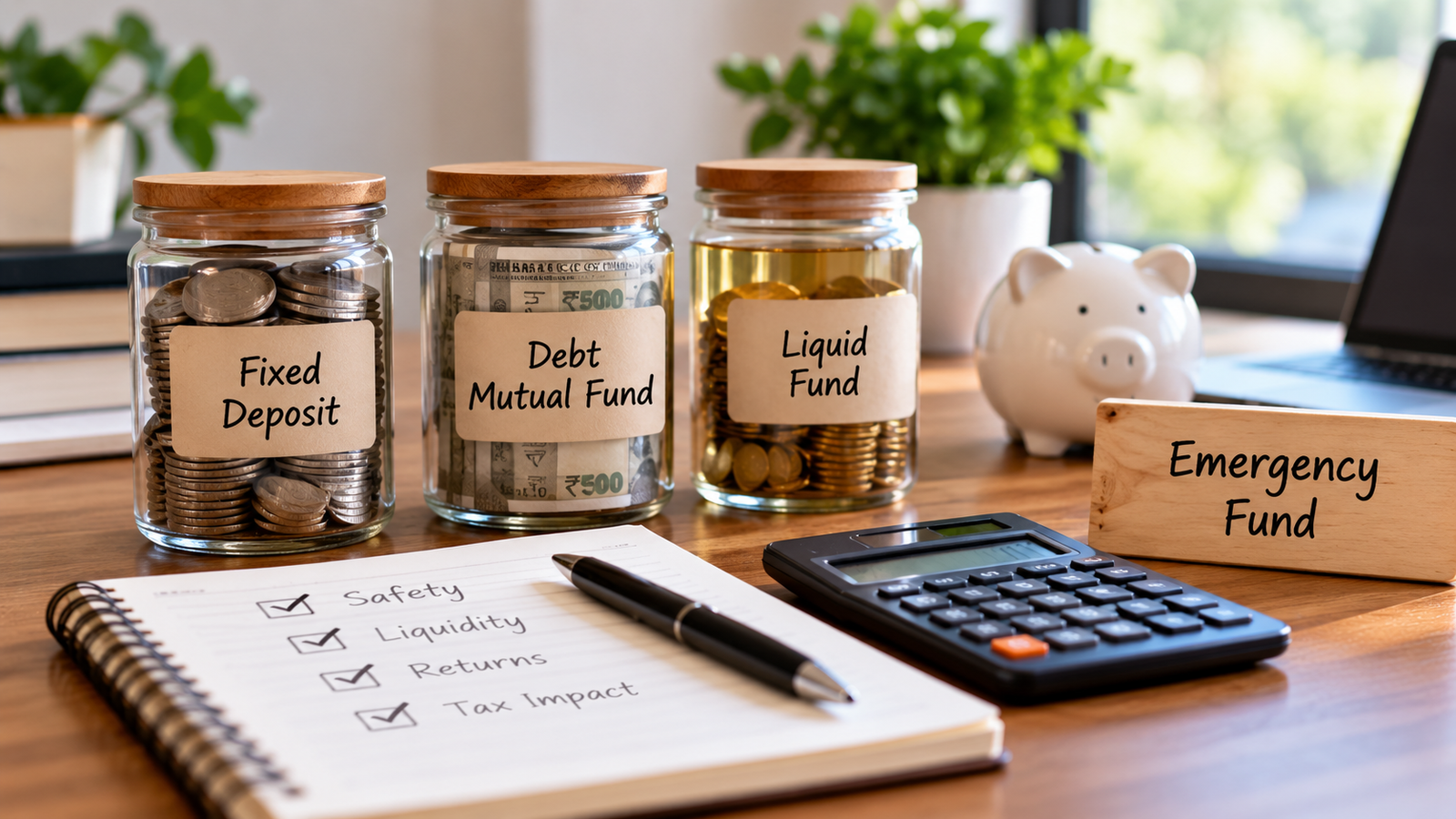
Everyone agrees you need an emergency fund. Hardly anyone agrees on where to keep it.
Your bank manager pushes a fixed deposit. A colleague swears by liquid funds. Some finfluencer calls debt funds the “smart money” option. All three can work, but they behave very differently on the day your car breaks down or your company announces layoffs.
If you’re still setting up your finances, our complete roadmap for Indian investors covers the bigger picture. This post answers one narrow question: FD vs debt mutual fund vs liquid fund: which one should hold your emergency money?
We’ll compare them on liquidity, tax and returns, and then give you a straight answer.
What an Emergency Fund Actually Has to Do
Before comparing products, get the job description right. Emergency money isn’t an investment. It’s insurance you pay for yourself.
It has three jobs, in this order:
- Stay intact. The ₹3 lakh you parked should still be ₹3 lakh (or more) when you need it.
- Be reachable fast. Hospitals, repairs and job gaps don’t wait for a maturity date.
- Beat inflation, if possible. This comes last, not first.
Most people rank these the other way round. They chase an extra 0.75% and end up with money that’s locked, volatile, or both. Keep this order in mind as we go.
The Three Options in Plain Terms
Fixed Deposit (FD)
You lend money to a bank for a fixed period at a fixed rate. Deposits are insured by DICGC up to ₹5 lakh per depositor per bank (principal plus interest combined). Breaking it early usually costs you a 0.5% to 1% cut in the interest rate.
Liquid Fund
A mutual fund that can only hold debt and money market instruments maturing within 91 days: treasury bills, commercial paper, certificates of deposit. Because everything it owns matures so quickly, its value barely moves day to day.
Debt Mutual Fund (Short Duration and Beyond)
This is a broad family: short duration, corporate bond, banking and PSU, dynamic bond, gilt funds and more. They hold longer-dated bonds, which means higher potential returns but also real price swings when interest rates move.
That last point matters more than most comparisons admit, so let’s start there.
Liquidity: How Fast Can You Actually Get Paid?
This is where the three split apart.
- Liquid funds pay out regular redemptions on T+1, meaning the next business day. Many fund houses also offer instant redemption of up to ₹50,000 (or 90% of your holding, whichever is lower) per day, credited within minutes, even on weekends.
- FDs can be broken online in minutes with most banks. You pay for it with the premature withdrawal penalty, and some tax-saver and non-callable FDs can’t be broken at all.
- Other debt funds also settle in a day or two, but many charge an exit load if you redeem within a few months. The bigger issue is that the amount you get back depends on where bond prices are that week.
Liquid funds do charge a tiny exit load in the first 7 days, about ₹7 on ₹1 lakh. You can ignore it.
Winner on liquidity: Liquid fund, with a sweep-in FD close behind.
Tax Efficiency: Where Most Comparisons Get It Wrong
You’ll still find old articles praising debt funds for “indexation benefits”. That’s history. For investments made from April 2023 onwards, gains from funds that mainly hold debt are added to your income and taxed at your slab rate, however long you hold them. No indexation, no 20% long-term rate.
So on paper, FD interest and liquid or debt fund gains are taxed at the same rate. The difference is when and how the tax hits you.
How FD interest is taxed
- Interest is taxable every year as it accrues, even if you don’t withdraw a rupee.
- The bank deducts 10% TDS once interest crosses ₹50,000 a year (₹1 lakh for senior citizens).
- If you’re in the 30% slab, you still owe the balance when you file your return.
How liquid and debt fund gains are taxed
- You pay tax only when you redeem, and only on the gain portion of the units you sell.
- No TDS for resident investors.
- Money you don’t touch keeps compounding on the full pre-tax amount.
What that deferral is worth in rupees
Say you’re in the 30% slab (31.2% with cess) and park ₹5 lakh for three years at an assumed 6.75% a year, whether FD or liquid fund.
- FD: Tax gets taken out every year, so you effectively compound at about 4.64%. Net gain after three years: roughly ₹72,900.
- Liquid fund: The full amount compounds at 6.75%, and you pay 31.2% tax once at the end. Net gain: roughly ₹74,500.
That’s about ₹1,500 in favour of the liquid fund. It’s real money, but it won’t change your life. The bigger practical wins are no TDS to reconcile, no tax bill on money you haven’t touched, and in a partial withdrawal you’re taxed only on the small gain inside those units, not the whole amount.
If you’re in the 0% to 10% slab, the tax gap nearly disappears, and a well-priced FD can come out ahead.
Winner on tax: Liquid fund (a small edge that grows with your slab and how long you hold).
Returns: Closer Than You Think
Liquid fund returns track short-term rates such as the repo rate and T-bill yields. Historically they’ve run close to 1-year FD rates at large banks, sometimes a bit above and sometimes a bit below.
A few honest observations:
- Small finance banks often pay 1 to 1.5 percentage points more on FDs than large banks. That’s a real edge, but keep each bank under the ₹5 lakh DICGC limit.
- Liquid fund returns adjust quickly. When RBI raises rates, your liquid fund catches up within weeks. An FD locks you in, which is good when rates are falling and bad when they’re rising.
- Short-duration and corporate bond funds can beat both over a 2 to 3 year stretch. They can also post a negative month when yields jump. That’s fine for goal-based money but a poor fit for emergencies.
How big your emergency fund should be, and how it fits with the rest of your money, depends on your income and commitments. Our guide to salary and asset allocation goes through that split step by step.
Winner on returns: Tie between FD and liquid fund. Debt funds may earn more, but not reliably over the short periods emergency money usually sits.
Risk: What Can Actually Go Wrong
- FD: Very little, as long as you stay within ₹5 lakh per bank. Above that, you’re relying on the bank’s own health. Rare, but it has happened with cooperative banks.
- Liquid fund: Not insured, but the portfolio is very short-dated and mostly top-rated. Liquid funds have had brief wobbles during credit events. Picking a large fund that holds mostly government securities and AAA paper cuts that risk sharply.
- Debt funds: Two risks at once. Interest rate risk means prices fall when yields rise. Credit risk means a bond issuer can default. The 2020 closure of six Franklin Templeton debt schemes locked investors out of their money for months. That’s the worst possible outcome for emergency cash.
Side-by-Side Comparison
| Factor | Fixed Deposit | Liquid Fund | Debt Fund (Short Duration etc.) |
|---|---|---|---|
| Access speed | Minutes (online break) | Instant up to ₹50k; T+1 for the rest | T+1 to T+2 |
| Cost of early exit | 0.5–1% rate penalty | Negligible after 7 days | Exit load possible for months |
| Capital safety | Very high (insured up to ₹5L) | High (not insured) | Moderate |
| Tax timing | Every year, on accrual | Only on redemption | Only on redemption |
| TDS | Yes, above ₹50k interest | No | No |
| Return stability | Fixed | Very stable | Can fluctuate, even go negative |
| Fit for emergency money | Good | Best | Poor |
The Verdict: Where Your Emergency Money Should Sit
You don’t have to choose just one. The setup that works best for most salaried Indians has three layers:
Layer 1: Savings account or sweep-in FD (about 1 month of expenses)
This is for the 2 a.m. emergency when you need money immediately. A sweep-in FD earns FD-like interest on idle cash and releases it automatically when your balance drops.
Layer 2: Liquid fund (2 to 3 months of expenses)
This is the core of your emergency fund. It’s reachable the next day, instant up to ₹50,000, earns close to FD rates, and you’re taxed only on what you withdraw. Choose a large fund from a reputed AMC with a low expense ratio, and use the direct plan.
Layer 3: FD ladder (the remaining 2 to 3 months)
Split this across a few FDs with staggered maturities, for example 3, 6 and 12 months, and keep each bank under ₹5 lakh. This part gives you insured safety and a locked rate for the money you probably won’t need.
What to skip: Short-duration, corporate bond, credit risk and gilt funds. They’re decent tools for goals 2 to 4 years away. Emergency money shouldn’t depend on where bond yields happen to be that week.
One adjustment by tax slab: If you’re in the 0% to 10% slab or have no taxable income, the tax advantage of liquid funds mostly disappears. Put more into FDs, particularly insured small finance bank FDs, and keep only the instant-access portion in a liquid fund.
Frequently Asked Questions
Is a liquid fund safer than an FD?
Not strictly. An FD within ₹5 lakh is insured and a liquid fund isn’t. But a large, high-quality liquid fund carries very low risk, and for most people its better access and tax timing outweigh that small gap.
Can a liquid fund give negative returns?
Over a single day it’s possible in rare stress events, but over a week or more it’s extremely unusual for a well-run liquid fund. Over the months emergency money typically sits, it’s not a practical worry if you pick a quality fund.
How much emergency fund do I need?
Six months of essential expenses (rent, EMIs, groceries, insurance premiums, school fees) is a sensible default. Freelancers, single-income families and people in volatile industries should aim for 9 to 12 months.
The Bottom Line
For most people reading this, the answer is simple. Keep the core of your emergency fund in a good liquid fund, hold an insured FD ladder behind it, and keep a month’s expenses in your savings account. Leave longer-duration debt funds for money you won’t need soon.
Review the setup once a year, or whenever interest rates change sharply. When RBI moves rates, FD offers and liquid fund yields both follow. Our explainer on what RBI’s interest rate decisions actually mean for you shows how those changes reach your wallet.
Set it up once, keep it topped up, and don’t touch it unless it’s a real emergency.
This article is for general information only and isn’t personalised financial advice. Tax rules are as applicable at the time of writing; check the current position or consult a tax professional before acting.