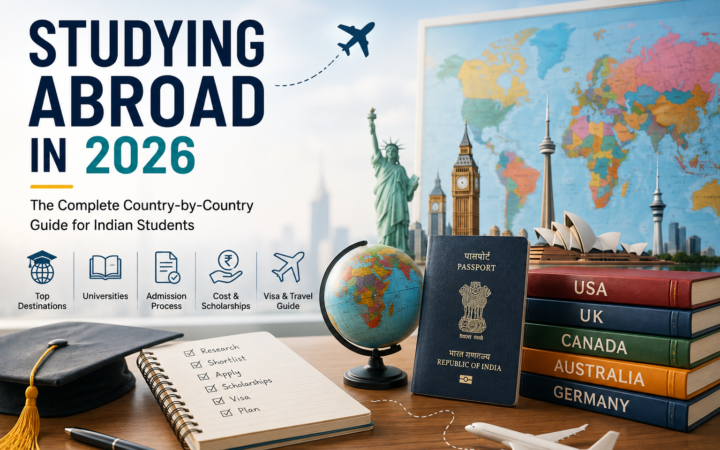
If you are an Indian student planning a September 2026 or January 2027 intake, the Canada student visa cap is no longer background noise. It is the single number that decides whether your file gets looked at or quietly sits in a queue that has already closed. IRCC has locked the 2026 ceiling at 408,000 study permits, and only a slice of that is available to first-time applicants from India. Before you shortlist a college, it helps to see where Canada now sits against the rest of the map in our complete country-by-country guide for Indian students.
Here is the honest, numbers-first version of what the cap means for you, which streams are squeezed, which ones quietly escaped, and what a smart Plan B looks like.
The 2026 Numbers: What Is Actually Left
Canada’s 2026–2028 Immigration Levels Plan does not just repeat the old cap. It shrinks it again.
- 408,000 — total study permits IRCC expects to issue in 2026
- 155,000 — permits for newly arriving students (this is the number that matters to you)
- 253,000 — extensions for students already inside Canada
- 7% lower than the 2025 target of 437,000
- 16% lower than the 2024 target of 485,000
Read that second line again. Roughly 62% of the 2026 allotment is already spoken for by students who are in Canada renewing their status. The genuinely open pool for fresh arrivals worldwide is 155,000 — split across every country, every province and every level of study.
The Capped Pool Inside the Pool
Not every permit sits under the provincial attestation system. IRCC has split 2026 like this:
- 180,000 — applicants who need a Provincial or Territorial Attestation Letter (PAL/TAL)
- 115,000 — primary and secondary school students (exempt)
- 64,000 — other exempt categories
- 49,000 — master’s and doctoral students at public institutions (newly exempt)
To fill that 180,000 issuance target, IRCC is accepting 309,670 applications into processing. Do the arithmetic and the message is blunt: for every capped seat issued, close to two applications will be filed. The cap is not the only filter — refusal does the rest of the work.
The India-Specific Reality Check
National averages hide what has actually happened to Indian applicants. The drop here has been far steeper than the cap alone explains.
- India received 188,255 study permits in 2024.
- Full-year 2025 landed near 90,000 — a fall of roughly 52% in a single year.
- Against the 2023 peak, that is a decline of close to 67%.
- Refusal rates for Indian applications touched 74% in August 2025, against about 32% two years earlier.
- The all-nationality refusal rate over the same period sat around 40%; Chinese applicants were refused at roughly 24%.
So the real constraint for an Indian student in 2026 is not just a smaller cap. It is a cap plus a refusal rate that is nearly double the global average. Two students with identical marks now get very different outcomes depending on how their file is built.
Which Streams Are Hit — and Which Escaped
Hardest hit: college diplomas and PG certificates
Private college programs, public-private partnership programs and one-year PG diplomas sit squarely inside the capped 180,000 pool. They also carry the heaviest refusal load, because these are the applications officers scrutinise hardest for genuine student intent.
Quietly protected: master’s and PhD at public institutions
This is the biggest structural change of 2026 and most agents are not shouting about it. Master’s and doctoral students at public designated learning institutions no longer need a PAL or TAL. They sit outside the capped pool entirely, in a 49,000-permit lane of their own. If you can fund a two-year master’s, you have moved from the most contested queue into the least contested one.
Untouched: school students
K–12 applicants hold 115,000 permits and are fully exempt. Irrelevant to most readers here, but it explains why the “408,000” headline feels bigger than the opportunity actually is.
Also exempt
Students extending a permit at the same institution and the same level of study, plus certain Government of Canada priority and vulnerable groups.
Where the Spaces Actually Are: Provincial Allocations
The capped 180,000 is carved up province by province, and the split is uneven enough to change where you should apply.
- Ontario: 104,780 application spaces
- Quebec: 93,069
- British Columbia: 32,596
- Alberta: 32,271
- Nunavut: no allocation (no post-secondary institutions)
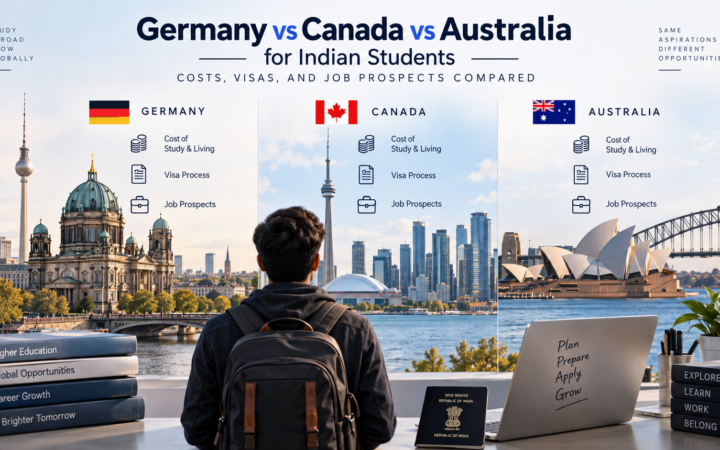
Ontario and Quebec together hold the bulk of the capped spaces — but they are also where Indian demand concentrates most heavily, which is exactly why refusal pressure there is fiercest. Alberta and the smaller Atlantic provinces receive fewer spaces in absolute terms, yet attract far fewer applications per seat. If your program exists in more than one province, the province you pick is a strategic decision, not an afterthought. The same logic applies when you weigh Canada against other destinations — our side-by-side on Germany vs Canada vs Australia for Indian students breaks down cost, visa odds and job prospects for each.
The Three Rules That Decide Your 2026 File
1. The attestation letter (PAL/TAL)
Unless you fall into an exempt category, your application is incomplete without a PAL or TAL from the province. Provinces issue these against their own allocation, and once a province’s share is consumed, it is consumed. Early intakes are not a preference in 2026 — they are the difference between applying and not applying.
2. Proof of funds
From 1 September 2026, the living-cost requirement for a single applicant rose to CAD 23,448. That figure covers living expenses only. Tuition and travel are shown separately and on top. IRCC has also sharpened two questions officers must be satisfied on: whether the money is genuinely available to you without working in Canada, and where it came from. A large, unexplained deposit weeks before filing is now a refusal trigger, not a formality.
3. PGWP field of study
The list of PGWP-eligible fields of study has been frozen for 2026 — nothing added, nothing removed. If you applied for your study permit on or after 1 November 2024 and your program is not a degree, its CIP code must appear on that list or you graduate with no work permit. Degree graduates — bachelor’s, master’s, doctoral — are exempt from the field-of-study list entirely. This one rule quietly makes a degree worth more than a cheaper diploma, even after the higher tuition.
And note what disappeared: the Student Direct Stream, the fast-track most Indian applicants relied on, was scrapped in November 2024. Everyone now files through the regular stream, with regular timelines.
What To Do Instead: Four Practical Moves
Move 1 — Shift up a level, not sideways
If you were planning a two-year PG diploma at a private college, price a master’s at a public university instead. You skip the PAL queue, sit in the 49,000 lane, get a three-year PGWP, and dodge the field-of-study list. The tuition gap is real, but so is the approval gap.
Move 2 — Apply where the seats are less contested
Look past Toronto, Brampton and Vancouver. Alberta, Manitoba, Saskatchewan and the Atlantic provinces process fewer applications per allocated space, and several run provincial nomination pathways that reward graduates who stayed local.
Move 3 — Build the file, not just the application
Most Indian refusals are not about the cap. They cite weak study plans, unclear finances or doubts about return intent. A clear career narrative linking your past degree, your chosen program and your plans afterwards does more for your odds than an extra 5% in IELTS.
Move 4 — Keep a second country live
Filing only for Canada in 2026 is a concentration risk. Germany’s public universities, Ireland’s two-year stay-back, and Australia’s post-study work rights all remain open to Indian students, often with better odds per rupee spent.
Your 2026 Application Checklist
- Confirm whether your program needs a PAL/TAL, or falls in an exempt category.
- Check your program’s CIP code against the frozen PGWP list — before you pay a deposit.
- Arrange proof of funds at least six months early, with a clean, traceable source.
- Apply for admission early enough that the province still has attestation spaces left.
- Write a study plan that answers “why this program, why Canada, why now” in plain language.
- Keep one parallel application alive in a second country.
FAQs
Does the 2026 cap apply to master’s students?
No. Master’s and doctoral students at public designated learning institutions are exempt from the PAL/TAL requirement in 2026 and sit in a separate 49,000-permit allocation.
How many study permits will Indian students get in 2026?
IRCC does not publish country quotas. But with 155,000 permits for new arrivals globally and Indian refusal rates near 74%, planning around a further contraction from 2025’s roughly 90,000 is realistic.
Is the cap permanent?
It has been extended and revised every year since 2024, tightening each time. Treat it as the new normal rather than a temporary measure.
Can I still get a PGWP after a college diploma?
Yes — if your study permit application was filed on or after 1 November 2024 and your program’s CIP code is on the eligible field-of-study list, which is frozen for all of 2026.
The Bottom Line
The Canada student visa cap in 2026 is not a wall. It is a sorting machine. It pushes applicants toward degrees over diplomas, public institutions over private ones, and provinces outside the obvious three. Indian students who read the allocation tables and apply where the seats actually are will still get through. Those who file a 2019-style application into a 2026 system will be part of that 74% refusal statistic.
Pick the level of study that puts you outside the capped pool, prove your funds cleanly, and apply early enough that the province still has attestation spaces. And before you commit to one destination, compare the full picture — fees, scholarships and work rights — across the 8 best countries to study abroad in 2026. Canada is still worth applying to in 2026. It is simply no longer worth applying to casually.