There is something about Christmas in Europe that no other continent can quite match. Maybe it is the snow settling on cobblestones that have been walked for centuries. Maybe it is the way an entire continent seems to slow down, light candles, and gather around wooden market stalls selling things nobody needs but everyone wants. Whatever it is, it gets under your skin.
If you have been thinking about spending December somewhere that feels like stepping inside a snow globe, here are 10 European Christmas destinations that deliver on that promise, and then some.
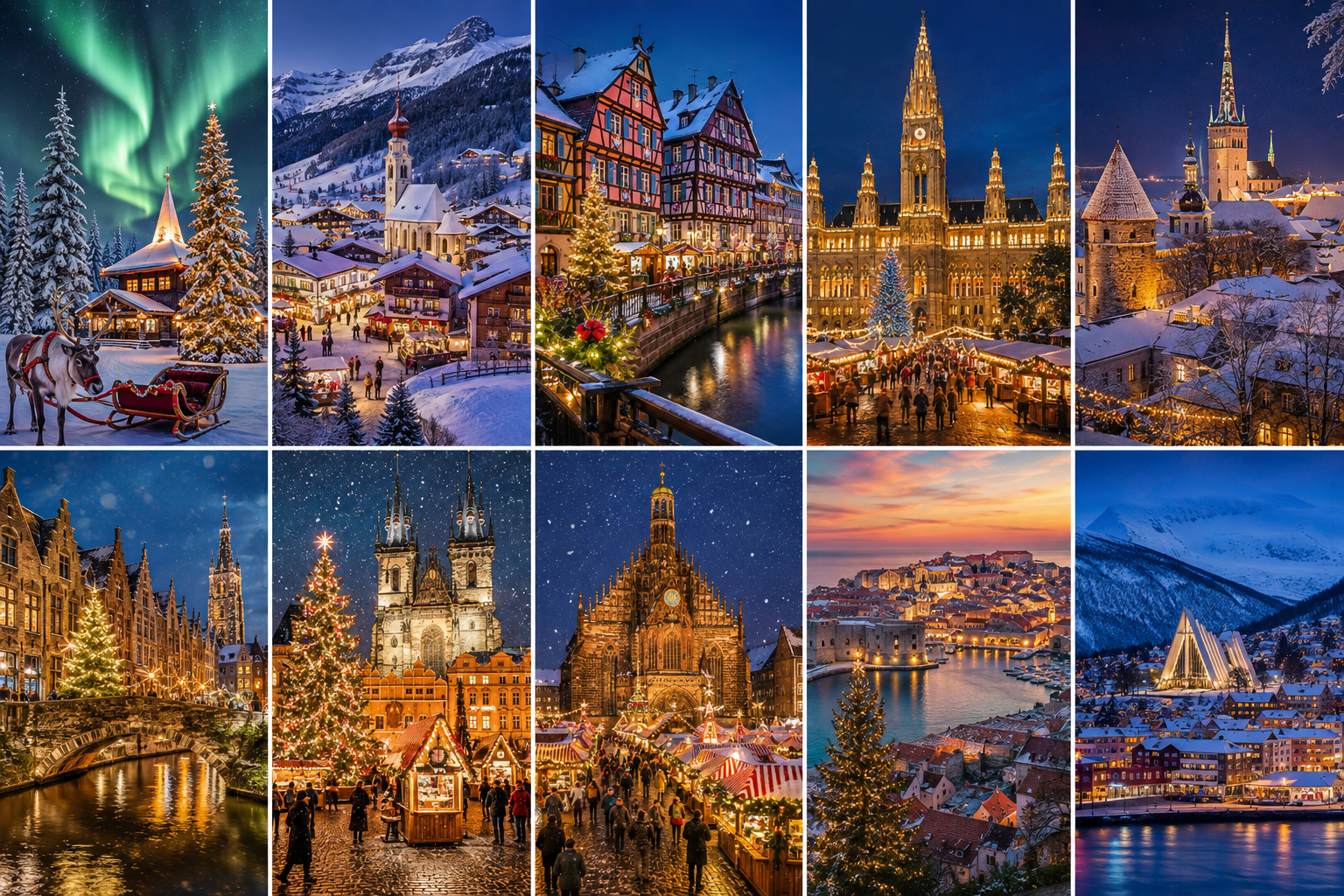
1. Rovaniemi, Lapland, Finland
Forget everything you think you know about Santa Claus. In Rovaniemi, Christmas is not a holiday. It is an entire way of life. This small Arctic city sits right on the Arctic Circle, and it takes its role as the official hometown of Santa Claus very seriously.
At Santa Claus Village, you can meet the man himself every single day of the year. But visiting in December is something else entirely. The polar night means the sun barely rises, so the whole town glows under soft golden lights and the occasional shimmer of the northern lights overhead. You can send postcards stamped with Santa’s official Arctic postmark from the Santa Claus Post Office, take a reindeer sleigh ride through frozen forests, or sleep in a glass igloo and watch the aurora borealis dance across the sky while you drift off.
There are husky safaris that take you deep into silent wilderness, snowmobile rides across frozen lakes, and evenings spent in wooden cabins where the fire crackles and the hot chocolate tastes better than it has any right to. Rovaniemi does not pretend to be magical. It just is.
2. St. Anton am Arlberg, Austria
St. Anton is where alpine skiing was born, and spending Christmas here feels like stepping into a world that modern life forgot to touch. The pedestrianised main street, Dorfstrasse, runs through the heart of this Tyrolean village, lined with old timber and stone farmhouses, their windows glowing with warm light. An onion-domed church sits at one end, packed for Christmas Eve services, while snow-capped peaks tower over everything.
The Advent market at the local museum is small and intimate, nothing like the massive commercial affairs in bigger cities. Stalls sell hand-carved wooden ornaments, local honey, and Gluhwein made from Tyrolean recipes passed down through generations. After a day on the slopes (over 300 kilometres of pisted runs across the Arlberg ski area), you can warm up at legendary spots or simply wander the village as snowflakes drift down around the Christmas trees that line every corner.
If you are planning a winter sports trip alongside your Christmas experience, Alpenature’s St. Anton ski trip planner is worth a look for local tips on hitting the slopes around the Arlberg region.
Austria pairs the festive season with some of the best skiing in Europe, so many travelers combine a Christmas market visit with a few days on the mountain. If that sounds like your kind of trip, our guide to snowboarding in Austria covers the top resorts and what to expect.
3. Colmar, Alsace, France
If you asked an illustrator to draw the most perfect Christmas town imaginable, they would probably end up sketching Colmar without realising it. This small Alsatian city sits right along the French-German border, and its half-timbered houses painted in pastels of pink, blue, and yellow look absurd in the best possible way, like a gingerbread village that someone accidentally made life-sized.
The canals that wind through the old town earn Colmar its nickname, “Little Venice,” and in December they reflect the thousands of lights strung across the bridges and buildings. 5 separate Christmas markets spread across the city, each with its own character. The one in the old customs house square specialises in Alsatian crafts, while the children’s market at Place des Six Montagnes Noires is all about gingerbread, carousels, and wide-eyed wonder.
What makes Colmar stand out from bigger, more famous destinations is the quiet. You can walk the backstreets at dusk, past windows framed with pine wreaths and red ribbons, and feel like the whole place was decorated just for you.
4. Vienna, Austria
Vienna does not do Christmas small. The city hosts over a dozen different Christmas markets simultaneously, spread across imperial squares and palace courtyards, and the cumulative effect is extraordinary. Walking from Rathausplatz to Schonbrunn to Spittelberg feels like moving through different chapters of the same beautifully written story.
The Rathausplatz market in front of City Hall is the biggest, with hundreds of stalls, an ice skating rink, and a tree so tall it makes you tilt your head back until your neck hurts. Schonbrunn Palace’s market opens as early as mid-November and runs into January, set against the backdrop of Habsburg grandeur that makes even a paper cup of Punsch feel regal. But the real gem is Spittelberg, tucked into narrow cobblestone streets where artisans sell handmade ceramics, wool scarves, and jewellery that you will not find anywhere else.
The smell is what stays with you. Roasted chestnuts, cinnamon, baked apples, and the sharp sweetness of Gluhwein mixing with cold December air. Vienna knows exactly what it is doing, and it has been doing it for centuries.
5. Tallinn, Estonia
Tallinn’s Christmas market sits in the Town Hall Square, surrounded by medieval walls and Gothic spires, and it looks like something from a film set that nobody dismantled because it was too beautiful. Estonia actually claims to have erected the first public Christmas tree in Europe, back in 1441, and the city has been taking the season seriously ever since.
The market itself is smaller than what you will find in Germany or Austria, but that is exactly the point. Stalls sell handmade woollen mittens, marzipan shaped into tiny animals, and black bread with smoked fish. There is almost always snow, and when it falls on the red-roofed buildings of the Old Town, Tallinn becomes the kind of place you want to photograph from every angle.
What really sets Tallinn apart is the price. A weekend here costs a fraction of what you would spend in Vienna or Paris, and the magic per euro might be the highest on the continent.
6. Bruges, Belgium
Bruges already looks like it belongs in a fairy tale on an ordinary Tuesday in March. Add Christmas lights, a 30-metre ice rink in the Markt square, and the smell of warm Belgian waffles drifting through medieval streets, and the effect is almost unfair to every other city trying to compete.
The Christmas market wraps around the Markt and nearby Simon Stevinplein, with wooden chalets selling artisan chocolates (this is Belgium, after all), lace, and craft beer. A large Ferris wheel gives you views over the canal-laced old town, lit up gold and white against the dark December sky. Horse-drawn carriages clip through the streets, and every other shop seems to be a chocolatier offering free samples with a smile.
If you wander to the quieter Minnewater area, known as the Lake of Love, you will find swans gliding on still water beneath ancient stone bridges, surrounded by bare trees strung with fairy lights. It is the kind of scene that makes you stop talking and just look.
7. Prague, Czech Republic
Prague’s Christmas markets take over Old Town Square and Wenceslas Square every year, and the backdrop alone is worth the trip. The Gothic towers of the Tyn Church rise above the wooden market stalls, and the Astronomical Clock ticks away the centuries while shoppers browse handmade glass ornaments and puppets below.
The food is a big part of the experience here. Trdelnik, a spiral pastry rolled in cinnamon and sugar and cooked over an open flame, is sold on every corner and tastes exactly as good as it smells. Smoked ham, roasted sausages, and potato pancakes fill the air with smoky, savoury warmth that pulls you from stall to stall. Prague’s markets also run later than most, often staying open into early January, which makes it a solid option if you cannot travel before Christmas.
The city itself is stunning in winter. Snow on the Charles Bridge, mist rising off the Vltava River, and the castle glowing on the hill above, Prague at Christmas feels cinematic without even trying.
8. Nuremberg, Germany
Nuremberg’s Christkindlesmarkt is the one that started it all, or close to it. Dating back to at least 1628, this is one of the oldest and most famous Christmas markets in the world, and it draws over 2 million visitors every December. That sounds overwhelming, but the atmosphere is so warm and well-organised that it never feels like a theme park.
The stalls are held to strict standards. Only traditional handmade goods and local food are sold, which means no mass-produced plastic trinkets. The famous Nuremberg Lebkuchen (gingerbread) is baked fresh and sold in decorated tins that people collect year after year. The Zwetschgenmannle, little figures made from dried plums, are a quirky local tradition that dates back to the 17th century.
Every year, a young woman from Nuremberg is chosen to serve as the Christkind, opening the market from the balcony of the Frauenkirche church with a prologue that has been spoken for hundreds of years. It is ceremonial, earnest, and genuinely moving, the kind of tradition that reminds you why these markets matter in the first place.
9. Dubrovnik, Croatia
Most people associate Dubrovnik with summer, blue water, and Game of Thrones tours. But visit in December and you will find a completely different city. The Dubrovnik Winter Festival transforms the old walled town into a festive stage, with concerts, light installations, and food stalls set up along the Stradun, the main limestone-paved street that runs through the centre.
The weather is mild compared to northern Europe, with temperatures hovering around 10 to 15 degrees Celsius, which means you can stroll the city walls without freezing and enjoy mulled wine outdoors without needing 4 layers. The crowds that choke the narrow streets in July are long gone, and what remains is a quieter, more intimate version of one of Europe’s most beautiful cities.
Local vendors sell Dalmatian olive oil, lavender products, and handmade Christmas ornaments. Concerts echo off the stone walls of churches and squares. And on a clear night, standing on the Stradun with the Adriatic Sea dark and still beyond the ramparts, Dubrovnik feels like a place where time moves a little slower than everywhere else.
10. Tromso, Norway
Tromso sits 350 kilometres north of the Arctic Circle, which means that from late November through mid-January, the sun does not rise at all. That sounds bleak until you experience it. The “polar night” is not pitch dark. Instead, the sky shifts through hours of deep blue and purple twilight, and when the northern lights appear, the whole town stops to watch.
Christmas in Tromso is understated and deeply atmospheric. There is no massive commercial market, no crowds pushing past each other for Gluhwein. Instead, there are small local gatherings, warm cafes serving reindeer stew and cloudberry desserts, and a sense of community that bigger cities lost somewhere along the way. The Arctic Cathedral, a striking triangular building made almost entirely of glass, hosts Christmas concerts that fill the space with music and candlelight.
For those who want adventure, December in Tromso offers whale-watching excursions (humpback and orca migrations peak in winter), dog-sledding trips across snow-covered tundra, and northern lights chases that take you far from the city into complete silence. It is not the kind of Christmas you see on postcards. It is better.
Making It Happen
The best European Christmas destinations book up fast, especially accommodation close to the main markets and attractions. If you are serious about visiting any of these places, start looking at flights and hotels by September or October at the latest. Prices spike sharply from mid-December through New Year, and the most popular spots, particularly Rovaniemi and Vienna, can sell out months in advance.
Consider combining 2 or 3 destinations into one trip. Vienna and Prague are just 4 hours apart by train. Bruges makes a perfect day trip from Brussels or Amsterdam. And if you are heading to Lapland, a stop in Tromso adds a Norwegian dimension to your Arctic adventure without too much extra travel. If you are still narrowing down your options, our guide to the best countries in Europe to visit can help you figure out where to start.
Whatever you choose, go with the intention of slowing down. The best Christmas moments in Europe do not happen on a schedule. They happen when you are standing in a quiet square, snowflakes in your hair, holding a warm cup of something spiced, and realising that the world has not completely lost its ability to feel like this.