Thailand has quietly rewritten its own rulebook over the past two years, and most of the advice floating around online still runs on 2024 information. If you are planning a trip now, that gap can cost you money — or your entry stamp. Before we get into the numbers, our Indian traveler’s complete visa and destination guide for 2026 covers the wider paperwork picture. This piece is the honest Thailand update: what changed, what it costs now, and whether it is still worth it.
The short answer first
Yes, Thailand is still worth going to. No, it is not the bargain it was five years ago.
Three things are true at the same time in 2026:
- Prices are up roughly 5–7% year on year across food, rooms and transport.
- The free entry window has been cut in half, and there is more paperwork before you board.
- Foreign arrivals are down about 3% so far this year — which means thinner crowds, softer shoulder-season rates and more room to negotiate than Thailand has offered in a decade.
The trip is different. It is not worse. You just have to plan it with current numbers instead of nostalgic ones.
What actually changed in Thailand for 2026
1. Visa-free stays dropped from 60 days to 30
This is the change that catches the most people out. Thailand spent 2024 and most of 2025 running a generous 60-day visa exemption. From 15 September 2026, that exemption covers 30 days for most eligible nationalities, including Indian passport holders.
What that means in practice:
- A two-week holiday is completely unaffected. Nothing to do differently.
- A month-long slow trip now sits right on the line. Build in a buffer.
- A lazy two-month base in Chiang Mai on a free stamp is no longer possible without extra steps.
If you need longer, you have two options: extend once at a Thai immigration office inside the country (usually around 1,900 baht for another 30 days, subject to their discretion), or apply for a proper tourist visa before you fly.
2. The Thailand Digital Arrival Card is mandatory — and free
Since May 2025, every non-Thai national entering the country by air, land or sea must file the Thailand Digital Arrival Card (TDAC) online before arriving. The old paper TM6 card handed out on the plane is gone.
Two details worth burning into memory:
- You can only submit it within 72 hours of arrival. Try to do it a week early and the system will simply reject the date.
- It is free. Any website charging you a “processing fee” for a TDAC is running a scam. There are dozens of them, and they buy search ads.
3. The 300-baht tourist fee is coming, but is not being charged yet
You will see the 300-baht (roughly ₹735) entry fee mentioned in almost every Thailand article published this year, often as though it is already live. It is not, at least not as of this writing.
Here is the accurate version:
- The fee applies only to foreign tourists arriving by air. The proposed 150-baht land and sea version has been shelved.
- Of the 300 baht, about 70 baht funds accident and medical cover that starts the moment you land. The rest goes to tourism infrastructure and safety.
- It has been delayed repeatedly and is now expected sometime later in 2026, pending final cabinet sign-off and a working collection system.
Budget for it anyway. It is one meal out, and it is better to have the money set aside than to be surprised at a counter.
4. Cannabis is back behind a prescription
Thailand decriminalised cannabis in 2022, and for three years Bangkok and the islands filled up with dispensaries. That window closed in June 2025.
Recreational use is banned again. Buying cannabis flower now requires a prescription from a Thai-licensed practitioner, and dispensaries can only sell against that prescription. Importing it — even with a legitimate prescription from home — remains flatly illegal.
If cannabis tourism was part of why Thailand appealed to you, adjust your expectations before you book, not after you land.
5. Alcohol rules loosened, slightly
One change went the other way. The long-standing afternoon alcohol sales ban between 2pm and 5pm has been lifted, so you can buy a beer with a late lunch without the ritual confusion at the 7-Eleven counter.
Sales are still completely banned on major Buddhist holidays. Check the calendar if your trip overlaps with Makha Bucha, Visakha Bucha or Asalha Bucha.
Your 2026 entry checklist
Run through this in order and nothing will go wrong at the airport:
- Confirm your passport has at least six months of validity left.
- Check the current visa exemption period for your nationality on the Thai embassy site — this is the rule that has moved most, and it can move again.
- Book a confirmed onward or return ticket. Airlines do check this at boarding.
- File your TDAC on the official government portal, within 72 hours of arrival, and save the QR confirmation offline.
- Carry proof of funds and your first night’s accommodation booking. Rarely asked for, occasionally decisive.
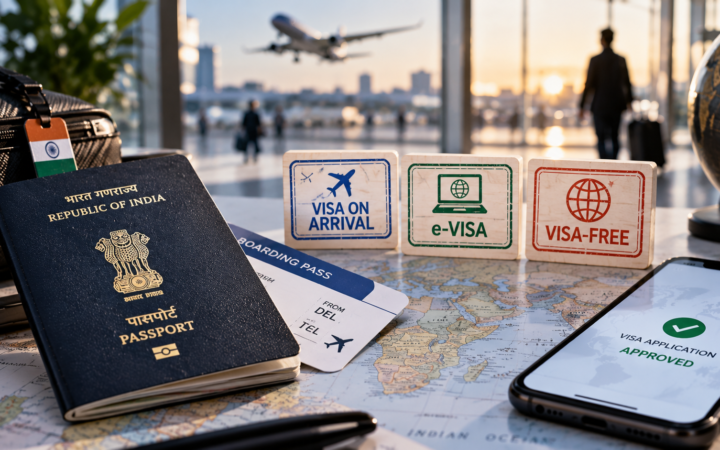
If you are not sure which entry category you actually fall into, our explainer on visa-on-arrival vs e-visa vs visa-free untangles the three terms that travel sites use interchangeably and that mean very different things at an immigration desk.
What Thailand actually costs in 2026
The baht trades around 36–37 to the US dollar, which works out to roughly ₹2.4–₹2.5 per baht. Rates move, so treat the rupee figures below as indicative rather than quotable.
Daily budgets, honestly
- Backpacker: about $30 (₹2,600) a day — hostel dorm, street food, local buses and songthaews, one paid activity.
- Mid-range: about $80 (₹7,000) a day — a decent private room, a mix of street and restaurant meals, Grab rides, daily activities.
- Comfortable to luxury: $200 (₹17,500) a day and up — resort rooms, spa time, private transfers, island-hopping boats.
The line items that matter
- Hostel dorm bed: 400–700 baht (₹980–₹1,720).
- Hotel room: around $38 (₹3,300) in low season, rising to about $71 (₹6,200) at peak.
- Street food plate: 40–70 baht (₹100–₹170). Pad thai from a cart is still about 50 baht.
- Restaurant meal for two: 400–800 baht (₹980–₹1,960) outside tourist strips.
- Scooter rental: 200–300 baht a day (₹490–₹735), plus a real licence and a real helmet.
- Domestic flight, Bangkok to Krabi or Chiang Mai: 1,200–2,500 baht (₹2,900–₹6,100) when booked ahead.
A realistic ten-day trip for two
Flying from a major Indian metro, mid-range style, two people sharing:
- Return flights: ₹45,000–₹70,000 total, depending on season and how early you book.
- Accommodation, 9 nights: ₹35,000–₹55,000.
- Food and drink: ₹30,000–₹45,000.
- Transport, activities and one island day trip: ₹25,000–₹40,000.
- Buffer for the entry fee, SIM, tips and the inevitable extra massage: ₹8,000.
Working total: roughly ₹1.45 lakh to ₹2.2 lakh for two. That is real money now. It was closer to ₹1 lakh not long ago.
Where your money still goes further — and where it does not
Still excellent value: street food, local transport, massages, temples and national parks, domestic flights, long-stay apartment rentals in Chiang Mai and Bangkok.
No longer cheap: beachfront accommodation in Phuket, Koh Samui and Krabi during high season, imported alcohol, branded coffee, Western food in tourist zones, and speedboat island tours that have quietly doubled since 2022.
The practical move is to spend your nights cheaply and your days generously. A 900-baht guesthouse and a 1,500-baht diving trip will give you a far better week than a 4,000-baht resort room you barely see.
Thailand versus the competition
Thailand’s 3% arrivals dip is not random. Vietnam grew close to 15% in the first quarter of 2026, and it is winning on exactly the axis Thailand used to own: price.
That said, the comparison is not one-sided:
- Thailand wins on infrastructure, English signage, domestic flight networks, healthcare, island variety and sheer ease. Nothing in the region is as frictionless.
- Vietnam wins on cost, and on feeling less pre-packaged.
- Thailand wins for first-timers. If this is someone’s first trip outside India, the low-stress version matters more than saving ₹15,000.
Who should still go, and who should skip it
Go if: it is your first international trip, you are travelling with parents or young kids, you want beaches and cities in one trip, you are booking shoulder season (May–June, September–October), or you value convenience over squeezing the last rupee.
Consider elsewhere if: you wanted a two-month visa-free base, your budget is genuinely tight and Vietnam or Sri Lanka would do the same job, or your trip was built around the old cannabis scene.
Frequently asked questions
Do Indians need a visa for Thailand in 2026?
Indian passport holders currently fall under the visa exemption scheme, now 30 days, and must still file the free TDAC before arrival. Confirm on the Thai embassy website before booking, since this rule has changed twice in two years.
Is the 300-baht tourist fee being charged right now?
Not yet. It is approved in principle for air arrivals but has been delayed repeatedly. Budget for it regardless.
When is the cheapest time to visit?
May to early October. It rains, usually in short heavy bursts rather than all day, and room rates fall 30–40%. September is the sweet spot for value.
How much cash should I carry?
Card acceptance is wide in cities but thin at markets, islands and small guesthouses. Carry 3,000–5,000 baht in cash and top up from ATMs, factoring in the 220-baht foreign card fee most Thai ATMs charge.
The verdict
Thailand in 2026 asks more of you than it used to. Less free time on the stamp, one more form before you fly, a fee on the horizon, and a bill that has grown faster than the experience has.
But the things that made it worth the trip have not moved. The food is still absurdly good for what it costs. The islands are still there. And with arrivals softening, you are seeing a version of Thailand with a little more breathing room in it — something the 2019 crowds never got.
Go with accurate numbers and a 30-day mental clock, and it still delivers. Go expecting 2018 prices and you will spend the trip feeling short-changed by a country that has not actually done anything wrong.
If the budget is the sticking point, it is worth comparing before you commit — our roundup of the cheapest countries to travel from India in 2026 puts Thailand side by side with the alternatives that are quietly taking its share.