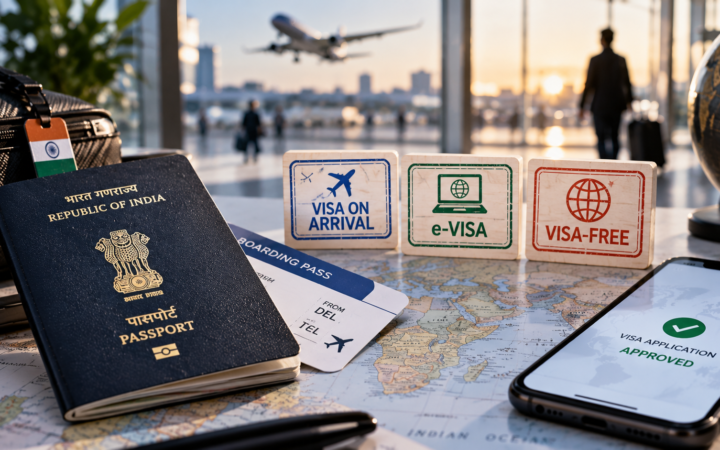
Planning an international trip with an Indian passport used to mean weeks of paperwork, embassy visits, and a fair bit of prayer. That picture has changed dramatically. In 2026, Indian passport holders can enter over 55 countries without applying for a traditional visa, whether through visa-free entry, visa on arrival, or a quick e-visa processed from your phone.
India now ranks 80th on the Henley Passport Index, up from 85th just last year. That jump reflects years of diplomatic groundwork, bilateral agreements, and India’s growing economic clout on the world stage. For everyday travelers, the impact is simple: more destinations, less red tape, and far more spontaneous trip planning than was possible even 3 years ago.
This guide breaks down everything you need to know. Every visa-free and visa-on-arrival destination available to Indian passport holders in 2026, the e-visa countries worth considering, the latest Schengen and Europe updates, budget-friendly picks, and the documents you should carry even when no visa is required. Consider this your one-stop travel guide for the Indian passport in 2026.
Where the Indian Passport Stands in 2026
The Indian passport’s global ranking has been climbing steadily. As of mid-2026, India sits at 80th on the Henley Passport Index, tied with Algeria. Passport holders can access roughly 55 to 62 destinations through some combination of visa-free entry, visa on arrival, and electronic travel authorization, depending on how various indexing bodies count e-visa nations.
That is a significant improvement from a decade ago when Indian travelers had fewer than 40 accessible destinations without a full visa application. The progress comes from targeted bilateral negotiations. India’s agreements with Southeast Asian nations, Caribbean island states, and several African countries have steadily expanded the travel map.
To put it in perspective, Indian passport holders now have more visa-free access than citizens of several neighboring countries. While top-ranked passports like Singapore, Japan, and Germany unlock over 190 destinations, India’s trajectory is clearly upward. And for practical purposes, the destinations now accessible cover a wide range of experiences, from tropical beaches and mountain treks to cultural capitals and island escapes.
Visa-Free Countries: Where You Can Land Without Any Paperwork
Visa-free means exactly what it sounds like. No application, no fee at the border, no advance paperwork. You book your flight, carry a valid passport, and immigration stamps you in. As of 2026, approximately 25 to 30 countries offer this level of access to Indian passport holders.
Asia and the Pacific
This is where the strongest cluster of visa-free options sits for Indian travelers. Nepal remains the easiest international trip from India, with no passport even required for entry by road (though carrying one is always recommended for air travel). Bhutan allows Indian nationals in with just an ID proof, making it one of the most accessible Himalayan escapes on the planet.
Malaysia offers 30 days of visa-free stay, making it an excellent short-trip destination for everything from Kuala Lumpur’s food scene to Langkawi’s beaches. Fiji in the Pacific grants visa-free access for up to 120 days, a surprisingly generous allowance that makes it viable for longer stays.
Caribbean and the Americas
The Caribbean is quietly one of the best visa-free zones for Indian travelers, though most destinations require at least one connecting flight. Barbados, Jamaica, Dominica, Grenada, Trinidad and Tobago, Saint Vincent and the Grenadines, and Haiti all allow Indian passport holders to enter without a visa. Stays typically range from 30 to 90 days depending on the country.
These are not the cheapest destinations to reach from India due to flight costs, but they offer something few other accessible regions can match: pristine Caribbean beaches, reggae culture, rum distilleries, and a pace of life that forces you to actually relax.
Africa and the Indian Ocean
Mauritius stands out with a generous 90-day visa-free stay. It is one of the most popular international destinations for Indian honeymooners and families, and for good reason. White sand beaches, affordable luxury resorts, and direct flights from multiple Indian cities make it a no-brainer. Seychelles also grants 90 days of visa-free access, though flights are pricier. Other African nations offering visa-free entry include Senegal, Rwanda, Gambia, and Angola.
If you are specifically looking for destinations where your rupee stretches the farthest, our guide to the cheapest countries to travel from India in 2026 covers the budget side of planning in detail.
Best Visa-on-Arrival Destinations for Indians
Visa on arrival (VoA) does not mean visa-free. You still get a visa, but you collect it at the airport immigration counter when you land instead of applying at an embassy weeks in advance. Most VoA destinations charge a small fee (typically between 20 and 50 USD) and require a return ticket, proof of accommodation, and sometimes a passport-sized photo.
Top VoA Destinations in Asia
The Maldives is the crown jewel of VoA travel for Indians. The visa on arrival is free, valid for 30 days, and the process at Male airport takes minutes. Direct flights from Indian cities keep costs reasonable, especially if you book off-season. Indonesia (including Bali) offers a 30-day VoA for approximately 35 USD. Cambodia, Laos, and Timor-Leste also fall in this category.
Africa and Beyond
Ethiopia, Tanzania, Madagascar, Mozambique, Zimbabwe, Samoa, Tuvalu, Palau, and Bolivia are among the other VoA destinations open to Indian passport holders. Most of these charge between 20 and 50 USD and require basic documentation. Tanzania and Ethiopia are particularly popular with Indian travelers exploring Africa for the first time, offering wildlife safaris, historical sites, and landscapes that few other continents can rival.
The Thailand Situation: What Actually Changed in 2026
Thailand deserves its own section because the visa situation has been a rollercoaster this year, and a lot of Indian travelers are confused about where things stand.
Here is the timeline. From July 2024 to May 2026, Thailand granted Indian passport holders 60 days of visa-free entry. It was the golden era of spontaneous Bangkok weekends. Then on May 19, 2026, the Thai Cabinet approved a sweeping immigration overhaul that moved India out of the visa-free category entirely and into a visa-on-arrival tier, limited to 15 days with a fee of 2,000 THB (roughly 5,000 INR).
That decision triggered a sharp decline in Indian tourist bookings. The travel industry pushed back hard. And on July 14, 2026, the Thai Cabinet reversed course. India was added to the 30-day visa exemption list, canceling the VoA plan entirely. Indian passport holders can now enter Thailand for up to 30 days without a visa or any entry fee, the same treatment extended to EU travelers.
There is one mandatory step, though. All travelers entering Thailand must complete the Thailand Digital Arrival Card (TDAC) online before their flight. It is not a visa, just a digital replacement for the old paper arrival card, and it must be submitted at least 3 days before your arrival date. Carry a return ticket, proof of accommodation, and ensure your passport has at least 6 months of validity.
E-Visa Countries: Apply Online, Skip the Embassy
For destinations that are not visa-free or VoA, the e-visa has become the next best thing. You apply online, upload your documents, pay the fee, and receive approval by email, sometimes within hours. As of 2026, Indian passport holders can apply for e-visas to approximately 51 countries.
Some of the most popular e-visa destinations for Indians include Turkey (30 days, single entry), Vietnam (90 days), Singapore, Azerbaijan, the United Kingdom, Australia, New Zealand, and Kenya. Processing times vary from a few hours (Turkey, Vietnam) to several days (UK, Australia), and fees range from roughly 1,500 INR to over 10,000 INR depending on the destination and visa type.
The key advantage of e-visas is that you never need to visit an embassy or surrender your passport. For working professionals who cannot afford weeks without their travel document, this is a game-changer. Just make sure you apply well in advance, particularly for destinations like the UK and Australia where processing can take longer than expected during peak seasons.
If you are considering combining travel with education, the visa requirements for study destinations are different from tourist visas. Our comprehensive guide to studying abroad in 2026 covers country-specific student visa processes, fees, and scholarship options for Indian students.
Europe and the Schengen Visa: What Indian Travelers Need to Know
Let us address this directly: no European country offers blanket visa-free entry to an ordinary Indian passport as of 2026. Every easy European option requires either an e-visa, a Schengen visa, or conditional access based on holding a valid UK, US, or Schengen visa from a previous trip.
The Schengen visa remains the primary gateway to Europe for Indian travelers. One application gives you access to 29 countries across the Schengen Area for up to 90 days within a 180-day period. The visa fee is 90 EUR (approximately 9,600 INR) and processing takes 15 working days, though it can stretch to 30 to 60 days during peak season.
The India-EU Mobility Pact
In January 2026, India and the European Union signed a “Comprehensive Framework for Cooperation on Mobility” at the Delhi summit. This agreement is expected to streamline visa processes, potentially reduce fees, and introduce a digital application portal. However, the implementing guidelines are expected by mid-2026, and the operational changes have not taken effect yet. For now, the current Schengen visa application process remains in place.
EES: Europe’s New Biometric Border System
The Entry/Exit System (EES) is the most immediately practical change for Indian travelers heading to Europe. This EU-wide digital border system replaces manual passport stamps with automated biometric registration. When you first enter a Schengen country, your passport details, fingerprints, and facial image are registered. On subsequent trips, your biometric data is checked against your existing record.
The EES began its phased rollout in October 2025 and became fully operational at participating border crossings by April 2026. For Indian travelers, the system does not change the visa requirement itself, but it does mean faster processing at immigration and a digital record of your entries and exits.
Conditional Access: The Schengen Visa Shortcut
Several non-Schengen European and Balkan countries offer visa-free or simplified entry to Indian passport holders who already carry a valid multiple-entry Schengen, UK, or US visa. Serbia is the most well-known example, though it ended blanket visa-free access for ordinary Indian passports in 2023. If you are a frequent traveler to Europe or the US, your existing visas can unlock additional destinations without separate applications.
For a deeper look at specific European destinations, including what to see, where to stay, and how to plan your itinerary, check out our guide to the best countries in Europe to visit in 2026.
Budget-Friendly Destinations Where the Rupee Goes Furthest
Not every international trip needs to drain your savings account. Several visa-free and VoA destinations are remarkably affordable for Indian travelers, especially when you factor in cheap flights from Indian cities.
Nepal tops the budget list. No flight is even necessary if you are driving from North India, daily costs are among the lowest for any international destination, and the cultural familiarity makes it a comfortable first international trip for many families. Sri Lanka is another strong option with short, affordable flights and reasonable accommodation costs across the island.
Thailand remains one of the best value-for-money destinations in Asia despite the visa policy changes this year. Low-cost carriers from Indian cities keep airfares competitive, street food is famously cheap, and budget hotels in Bangkok, Chiang Mai, and beach towns offer clean, comfortable stays for under 2,000 INR per night.
Indonesia, specifically Bali, offers affordable accommodation and transport once you arrive. The VoA fee of 35 USD is the main additional cost. Vietnam (e-visa required) is also excellent for budget travelers, with daily expenses that can stay well under 3,000 INR if you eat local and use public transport.
Documents You Need Even for Visa-Free Travel
This is where many Indian travelers trip up, sometimes literally at the immigration counter. Visa-free does not mean document-free. Even countries that do not require a visa will expect you to carry specific paperwork, and immigration officers can and do deny entry if your documents are incomplete.
Here is what you should always carry for any international trip:
- Passport with at least 6 months validity from your date of entry. This is non-negotiable at virtually every international border.
- Return or onward ticket. A confirmed booking showing you plan to leave the country before your permitted stay expires.
- Proof of accommodation. Hotel bookings, Airbnb confirmations, or a letter of invitation from your host.
- Proof of sufficient funds. Bank statements, credit card limits, or cash in the local currency to demonstrate you can support yourself during your stay.
- Travel insurance. While not legally mandatory at every destination, countries like Thailand and Indonesia have seen cases where Indian tourists faced massive hospital bills without coverage. A basic international travel insurance policy costs just 500 to 1,000 INR for a short trip. It is absolutely worth it.
- Passport-sized photographs. Some VoA counters still ask for paper photos. Carry at least 4 recent photos meeting ICAO standards.
Travel Insurance: The One Thing You Should Never Skip
This point deserves emphasis beyond a single bullet point. International medical costs can be devastating without insurance. A broken bone in Thailand can set you back over 2 lakh INR. A hospital stay in Europe can easily cross 10 lakh INR. And if you need medical evacuation from a remote island in the Maldives or Indonesia, costs can run into tens of lakhs.
Comprehensive travel insurance covering medical emergencies, trip cancellation, baggage loss, and emergency evacuation is available from Indian insurers starting at roughly 500 INR for a week-long trip to Southeast Asia. For Europe, where Schengen visa applications require proof of insurance with a minimum coverage of 30,000 EUR, expect to pay slightly more.
Do not treat this as optional. The cost of insurance is negligible compared to the financial risk of traveling without it.
Practical Tips for Indian Travelers Going Abroad in 2026
Book flights early for peak seasons. Flights from India to Southeast Asia and the Middle East see sharp price spikes during Diwali, Christmas, and summer holidays. Booking 8 to 12 weeks in advance can save you 30 to 50% on airfare.
Check visa rules on official government websites. Do not rely solely on travel blogs or social media posts. Visa policies change frequently, as the Thailand situation this year proved. The official embassy website of your destination country and the Bureau of Immigration India website are your most reliable sources.
Carry both cash and cards. While UPI has transformed payments within India, it is not accepted abroad (except in limited pilots in Singapore, UAE, and Bhutan). Carry a forex card or a zero-markup international debit card, plus some cash in the local currency for markets, street food, and VoA fee payments.
Register with the Indian embassy. For longer trips, register with the nearest Indian embassy or consulate. In case of emergencies, natural disasters, or political unrest, registered travelers receive priority assistance.
Download offline maps and translation apps. Google Maps allows offline downloads for specific regions. Pair this with Google Translate’s offline language packs and you will never be completely lost, even without an internet connection.
Respect local customs and laws. Drug laws in Southeast Asia are extremely strict, with some countries imposing the death penalty. Dress codes vary at religious sites across the world. A little research before you go prevents a lot of awkward or dangerous situations at your destination.
The Bottom Line
The Indian passport in 2026 is more powerful than it has ever been. With 55+ destinations accessible without a traditional visa application, from the beaches of Mauritius and Maldives to the mountains of Nepal and Bhutan, there is no shortage of places to explore.
The key is preparation. Even visa-free travel requires the right documents, adequate insurance, and a realistic budget. The Schengen and Europe route takes more planning, but the India-EU Mobility Pact signals easier access ahead. And for everything in between, e-visas have made what used to be a weeks-long embassy process into a 15-minute online application.
Your Indian passport is your ticket to a bigger world than most people realize. The only question left is where you want to go first.