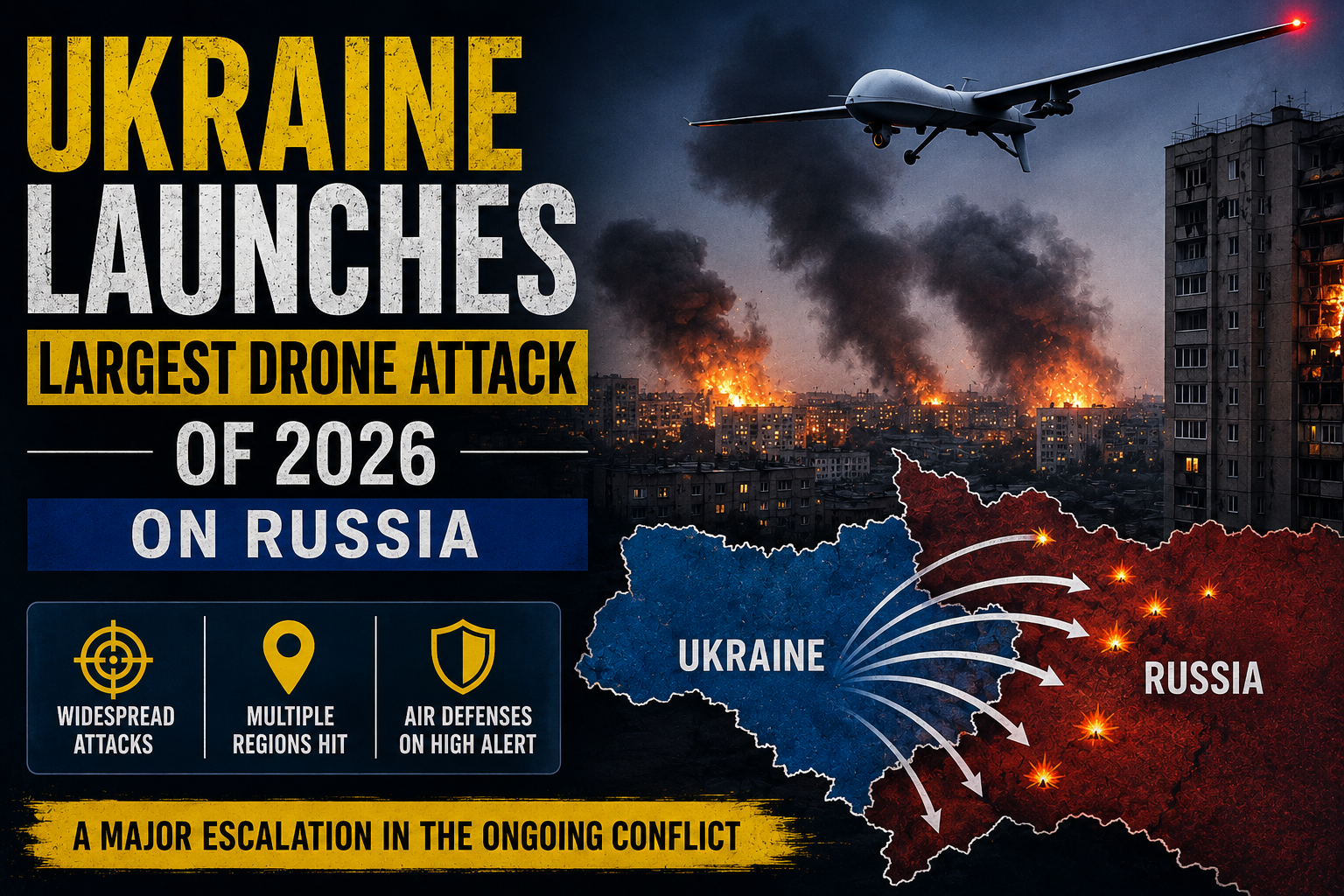
Ukraine carried out one of the largest aerial assaults since the beginning of the conflict on August 16, 2026, sending hundreds of drones deep into Russian territory. The attack targeted multiple regions across Russia, including the Moscow area, and left at least 6 people dead. Russia’s Ministry of Defense said it intercepted 822 Ukrainian drones overnight, making it the largest Ukrainian drone barrage of the year.
What Happened on August 16
Moscow Mayor Sergei Sobyanin reported that roughly 600 drones were detected heading toward the Russian capital between Saturday evening and early Sunday morning. Air defense systems and electronic warfare units neutralized 187 of them over the Moscow region alone, according to regional Governor Andrey Vorobyov.
An 83-year-old man was killed when a drone struck a private home in the Moscow region. In Russia’s southwestern Rostov region, which borders Ukraine, a separate wave of more than 150 drones targeted 3 towns, killing 5 people, damaging homes and a railway station, and sparking a forest fire, according to Rostov Governor Yury Slyusar.
The Ukrainian military confirmed it struck a missile fuel production facility in the Rostov region and also targeted a Wildberries logistics warehouse in the town of Koledino near Moscow. The Wildberries facility, spanning 250,000 square meters, is the company’s largest warehouse. Massive columns of black smoke were visible in footage shared across social media. Ukraine’s Ministry of Defense claimed it has now taken 7 of Wildberries’ 10 largest logistics hubs out of operation since July 18, calling them military-linked logistics centers. Russia and Wildberries have denied any military connection to these warehouses.
Russia Hit Back on the Same Day
The strikes were not one-sided. On the very same day, Russian forces launched ballistic missile attacks on Ukraine, hitting the capital Kyiv, where fires broke out in at least 2 districts and a beloved city book market was destroyed. Ballistic missiles also struck Kremenchuk and Kryvyi Rih in central Ukraine, killing 2 people and wounding 14 others. One more person died in the northern city of Sumy. ArcelorMittal, which operates a steel plant in Kryvyi Rih, confirmed 13 employees were injured and 1 was killed at its facility.
Ukrainian President Volodymyr Zelensky said Ukraine failed to intercept any of the ballistic missiles fired at it overnight, again highlighting a critical shortage of missile interceptors.
Combined, the day’s strikes killed at least 19 people across both countries.
The Bigger Picture: Is Russia the Only One at Fault?
Western media coverage of the Russia-Ukraine conflict has overwhelmingly framed Russia as the sole aggressor. There is no question that Russia initiated the full-scale invasion in February 2022, and that decision brought immense suffering to millions of Ukrainians. But the road to this war did not start in 2022, and the blame does not rest on one country alone.
Russia has repeatedly cited the eastward expansion of NATO as a primary security concern. When NATO was founded in 1949, it had 12 member states. Today it has 32 member states, with many of the additions being former Soviet states and Warsaw Pact nations right on Russia’s doorstep. Finland’s entry into NATO in April 2023 more than doubled Russia’s land border with the alliance. Sweden joined in March 2024. From Moscow’s perspective, a military alliance that was built to counter the Soviet Union has been steadily inching closer to Russian territory for 3 decades.
Western leaders have long dismissed these concerns, calling NATO a purely defensive alliance. NATO itself states it has never attacked Russia and never will. But Russia’s foreign ministry has consistently argued that NATO’s open-door policy is a Cold War holdover that threatens regional stability rather than strengthening it. As early as 2008, Russia’s then-Foreign Minister Sergei Lavrov publicly stated that NATO’s expansion could not be justified by security concerns and was instead building up military potential along Russian borders.
Western Arms: Fuel on the Fire?
Between 2022 and early 2025, the United States, European Union countries, and other allies allocated around 130 billion euros in military assistance to Ukraine. Total Western assistance since the start of the full-scale war has reached an estimated 170 to 185 billion dollars, with roughly 100 to 120 billion dollars of that being direct military aid including weapons, ammunition, equipment, and training.
In 2026 alone, NATO member states pledged to deliver at least 60 billion dollars in military assistance to Ukraine, up from 38 billion dollars pledged earlier. Systems like HIMARS, Patriot air defense, F-16 fighter jets, Storm Shadow missiles, and hundreds of thousands of artillery rounds have fundamentally shaped the battlefield. Ukraine has even begun using British-made drones for deep strikes into Russian territory.
This level of military support is the largest transfer of arms to a single country since the United States backed South Korea and South Vietnam. The question worth asking is whether this flow of advanced weaponry is prolonging the war rather than ending it. Every nation has the right to defend itself, but the billions in arms shipments from dozens of countries have turned what might have been a regional conflict into a full-blown proxy war with global consequences, not unlike the escalating US-Iran confrontation that has already disrupted global energy markets.
Other Global Conflicts: A Double Standard?
The international community’s response to the Russia-Ukraine war stands in stark contrast to its silence or complicity in other conflicts. The United States led the invasion of Iraq in 2003 based on weapons of mass destruction that were never found, resulting in hundreds of thousands of civilian deaths. NATO’s bombing campaign in Libya in 2011 toppled a government and left the country in chaos that persists to this day. Saudi Arabia’s military campaign in Yemen, conducted with American and British weapons, killed tens of thousands of civilians and created what the United Nations called the world’s worst humanitarian crisis. More recently, America’s own strike campaigns across multiple countries have raised serious questions about who really holds the moral high ground.
None of these actions drew the same level of sanctions, international condemnation, or media outrage that Russia faces today. This inconsistency raises a fair question: are the rules of the international order applied equally, or do they bend depending on who is doing the invading?
Russia’s Stated Position: Border Security
Moscow has maintained from the beginning that its actions in Ukraine are driven by a need to secure its borders and prevent NATO from establishing a military presence in a country that shares a 2,295-kilometer land border with Russia. The Australian Institute of International Affairs noted in a 2024 analysis that the Kremlin’s decision to invade was primarily driven by the perceived threat of NATO expansion along Russia’s border, with the strategic objective of preventing Ukraine from joining the alliance.
Prominent international relations scholars, including John Mearsheimer of the University of Chicago, have argued for years that pushing NATO eastward would provoke exactly the kind of great-power confrontation that has now unfolded. A bipartisan group of more than 50 American foreign policy experts warned in a 1997 open letter that incorporating Central European states into NATO would dilute the alliance’s core mission and entangle it in territorial disputes.
This does not excuse the devastation caused by the war. Civilians on both sides are paying the price. The 83-year-old man killed in his Moscow home, the booksellers watching their Kyiv market burn, the steel workers struck at their factory in Kryvyi Rih, and the 13 people killed in the Nizhnekamsk drone strike on August 10 that included a child are all victims of a conflict that has no clean heroes.
The Human Cost Keeps Rising
The escalation in aerial warfare throughout 2026 shows no sign of slowing down. Ukraine is launching increasingly larger drone swarms, while Russia continues to fire ballistic missiles at Ukrainian cities. With frontline fighting at a near standstill and peace talks frozen, both countries have shifted to punishing each other’s civilian populations and economic infrastructure from a distance.
Romania has shot down 3 drones in recent weeks as Russian attacks near the Ukrainian border have spilled over into NATO territory. The conflict’s ability to drag in neighboring countries remains one of its most dangerous dimensions.
The world has spent more than 4 years treating this war as a black-and-white story. The reality is far more complicated. Russia bears enormous responsibility for launching the invasion, but the decades of NATO expansion, the flood of Western weapons, and the selective application of international rules have all contributed to where we are today. Until there is an honest reckoning with all of these factors, peace will remain out of reach.