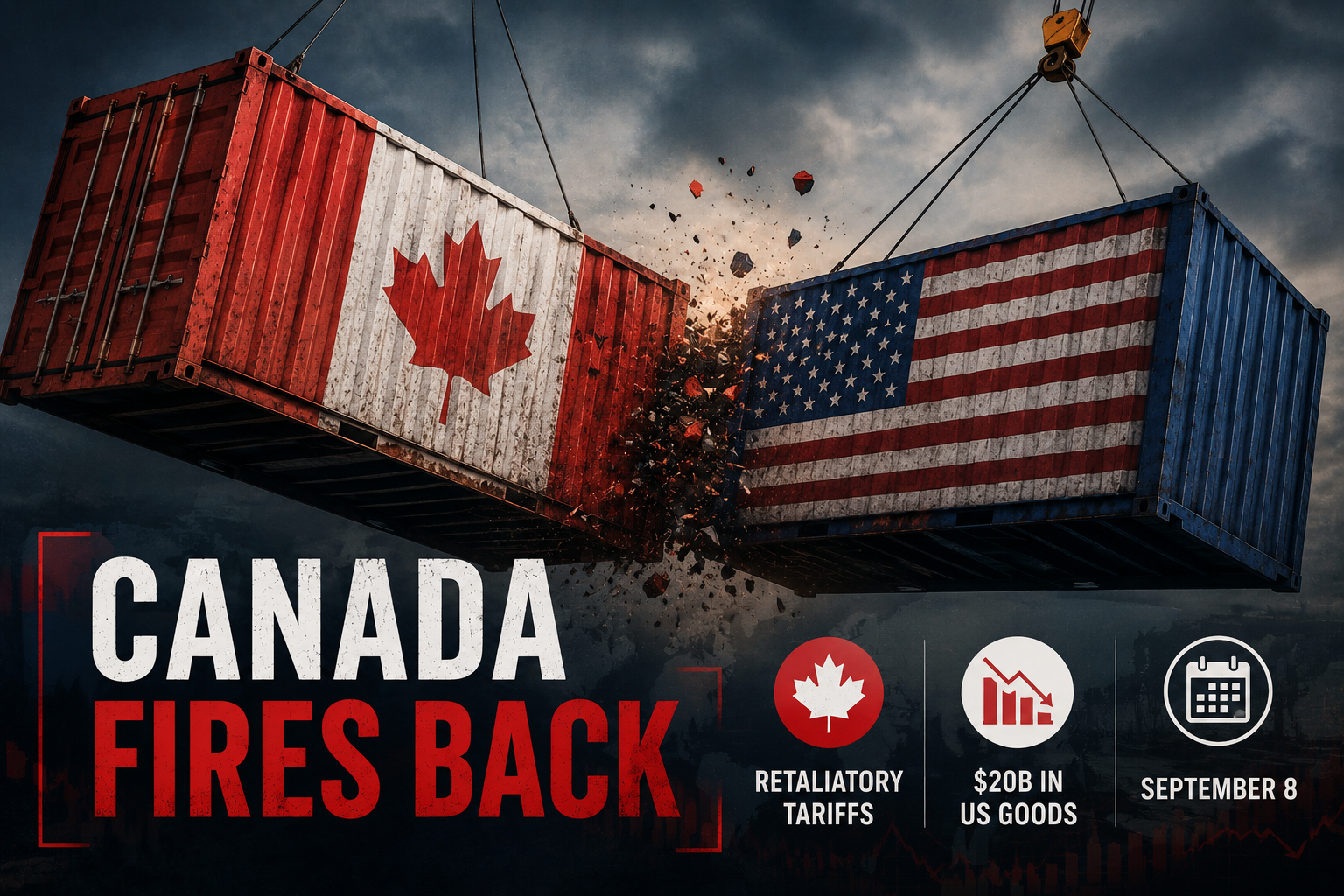
Canada has officially struck back. On August 25, 2026, the Canadian government announced retaliatory tariffs covering roughly $20 billion worth of American imports, matching the United States dollar for dollar after Washington imposed 50% duties on a wide range of Canadian products just days earlier.
The counter-tariffs take effect on September 8, 2026, and will impose duties of 15%, 25%, and 50% across approximately 700 US products. Steel and aluminum tariffs will double to 50%, while new levies will target American electronics, dairy products, appliances, and farm equipment entering Canada.
How the Trade Talks Collapsed
The breakdown was sudden and dramatic. On July 20, President Donald Trump signed presidential proclamations imposing additional 50% tariffs on Canadian goods originally set for August 19. A brief window of optimism opened when Trump delayed the tariffs for 3 days on August 19, posting on Truth Social that the two sides essentially had a deal, “subject to the finalization of documents.”
Canadian Trade Minister Dominic LeBlanc traveled to Washington and spent hours in talks with US Trade Representative Jamieson Greer. On Thursday, LeBlanc told reporters the sides were “very close.” But by Friday evening, Canada suspended negotiations, citing last-minute changes and demands it called unreasonable.
Prime Minister Mark Carney did not hold back. At a Saturday press conference, he called the new US tariffs “a miscalculation” and said Washington had “asked too much, and offered too little.” Carney revealed that the US had proposed terms that were “uneconomic, unfair, and undermined the net benefits for Canada.” He also confirmed that Canada would never give the United States exclusive access to its critical minerals.
A key sticking point was US Trade Representative Greer’s insistence that Canada remove all existing retaliatory measures, including provincial bans on American alcohol introduced in 2025 during earlier rounds of the ongoing tariff war between the two countries. Canada had offered concessions, including returning US alcohol to Canadian store shelves, but it was not enough for Washington.
What Canada’s Retaliatory Tariffs Cover
The tariffs cover goods accounting for nearly 4.5% of Canada’s total imports from the United States, calculated using 2024 trade figures. Finance Minister François-Philippe Champagne declared at the announcement: “When the United States of America asked too much and offered too little, we made a choice. We chose Canada.”
Alongside the counter-tariffs, Ottawa unveiled a 7.5 billion Canadian dollar support package for businesses and workers affected by the trade war. The package includes direct funding for small and medium-sized enterprises, cash flow support for companies facing disruption, and assistance for workers at risk of losing their jobs.
Industry Minister Melanie Joly said the retaliatory tariffs were designed primarily to protect Canadian businesses but also to apply economic pressure where it would be most felt in the United States.
A Broader Pattern of US Trade Aggression
This is not an isolated dispute. The US-Canada trade war has been running since February 2025, when Trump first imposed sweeping tariffs including 25% duties on most Canadian imports and 10% on energy products. Canada retaliated immediately, and the conflict has escalated through multiple rounds since then.
Trump’s 50% tariffs that took effect on August 22 target roughly 5% of Canada’s exports to the United States. The affected products include hockey equipment, wine, building materials, cement, clothing, furniture, and fishing rods. While narrow in scope, trade analysts warn they could severely harm sectors already under pressure, particularly wood products and kitchen cabinet manufacturers.
The United States has also been tightening trade enforcement globally, targeting transshipment networks and imposing forced labor tariffs on imports from dozens of countries, including Canada. A 10% tariff under the new forced labor enforcement framework took effect on July 24, adding yet another layer to the trade pressure on Ottawa.
What Happens Next
As of now, no new talks are scheduled. US Trade Representative Greer told Fox News that the administration would move forward with additional countermeasures in response to Canada’s retaliation. Trump, posting on Truth Social, called Canada “easily the most difficult and unreasonable” country he deals with.
Trade Minister LeBlanc told CNBC that Ottawa did not want to abandon negotiations entirely but made clear that Canada would not wait by the phone. The USMCA trade agreement, which still covers over 85% of bilateral trade tariff-free, is up for formal review in 2026, adding another layer of uncertainty to the relationship.
For now, the two longest-standing trade allies in North America are locked in their most bitter economic standoff in modern history, with neither side showing signs of blinking first.