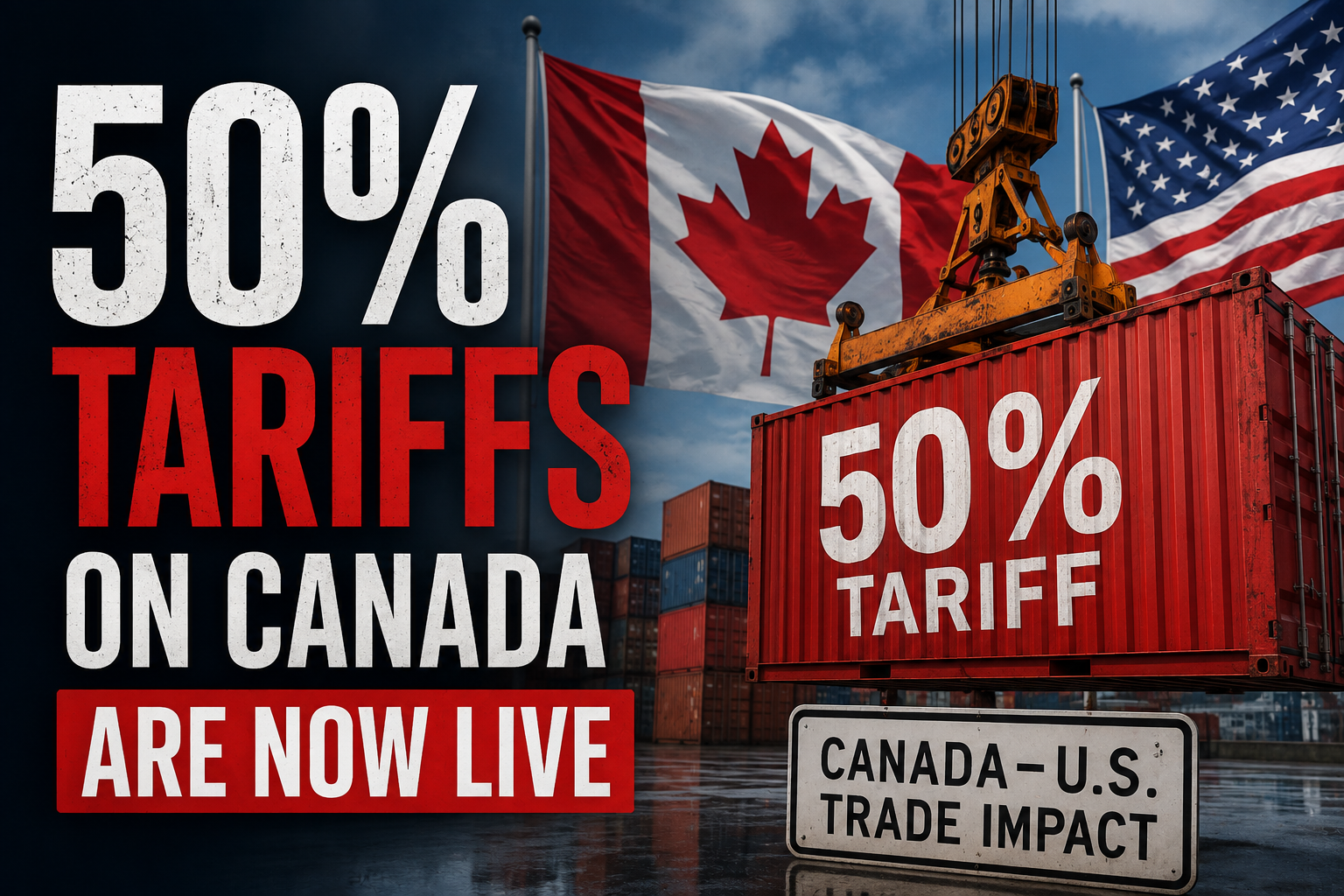
The United States slapped 50% tariffs on roughly $20 billion worth of Canadian goods early Saturday, August 22, 2026, after weeks of tense negotiations collapsed just hours before the deadline. Canada did not wait. Prime Minister Mark Carney announced his country would match the duties dollar for dollar, suspended all trade talks with Washington, and set the stage for what could become the most damaging economic confrontation between the 2 nations in modern history.
This is not a drill, and it is not a bluff. The tariffs are live, the goods are affected right now, and there is no expiration date attached to any of it.
How the Tariffs Came About
President Donald Trump signed 3 separate proclamations on July 20, 2026, invoking Section 338 of the Tariff Act of 1930. This is the same law that helped worsen the Great Depression nearly a century ago, and it had not been used or even threatened for at least 70 years before this move.
The White House framed the tariffs as a response to what it called Canada’s discriminatory treatment of American products in 3 sectors: dairy, alcoholic beverages, and motor vehicles. According to the official White House fact sheet, 8 of Canada’s 10 provinces had blocked or restricted sales of American alcoholic beverages on their shelves since early 2025. Canada’s tariff rate quota system on dairy also gave European Union suppliers better access than their American counterparts. And Canadian auto tariffs hit US vehicles with a 25% surtax while leaving imports from Japan, South Korea, and Germany untouched.
Washington saw all 3 as violations of fair trade, and Section 338 gave Trump the legal authority to respond with duties up to 50%, the maximum the law allows.
What Products Are Affected
The tariffs cover 569 product categories, far more than the dairy, alcohol, and auto sectors that triggered the action. The full list includes wine, beer, whiskey, vodka, gin, cement, plywood, electrical equipment, machinery, hockey sticks, tongue depressors, building materials, certain clothing, and wooden packaging.
There are notable exemptions. Energy products, potash, fish, critical minerals, and goods already under separate Section 232 tariffs (steel, aluminum, and copper) are not covered by this round. But here is the detail that makes these tariffs different from anything before: even goods that qualify as originating under the United States-Mexico-Canada Agreement (USMCA) are not exempt. In every previous tariff action, USMCA-compliant goods had been shielded. That shield is gone.
The 3-Day Deal That Fell Apart
The tariffs were originally supposed to kick in at 12:01 AM on Wednesday, August 19, 2026. Less than 2 hours before that deadline, Trump posted on Truth Social that he was pausing the tariffs for 3 days, claiming that the 2 sides had reached a deal pending finalization of documents.
Carney confirmed that Canada had agreed to the pause and that both sides would continue negotiating. For 72 hours, trade officials on both sides scrambled to close the gap. By Thursday, Canada’s trade minister had met with US Trade Representative Jamieson Greer for several hours. Optimism was high.
Then it all fell apart on Friday night. Carney made the announcement that while important progress had been made, it was not enough to meet Canada’s objectives. The tariffs went live at midnight. Carney immediately pledged retaliation and pulled out of talks entirely.
Why This Matters Beyond Trade Numbers
The economic impact sounds manageable on paper. The $20 billion in affected goods represents about 5% of what Canada ships to the United States each year. But the real damage runs deeper than percentages.
The US-Canada border stretches 5,525 miles. About 330,000 people and $2 billion worth of goods cross it every single day. The 2 countries traded $880 billion in goods and services in 2025. This is not a relationship built on occasional transactions. It is an economic lifeline for industries on both sides.
Small and medium-sized Canadian manufacturers are the most vulnerable. A 50% tariff is not something most businesses can absorb, and they cannot reasonably expect their American customers to absorb it either. Canadian kitchen cabinet makers, wine producers, and lumber companies that are already struggling from wildfire damage now face being priced out of the US market overnight. This pattern of aggressive trade moves by the Trump administration extends far beyond Canada. Washington has already declared economic warfare on Iran through sweeping sanctions, and earlier this year named over 40 countries, including major trading partners, in what it called a shadow transshipment network aimed at China.
On the American side, consumers will start seeing higher prices on Canadian imports within weeks. Businesses that rely on Canadian raw materials, from construction firms using Canadian lumber to manufacturers dependent on Canadian components, face supply chain disruptions and margin pressure. Economists have warned that while the macroeconomic damage may look contained for now, any escalation could halt the broader USMCA renegotiation that all 3 North American economies depend on.
Canada’s Response and What Comes Next
Carney’s dollar-for-dollar retaliation threat is not symbolic. Canada has already demonstrated the ability and willingness to hit back. Its 25% retaliatory tariffs on US steel, aluminum, and auto imports have been in place since September 2025. Those tariffs cost American auto exporters an estimated $5.6 billion between April 2025 and March 2026, a 22% drop in US auto exports to Canada.
The big question now is whether both sides return to the negotiating table before the damage becomes permanent. The USMCA trade pact was not renewed by the US, triggering renegotiations that could stretch until 2036. These 50% tariffs add enormous pressure to those talks.
Canada is not the only economy recalibrating its trade relationship with Washington. India struck its own tariff deal with the US earlier this year, cutting rates to 18% and posting 7.6% GDP growth in the process. But the playbook that worked for New Delhi may not apply to Ottawa, where the stakes are far more intertwined and the political will to compromise appears to be running out.
Section 338 tariffs carry no statutory expiration date. They stay in effect until explicitly modified or revoked by a future presidential proclamation. That means these are not temporary leverage. They are the new normal until someone decides otherwise. And right now, neither Washington nor Ottawa appears ready to blink first.