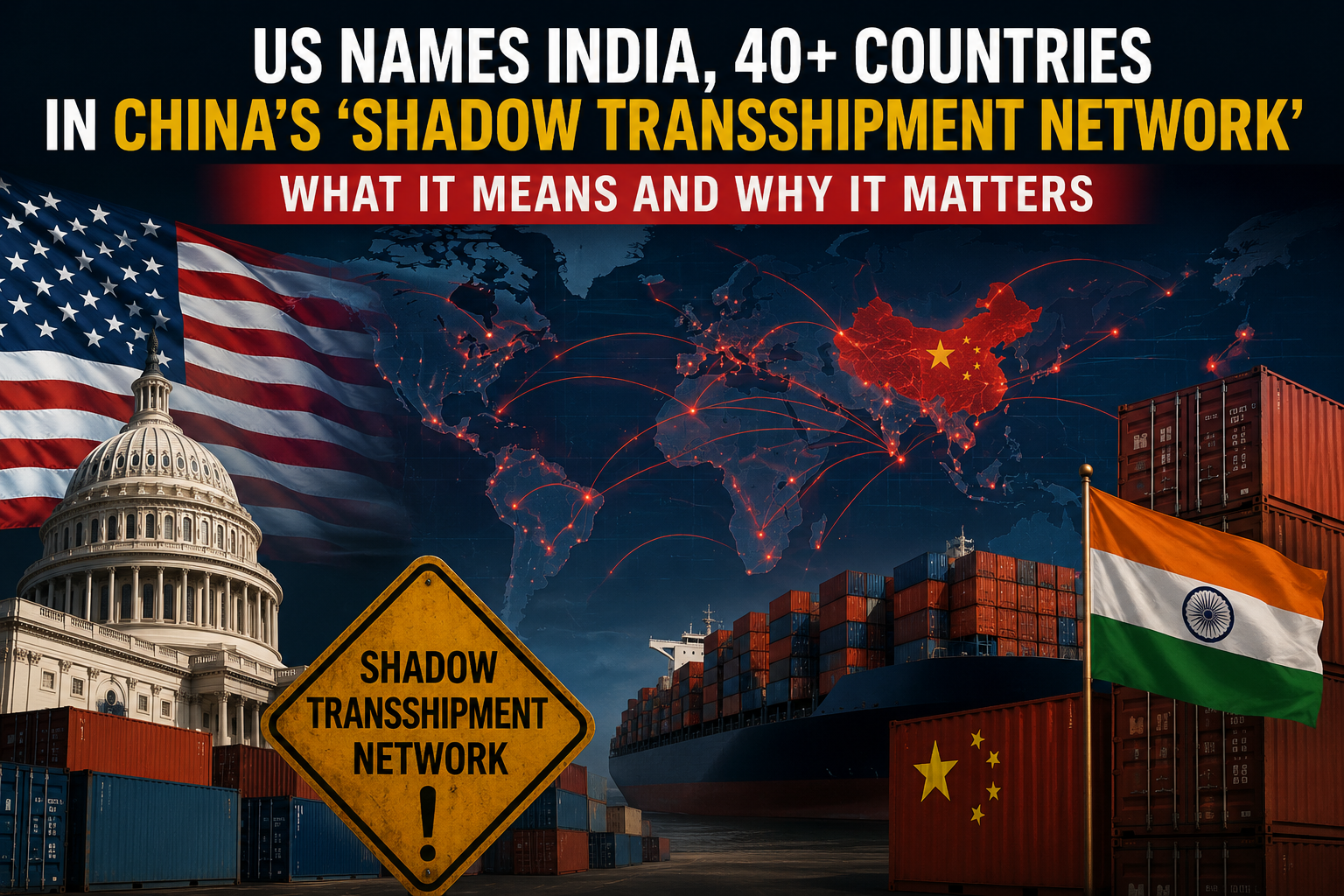
The White House dropped a 25-page bombshell on August 13, 2026, accusing more than 40 countries, India included, of enabling what it calls the “Great Transshipment Scam.” The report, authored by Peter Navarro, senior counselor for trade and manufacturing, claims that Chinese exporters have been funneling goods through third-party nations to dodge steep American tariffs. The estimated damage? Somewhere between $40 billion and $303 billion a year in illegally rerouted goods, depending on whose numbers you trust.
For India, this is not just an abstract geopolitical development. It lands at a moment when New Delhi and Washington are actively negotiating a reciprocal trade deal, and it threatens to complicate an already delicate balancing act.
What Exactly Is Transshipment?
Transshipment, at its simplest, is when goods produced in one country pass through a second country before reaching their final destination. On its own, this is perfectly legal. Global supply chains are complex, and goods routinely cross multiple borders during production and delivery.
The problem, according to Washington, begins when those goods are routed through a third country specifically to disguise where they were actually made. Think of a product assembled almost entirely in China, shipped to Vietnam or India, given a minor tweak (new packaging, a fresh label, maybe a single component added), and then exported to the United States as a “Vietnamese” or “Indian” product. The goods skip the heavy tariffs that would have applied if they had arrived directly from China.
The White House report uses vivid examples. Chinese electric motors fitted into recliners in Vietnam. “Screwdriver factories” that perform just enough assembly to create the appearance of a new national origin without any genuine transformation of the product. Reinvoicing, relabelling, repackaging, and minor processing that exists purely to game the system.
The 3-Tier Classification: Where Does Each Country Stand?
The report does not treat all 40-plus countries as equally culpable. Instead, it sorts them into 3 tiers based on the scale of their trade with China, the depth of supply chain integration, and how vulnerable their customs systems are to exploitation.
Tier 1: Diversified Scale Leaders
These are large, industrialized economies with massive and diverse trade volumes. Transshipment risks here are embedded within enormous flows of legitimate commerce, making them harder to detect. The countries in this tier are:
- Canada
- European Union
- India
- Israel
- Japan
- Mexico
- South Korea
- Taiwan
Tier 2: Significant Economic Integration with China
These nations have deep manufacturing and supply chain ties with China and handle significant volumes of goods that Washington considers suspicious:
- Brazil
- Indonesia
- Malaysia
- Thailand
- Turkey
- Vietnam
Tier 3: Small, Opportunistic Targets
Smaller economies that offer advantages like cheap labor, free trade zones, strategic port locations, or thin customs enforcement. These are seen as easier entry points for rerouted goods:
- Bangladesh
- Cambodia
- Philippines
- Singapore
- Sri Lanka
- United Arab Emirates
The report makes clear that other nations beyond these named examples are also included across the 3 tiers, with hubs ranging from Southeast Asian assembly operations to European processing centers in Poland and the Czech Republic, and maritime gateway models like the Jebel Ali free zone in the UAE.
What This Means for India Specifically
India’s placement in Tier 1 carries a particular sting because of timing. New Delhi is in the middle of negotiating a reciprocal tariff agreement with Washington, having already secured a reduction in US tariffs on Indian goods from 50% to 18% earlier in 2026 as part of an interim deal. That deal came with conditions: India committed to cutting back Russian oil imports and significantly increasing purchases of American goods.
Now, the transshipment report introduces a new variable. While the report does not accuse the Indian government of orchestrating tariff evasion, and it does not announce any new tariffs against India, it flags Indian supply chains as high-risk corridors for Chinese goods entering the American market under false origin labels. India, Mexico, and Vietnam were specifically identified as top hubs for China-origin goods among the listed countries.
The practical consequences could be significant. Indian exporters may face tougher origin verification checks at US customs. Shipments could be delayed as they undergo additional scrutiny. And if transshipment is detected, the penalties are severe: US Customs and Border Protection will be empowered to retroactively claim tariffs on a company’s shipments over the entire previous year, not just the specific consignment that was flagged.
For Indian manufacturers doing legitimate business, this creates an environment of uncertainty. A company that sources some components from China for genuine assembly and value addition in India could find itself caught in the crossfire if US customs algorithms decide the transformation was not “substantial” enough.
The AI-Powered ‘Detective Border’
Perhaps the most striking element of the crackdown is the enforcement mechanism. The White House announced that US Customs and Border Protection is deploying an AI-powered system called the “Detective Border.” This is not a future plan; deployment is already underway.
The system integrates multiple data streams: shipment records, routing histories, product classifications, corporate ownership structures, production capacity data, anomaly detection algorithms, and even computer vision analysis of packaging patterns and X-ray imaging at ports. The goal is to flag suspicious shipments before they clear customs rather than catching violations months later through audits.
According to the White House, the Detective Border is designed to distinguish between 2 things that can look very similar on paper: legitimate nearshoring (where a company genuinely shifts production to a new country) and illegal pass-through trade (where goods are simply routed through a country to pick up a different label). The distinction matters enormously because the entire “China Plus One” strategy that hundreds of companies have adopted since 2018 involves exactly this kind of supply chain diversification. The fear among trade analysts is that AI enforcement could penalize legitimate restructuring alongside actual fraud.
Why Now? The Bigger Picture
This report did not appear in a vacuum. When the Trump administration first imposed Section 301 tariffs on Chinese goods in 2018, businesses scrambled to adjust. Many moved portions of their manufacturing to lower-tariff countries like Vietnam, Cambodia, and India. Chinese-owned factories opened across Southeast Asia. Some of this was genuine diversification. Some of it, Washington now argues, was simply a shell game.
Since returning to office, the Trump administration has imposed some of the highest tariff rates in modern American history on imports from China. That has only intensified the incentive for Chinese exporters to find workarounds. The supply chain data firm Exiger estimated that between February 2025 and February 2026 alone, roughly $75 billion in goods were illegally transshipped, corresponding to $19 billion to $34 billion in lost tariff revenue for the US Treasury.
The administration’s strategy is clear: rather than trying to change China’s behavior directly, target the countries that enable the rerouting. As Navarro put it, the warning to lower-tariff countries is blunt. Preferential access to the American market is not a license to launder someone else’s exports.
Anti-Transshipment Clauses in Every Future Trade Deal
The enforcement push goes beyond customs technology. The US Trade Representative’s office has confirmed that anti-transshipment clauses are now being written into every new trade agreement, including the deal currently being negotiated with India. These clauses come with teeth: countries that allow disguised Chinese goods to pass through their borders face penalties that can be enforced according to the clause’s “spirit,” meaning nations could be penalized even without a clear-cut, black-and-white violation.
This is a significant shift in trade enforcement philosophy. Traditionally, proving transshipment fraud required a smoking gun, such as documentation showing a deliberate scheme to mislabel goods. Under the new approach, patterns of suspicious trade data could be enough to trigger penalties. The burden of proving legitimate origin may increasingly fall on exporters rather than US customs having to prove fraud.
What Does This Mean for Global Trade?
The ripple effects of this crackdown extend well beyond the 40-plus named countries. Several consequences are already visible or anticipated.
First, compliance costs are going up. Exporters in every country named in the report will need to invest more heavily in documenting their supply chains, proving country of origin, and maintaining records that can withstand AI-powered scrutiny. Small and mid-sized companies, which often lack the resources for sophisticated compliance systems, will feel this most acutely.
Second, legitimate “China Plus One” strategies may face collateral damage. Companies that genuinely shifted production to India, Vietnam, or Mexico over the past several years may find their shipments flagged simply because they source some inputs from China. The line between “substantial transformation” (which is legal) and “minor processing” (which is not) has always been blurry, and the introduction of AI enforcement does not necessarily make it clearer.
Third, diplomatic friction is inevitable. Being publicly named in a White House report as part of a “shadow transshipment network” is not something any government takes lightly, especially allies and trade partners like the EU, Japan, South Korea, and India. Expect pushback from multiple capitals in the coming weeks.
Fourth, the report may accelerate the fragmentation of global supply chains. Trade policy shifts like these directly influence how currencies move. If the cost and risk of routing goods through third countries goes up sharply, some manufacturers may respond by pulling production back to their home markets entirely, a process economists call reshoring. Others may simply absorb the tariffs. Either way, the era of frictionless global supply chains is facing another blow.
The Bottom Line
The “Great Transshipment Scam” report is part warning, part enforcement blueprint. It names names, assigns risk tiers, and backs the whole thing with AI-powered customs technology and legally binding trade clauses. For India, the immediate task is to avoid getting caught in the dragnet while protecting the trade relationship with Washington. For the 40-plus countries on the list, the message from the White House is unambiguous: the days of looking the other way while Chinese goods pick up a new passport are numbered.
Whether AI customs agents can actually tell the difference between genuine manufacturing and a relabelling operation remains to be seen. But the intent is clear, and the stakes, running into tens of billions of dollars, are high enough that no exporter in any named country can afford to ignore this.