Your phone unlocks by looking at your face. Your smartwatch notices an irregular heartbeat. Your earbuds cancel out a screaming toddler two rows behind you. None of that waits for the internet. That is edge AI, and it is quietly taking over jobs that used to belong to distant data centres. If you are still getting your bearings on the broader landscape, our complete guide to AI tools in 2026 is a useful companion to this piece.
This article breaks down edge AI vs cloud AI without the engineering jargon — what each one is, why the balance is shifting, and why it actually matters to you.
What Cloud AI Actually Means
Cloud AI is the model most people picture when they think about artificial intelligence.
You type a question. It travels over the internet to a data centre — a warehouse full of expensive chips somewhere in Virginia, Ireland, or Singapore. The model does the thinking there. The answer travels back.
Your device is basically a messenger. It collects the input, sends it off, and displays whatever comes back.
What cloud AI is good at:
- Running enormous models that no phone could hold
- Handling complex reasoning, long documents, and deep research
- Getting updated instantly for everyone at once
- Pulling from huge live datasets
When you ask a chatbot to summarise a 40-page contract, that is cloud work. The model is too big and the task too heavy for the chip in your pocket.
What Edge AI Actually Means
Edge AI flips the arrangement. The model lives on the device — the “edge” of the network, as far from the data centre as you can get.
Your phone, your car, your doorbell camera, your factory sensor. The processing happens right there. Nothing leaves.
This used to be impossible. Models were too big, chips too weak. Two things changed:
Chips got specialised. Modern phones ship with neural processing units — silicon built specifically for AI maths. They are startlingly efficient at it.
Models got smaller. Engineers learned to compress models dramatically through techniques like quantisation and distillation. A model that needed a server rack in 2020 now fits comfortably on a mid-range handset.
Put those together and suddenly a great deal of useful AI runs locally.
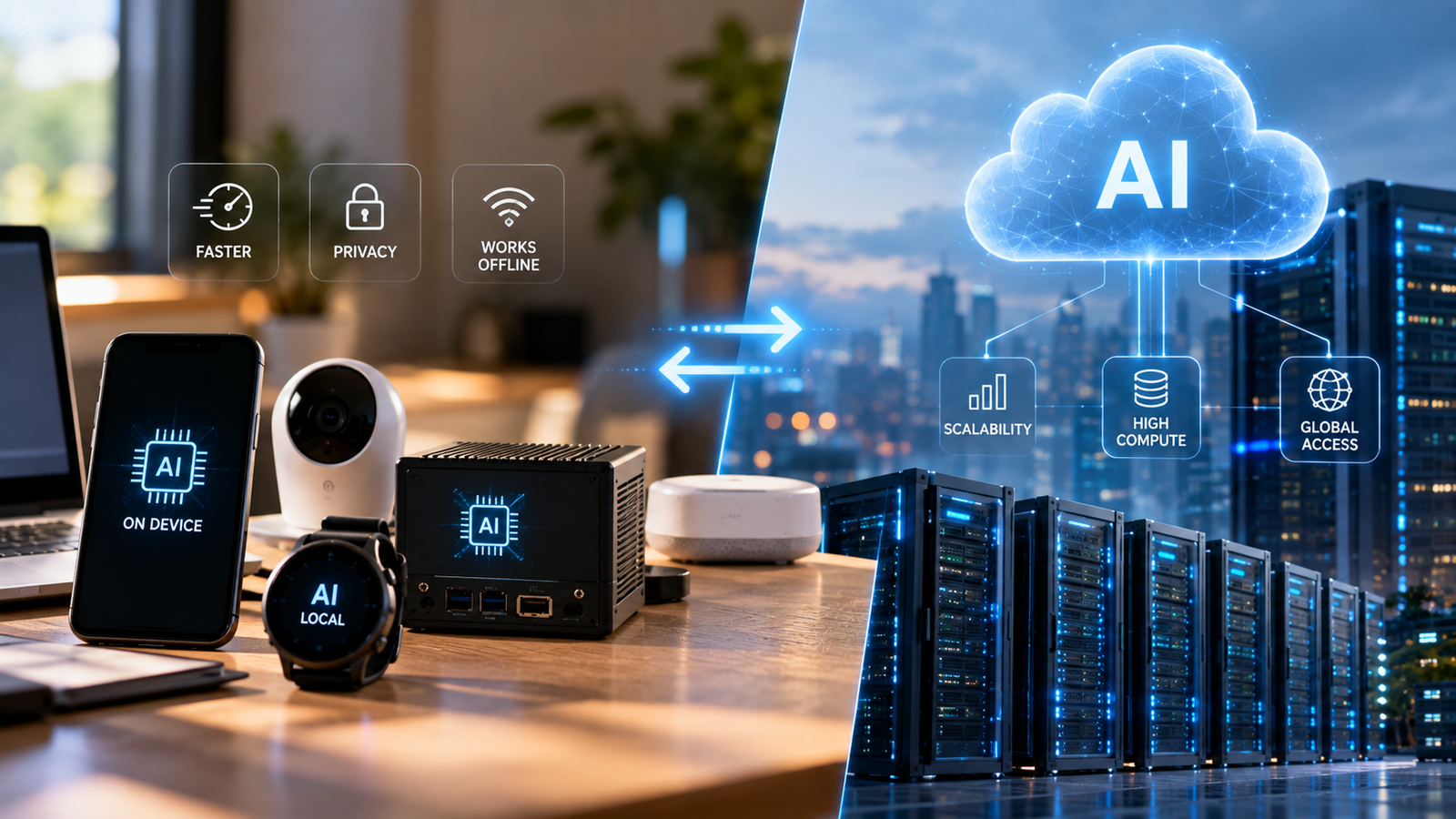
Edge AI vs Cloud AI: The Short Version
| Factor | Cloud AI | Edge AI |
|---|---|---|
| Where processing happens | Remote data centre | On your device |
| Internet needed | Yes | No |
| Speed | Depends on connection | Near-instant |
| Privacy | Data leaves your device | Data stays put |
| Model size | Very large | Compact |
| Running cost | Per request, ongoing | Built into the hardware |
| Best for | Heavy reasoning, research | Fast, repetitive, sensitive tasks |
Why the Shift Is Happening Now
Three forces are pushing work toward the edge. They are not equally obvious, but all three are real.
1. Privacy Stopped Being Optional
Every time data leaves your device, it becomes someone else’s problem to protect. It gets transmitted, stored, logged, and occasionally leaked.
Regulators noticed. GDPR in Europe, similar rules elsewhere, and India’s data protection framework all made careless data movement expensive.
Edge AI sidesteps most of that. If your face scan never leaves your phone, there is no server to breach and no transfer to disclose.
This is why the most sensitive features went local first: face unlock, fingerprint matching, health monitoring, voice wake words. Companies did not want that data either. Holding it is a liability.
2. Latency Is Not Just an Annoyance
A round trip to the cloud takes somewhere between 50 and 300 milliseconds on a good connection. For a chatbot answer, nobody cares.
For other things, it is unacceptable.
A car’s collision detection cannot pause to ask a server what it is seeing. At highway speed, 200 milliseconds is several metres of stopping distance. A factory robot cannot wait either. Neither can live translation in your ear, or a camera deciding whether to open a gate.
Then there is the simpler problem: connectivity is not guaranteed. Lifts, tunnels, rural roads, aircraft, basements. Cloud AI stops working. Edge AI does not notice.
This is the same practical logic behind a lot of the automation trend — it is worth reading why agentic AI is not just a smarter chatbot, because systems that act on their own behalf need to keep working when the network does not.
3. Cloud Compute Got Expensive
This is the reason companies rarely advertise, and possibly the strongest one.
Every cloud AI request costs money. Fractions of a cent, usually. Multiply by ten million users doing it forty times a day, and the maths turns ugly fast.
Edge processing costs the company nothing per use. The compute already shipped inside the device the customer paid for. Once it is there, running it is free.
So the commercial instinct is straightforward: push anything that can run locally to run locally, and reserve the cloud for work that genuinely needs it.
Where You Are Already Using Edge AI
Most of this is invisible, which is exactly the point.
- Your phone camera. Scene detection, background blur, night mode, and noise reduction all run on-device before you even tap the shutter.
- Face and fingerprint unlock. The biometric template never leaves a secured chip on the phone.
- “Hey” wake words. Your assistant listens locally for its name. Only after it hears it does anything go to a server.
- Smartwatches. Heart rhythm checks, fall detection, and sleep staging run on the watch itself.
- Noise-cancelling earbuds. They analyse and counter ambient sound in real time. There is no time to phone home.
- Modern cars. Lane-keeping, blind-spot warnings, and driver attention monitoring are all local.
- Security cameras. The better ones decide on the device whether they saw a person, a car, or a cat — instead of uploading every second of footage.
Count them up and you are probably using edge AI dozens of times a day without ever calling it AI.
What Edge AI Still Cannot Do
It is not a replacement, and anyone selling it that way is overstating things.
Size limits are real. The largest models have hundreds of billions of parameters. Your phone runs something a fraction of that size. For genuinely hard reasoning, the big model wins.
Knowledge goes stale. An on-device model knows what it shipped with. It cannot tell you today’s news or check a live price without reaching out.
Updates are slower. Improving a cloud model means updating one system. Improving an on-device model means shipping an update to millions of devices and hoping people install it.
Battery and heat. Sustained local AI drains a battery and warms a device. Fine for short bursts, painful for long sessions.
The Real Answer Is Hybrid
In practice, almost nothing is purely one or the other. Sensible systems split the work.
Your device handles the fast, private, repetitive parts. It listens for the wake word, blurs the background, reads the heartbeat, filters out the obvious. When something genuinely needs a bigger brain, it escalates to the cloud.
Voice assistants are the cleanest example. Wake word detection: local. Understanding a complicated request: cloud. You experience it as one smooth thing.
Expect the dividing line to keep drifting toward the device. Every generation of chips moves a few more tasks across.
Frequently Asked Questions
Is edge AI more private than cloud AI?
Generally yes, because the raw data does not leave the device. But check what the app actually does — some process locally and still upload results or usage data.
Does edge AI work without internet?
Yes. That is one of its main advantages. Anything genuinely running on-device keeps working in aeroplane mode.
Is edge AI faster than cloud AI?
For the tasks it handles, almost always — there is no network round trip. But it cannot handle the heaviest tasks at all, so “faster” only applies within its range.
Will edge AI replace cloud AI?
No. The two solve different problems. The mix will keep shifting, but large models will stay in data centres for the foreseeable future.
What This Actually Means for You
You do not need to pick a side. You just need to know which one you are using, because it changes what you should assume.
When a feature works offline, your data is very likely staying put. When it needs a connection, something is leaving your device — and it is worth knowing what, and to whom.
That single question is the most useful privacy filter available to a non-engineer. It cuts through marketing language faster than any policy document.
If you are choosing which assistant to actually rely on for heavier work, our breakdown of Claude vs ChatGPT vs Gemini compares them by real use case rather than benchmark scores.
The short version of edge AI vs cloud AI: the cloud is where AI learned to think, and your devices are where it is learning to be useful. Both are here to stay — the interesting part is watching which jobs move, and how quickly.