You have probably heard the term “agentic AI” thrown around in every tech conversation this year. And if your first reaction was “so it’s just a better chatbot,” you are not alone. Most people assume the agentic AI vs chatbot difference boils down to intelligence. Smarter model, better answers. But that completely misses the point. If you have been keeping up with the AI tools landscape in 2026, you have already noticed something shifting under the surface. AI is no longer just answering questions. It is starting to do actual work.
And that one change, the shift from responding to acting, is what separates agents from chatbots in a way that matters.
What a Chatbot Actually Does
Before we talk about what agents can do, it helps to be honest about what chatbots are designed to handle. A chatbot is reactive software. You type something, it responds. You ask another question, it responds again. The interaction starts and ends inside that text window.
Even the best chatbots, the ones powered by large language models like GPT or Claude, still follow this same loop. You prompt, they generate. They do not remember what happened 3 conversations ago unless you manually remind them. They cannot open your CRM, update a spreadsheet, or send an email on your behalf. They talk. That is what they do.
And for plenty of use cases, talking is enough. If someone needs a quick answer from a knowledge base, a chatbot handles that perfectly. Password reset instructions? FAQ lookups? Basic triage? Chatbots were built for exactly these kinds of interactions, and they do them well, cheaply, and at scale.
The problem starts when people expect chatbots to solve problems that require action, not just conversation.
What Makes Agentic AI Fundamentally Different
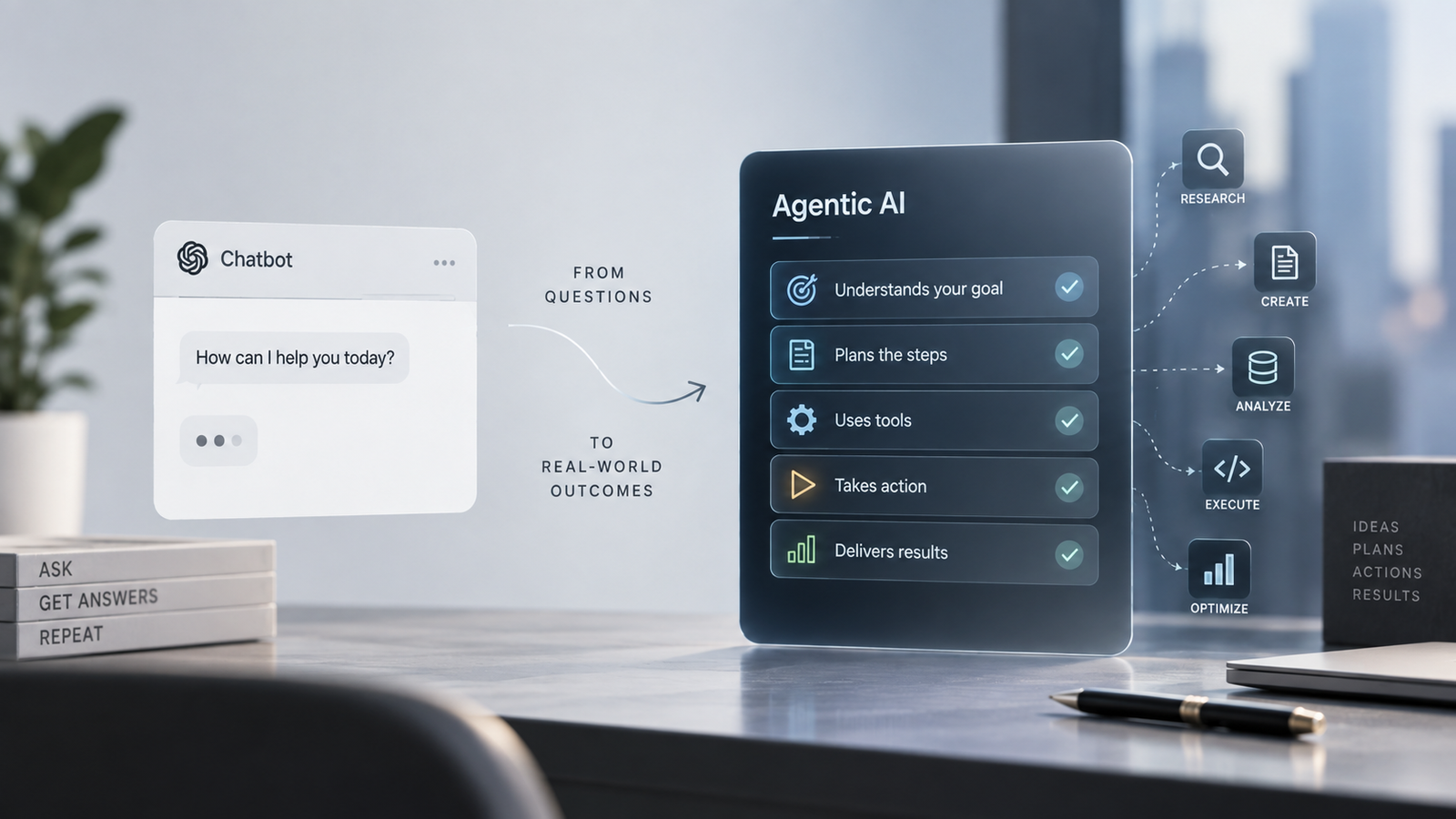
An AI agent does not just talk to you. It works for you. That distinction sounds subtle, but it changes everything about how these systems are built and what they can accomplish.
There are 5 core capabilities that separate agents from chatbots, and none of them are about being “smarter” in conversation.
1. Agents Take Action Across Systems
A chatbot lives inside a chat window. An agent connects to your tools, your databases, your calendars, your email, your CRM, and actually does things inside them. It does not describe what you should do. It goes and does it.
2. Agents Plan Multi-Step Workflows
Ask a chatbot to “onboard a new employee” and you get a checklist. Ask an agent the same thing and it creates the user account, assigns permissions, sends the welcome email, schedules orientation meetings, and updates the HR system. Multiple steps, executed in sequence, without you babysitting each one.
3. Agents Maintain Context and Memory
A chatbot forgets. An agent remembers. It knows what happened in previous interactions, what tasks are pending, and what the current state of a workflow looks like. This is not just a nice feature. It is what makes complex, ongoing tasks possible.
4. Agents Make Decisions Based on Conditions
When an agent hits an unexpected situation, like a missing vendor record during a financial close, it does not just stop and ask for help. It reasons about what to do, flags the anomaly, checks related data, and either resolves it or escalates with full context. Chatbots freeze when they encounter anything outside their script.
5. Agents Operate With a Goal, Not Just a Prompt
This is the biggest difference. You give a chatbot a prompt. You give an agent a goal. The agent figures out the steps, picks the right tools, handles exceptions, and keeps going until the job is done or it hits a boundary that requires human approval.
3 Real Workflows That Expose the Gap
The abstract differences are useful, but let’s make this concrete. Here are 3 real workflow scenarios where the gap between chatbots and agents becomes impossible to ignore.
Sales Prospecting
Chatbot approach: A sales rep asks the chatbot for a summary of a prospect. The chatbot pulls up whatever is in the knowledge base and generates a paragraph. The rep then manually researches the prospect on LinkedIn, writes a personalized email, logs it in the CRM, and sets a follow-up reminder.
Agent approach: The agent monitors buying signals automatically (website visits, job changes, social activity). When a prospect matches the ideal customer profile, the agent researches them across multiple sources, drafts a personalized outreach email, sends it, logs the interaction in the CRM, and schedules a follow-up sequence. The rep only gets involved when the prospect responds.
That is not a smarter chatbot. That is a different category of tool entirely.
Customer Support Escalation
Chatbot approach: Customer describes a billing issue. The chatbot searches the FAQ, offers a generic answer, and if the customer is still stuck, creates a support ticket. A human agent eventually picks it up.
Agent approach: Customer describes the billing issue. The agent pulls up their account, identifies the specific charge in question, cross-references it with the payment processor, finds the discrepancy, applies the correct adjustment, sends a confirmation email, and updates the ticket as resolved. No human touched it.
When you compare tools like Claude, ChatGPT, and Gemini, you will notice that all 3 are building toward this kind of agentic capability. The conversation interface is becoming the control panel, not the product itself.
Supply Chain Management
Chatbot approach: A procurement manager asks “what’s our current inventory status?” The chatbot returns whatever data it can access from a single source.
Agent approach: The agent continuously monitors warehouse telemetry, supplier APIs, and pricing feeds. When stock drops below a threshold, it runs optimization calculations, selects the best vendor based on cost and delivery speed, generates a purchase order in the ERP system, and logs an audit trail. All before the procurement manager even notices the shortage.
When Chatbots Still Make Sense
Let’s be fair. Not every problem needs an agent, and pretending otherwise is how companies waste money on technology they do not need.
Chatbots remain the right choice for high-volume, low-complexity interactions. If your primary need is answering repetitive questions, providing basic product information, or routing customers to the right department, a chatbot handles that at a fraction of the cost of building an agentic system.
The decision framework is straightforward. If the task starts and ends inside a conversation, a chatbot works fine. If the task requires reaching into other systems, making decisions, and completing multi-step processes, you need an agent. Many companies will run both, using chatbots for the front door and agents for the work that happens behind it.
Where This Is All Heading
The trajectory here is clear, and the numbers back it up. According to Gartner, by 2028, at least 15% of day-to-day work decisions will be made autonomously through agentic AI, up from essentially 0% in 2024. On top of that, 33% of enterprise software applications are expected to include agentic capabilities by 2028.
But there is an important reality check. Over 40% of agentic AI projects are projected to get cancelled by the end of 2027 due to rising costs, unclear value, or weak risk controls. The technology works, but only when it is scoped correctly. Companies that deploy agents on problems that chatbots can handle will waste resources. Companies that try to solve agent-level problems with chatbots will fall behind.
Two emerging protocols are also shaping how this all connects. Anthropic’s Model Context Protocol (MCP) standardizes how agents communicate with external tools. Google’s Agent-to-Agent (A2A) protocol defines how multiple agents coordinate with each other. These are the infrastructure layers that will make agentic AI practical at scale, not just impressive in demos.
The companies that are already experimenting with how AI systems are evolving behind the scenes are the ones positioning themselves for this shift. It is not about replacing chatbots. It is about recognizing when a conversation is no longer enough.
The Bottom Line
The agentic AI vs chatbot difference is not about intelligence. It is about capability. A chatbot answers. An agent acts. A chatbot processes your question. An agent processes your workflow.
If you are still evaluating AI tools based purely on how well they hold a conversation, you are looking at the wrong scoreboard. The next wave of value is not in better answers. It is in systems that can take those answers and turn them into completed work, across your tools, without needing you to hold their hand through every step.
That is the real shift. And it is already happening.