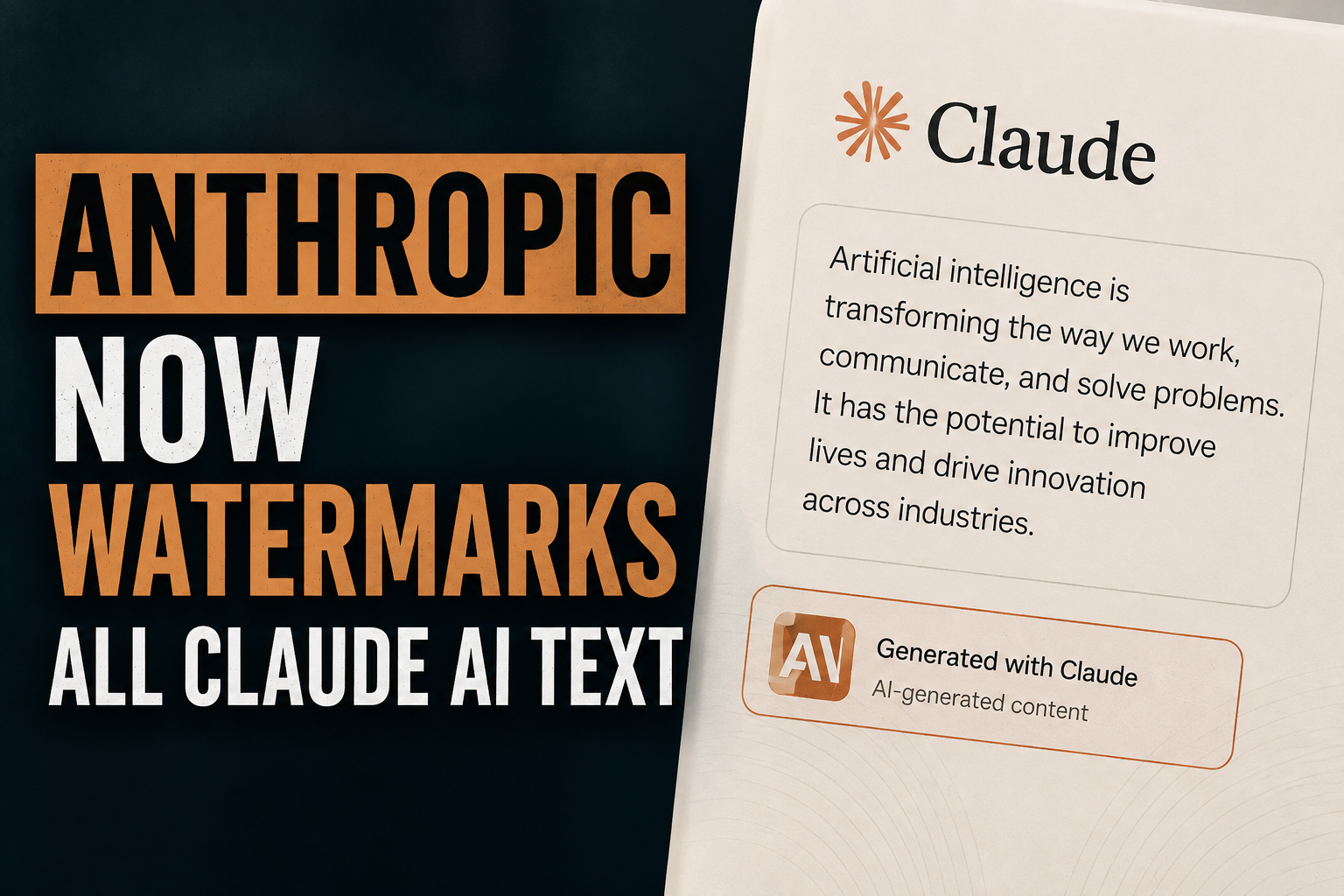
Every response Claude generates now carries an invisible mark that you cannot see, but machines can detect. Anthropic, the San Francisco-based company behind the Claude family of AI models, confirmed on August 11, 2026, that all Claude models launched on or after August 2, 2026, embed a hidden watermark directly into the text they produce. The watermark applies globally, across every product and platform where Claude operates.
This is not a quiet backend tweak. It represents one of the most significant shifts in how AI-generated content is labeled, and it has sparked fierce debate among users, developers, and content creators worldwide.
Why Anthropic Decided to Watermark Claude Output
The trigger behind this move is regulatory. The European Union AI Act, specifically Article 50, took effect on August 2, 2026, requiring AI providers to mark generated or manipulated content so that other systems can identify it. Non-compliance carries penalties of up to €15 million or 3% of global annual turnover, whichever figure is higher.
Anthropic, along with roughly 190 other signatories, signed the EU Code of Practice on Transparency of AI-Generated Content in July 2026. The company chose to apply watermarking globally at launch rather than limiting it to European users, stating that it does not yet have a reliable method to scope the feature by region.
The watermark now applies across Claude, the Claude API, Claude Code, Claude Cowork, and Claude Tag. It also extends to third-party providers hosting Anthropic models, including AWS, Google Cloud, and Microsoft Foundry.
How the Watermark Works Under the Hood
Anthropic watermark is based on Google DeepMind SynthID-Text method, published in the journal Nature in 2024. The technique belongs to a broader family of approaches that trace back to a proposal by computer scientist Scott Aaronson in 2022.
To understand how it works, consider how large language models generate text. Claude produces one word at a time by selecting from a list of candidates that fit the context. When the model reaches a point where 2 or more words would work equally well, the choice between them is settled by a random number. For example, after writing “The weather today was cold and,” the next word could reasonably be “grey” or “overcast.” The meaning stays the same either way.
Watermarking changes the source of that randomness. Instead of using an arbitrary random number generator, the system uses a secret key combined with the preceding words to guide the selection. The words Claude picks are still random and natural, but the pattern of choices becomes detectable to anyone holding the key. Over a long enough passage, that pattern accumulates into a signal strong enough to identify Claude involvement.
Anthropic has compared this to a game of Monopoly where dice rolls are replaced with digits of pi. The game plays out exactly the same for the participants, but afterward, someone who knows the sequence can confirm whether pi was used. The experience is identical. Only the source of randomness differs.
What the Watermark Does Not Do
The watermark carries no identifying information. It cannot be traced to a specific user, organization, or conversation. It does not slow down the model, generate extra tokens, or increase costs. According to Anthropic internal testing, there is no measurable impact on quality, creativity, or readability. Google DeepMind own tests on live Gemini traffic found no statistically significant difference in user satisfaction between watermarked and unwatermarked outputs.
It is also important to understand what detection actually proves. A positive watermark signal only indicates that Claude was likely involved in producing or processing the content. It does not confirm that Claude authored the original ideas, and it cannot distinguish between text Claude wrote from scratch versus text it heavily edited. A negative signal does not prove a human wrote the content either, since older models, heavily edited passages, and short samples may not carry a detectable mark.
Where the Watermark Gets Weaker
The system has clear limitations. Factual passages where there is only one correct answer, such as completing “Isaac Newton most famous work was called Principia…,” leave no room for the watermark to operate. Code carries less watermarking because syntax demands precision, although comments within code can still hold a signal.
Short text samples produce weaker detection confidence because there are fewer word-choice decisions for the pattern to accumulate. Proofreading and light editing produce minimal marks since most of the words remain the author own. Heavy rewrites where every word is replaced will eliminate the watermark entirely, though Anthropic notes that at that point, calling the text AI-generated is debatable.
Translations produced by Claude do carry a watermark because every word in the output is chosen by the model.
How Anthropic Handles Files
For generated files like PNG, JPG, and SVG, Anthropic takes a different approach. Instead of embedding a mark inside the file itself, Claude attaches a cryptographically signed note in the file metadata using the C2PA open standard, the same framework used by camera manufacturers and photo-editing software to record where an image came from. Any tool that supports C2PA can read this metadata.
Unlike the text watermark, file metadata can be stripped if the format changes or the metadata is deliberately removed.
User Backlash and Industry Reaction
The announcement has divided the AI community. On platforms like X and Reddit, dozens of Claude subscribers publicly announced subscription cancellations. Many content creators, writers, and professionals who use Claude as an editing or drafting tool objected to the idea that their own work could be flagged as AI-generated simply because Claude touched it. As AI assistants become deeply integrated into professional workflows, the line between AI-assisted and AI-generated keeps getting blurrier.
Others defended the move, arguing that watermarking is a necessary step toward accountability, particularly as AI-generated misinformation and low-quality content flood the internet. The International Conference on Machine Learning (ICML) 2026 used a similar watermark approach during its peer review process and caught 506 reviewers who violated its no-AI policy by copying and pasting AI outputs directly.
Anthropic is not alone in this space. Google has been developing its SynthID system across text, images, audio, and video for several years. OpenAI combines C2PA metadata with SynthID for image outputs, though it has not yet shipped a comparable text watermark. With the EU AI Act now enforceable, the entire industry is moving toward mandatory content labeling.
What Comes Next
Anthropic has confirmed that a watermark detection API is in development, which will allow users and third parties to check whether a piece of text was likely processed by Claude. The company is also working to add watermarking to older Claude models released before August 2, with a deadline of December 2, 2026, when the EU transition period for pre-existing systems expires.
For a detailed breakdown of the technical mechanism, Anthropic published a full explanation on its official blog titled How Claude Text Watermark Works.
Whether this watermark becomes a reliable tool for transparency or an imperfect label that creates more confusion than clarity will depend on how detection tools perform in the real world, how other AI providers implement their own systems, and whether users adapt or push back hard enough to force changes. For now, every word Claude writes carries an invisible signature, and there is no opt-out.