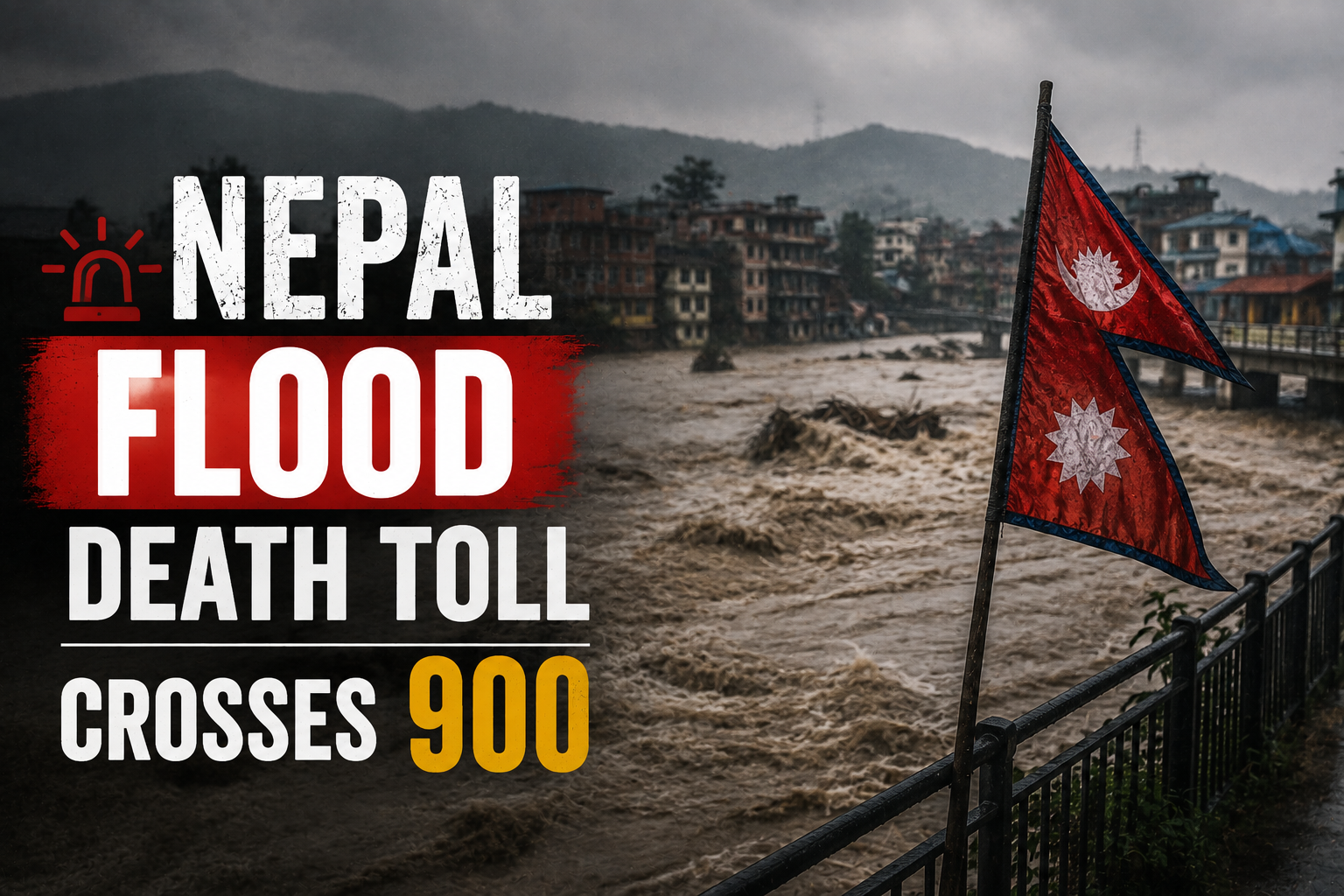
The death toll from the catastrophic flooding that struck the Nepal-China border region on August 26 has now climbed past 900, with more than 4,700 people still unaccounted for across both countries. What began as a glacier collapse high in the Himalayas has turned into one of the deadliest natural disasters in Nepal’s recent history, and the full scale of the destruction is still unfolding.
A Glacier Broke Loose Without Warning
The disaster started when a massive section of glacier at an elevation of roughly 5,200 meters broke away near the Langtang Lirung peak, plunging approximately 1,200 meters into the river valley below. The impact sent a violent surge of water, ice, mud and rock barreling down the Bhote Koshi and Trishuli river systems, tearing through settlements, bridges and hydropower facilities for nearly 100 kilometers.
What made this event particularly devastating was the complete lack of warning. It was not raining when the flood struck. Officials and residents were caught off guard. Water levels in the Trishuli River reportedly rose by as much as 9 meters in just 30 minutes, leaving almost no time for evacuation.
The Numbers Keep Rising
According to Nepal’s National Disaster Risk Reduction and Management Authority (NDRRMA), at least 788 people have died in Nepal alone. When casualties from the Chinese side of the border in Tibet are included, the combined death toll stands at over 919. More than 4,200 people remain missing in Nepal, a sharp increase from the approximately 2,500 reported just a day earlier. At least 1,473 people have been injured.
The missing include citizens from 33 countries. India’s Ministry of External Affairs confirmed that 275 Indian nationals were unaccounted for, while Malaysia reported 91 citizens listed as unable to be contacted. Nationals from Australia, the United States, the United Kingdom, South Korea, the Netherlands and South Africa are also among those missing.
Hydropower Tunnels Become the Priority
One of the most urgent fronts in the rescue operation is the network of hydropower tunnels in Nepal’s Rasuwa and Nuwakot districts. More than 900 workers from 11 hydropower project sites are missing or unaccounted for, according to Nepal’s Independent Power Producers’ Association. These workers include Nepali, Indian, South Korean and Chinese nationals.
Rescue teams from the Nepal Army have been drilling manholes and pumping air into mud-filled tunnels in a desperate effort to reach survivors. Video released by the Prime Minister’s Office showed rescuers pulling survivors through thick layers of mud at the Upper Trishuli hydropower project, where about 350 people were rescued. The government has declared the tunnel rescue operation its highest priority.
Barrier Lakes Add Another Layer of Danger
Complicating the rescue effort was the formation of 2 barrier lakes upstream near the Nepal-China border. One lake, with a volume of around 2 million cubic meters, overflowed on August 28, forcing both Nepali and Chinese authorities to suspend rescue operations temporarily. Chinese rescue teams pulled back to safe ground, and Nepal’s army paused search operations for 90 minutes.
By August 30, the primary barrier lake had largely drained. However, authorities continued to monitor a second lake at a higher elevation near the glacier collapse site. Flood warnings were issued again on August 30 after Chinese authorities detected increased upstream water flow, and rescue workers across the affected zone were told to remain on high alert.
International Response and the Staggering Cost of Rebuilding
Nepal’s Finance Minister Swarnim Wagle said the country could need $4 to $5 billion to rebuild, a figure that represents nearly one tenth of the nation’s entire economy. The affected hydropower projects alone account for more than 12% of Nepal’s generating capacity. The United Nations separately estimated physical damage to roads, bridges, power lines and communications at over $1.3 billion.
International aid has started flowing in. The United States increased its humanitarian contribution to $3.6 million, while the European Union pledged $2.3 million. The International Federation of Red Cross and Red Crescent Societies allocated over $1 million and launched an emergency appeal for $31 million. Over 30,000 Nepali security personnel have been deployed, and more than 3,000 people have been rescued so far.
Infrastructure damage has been severe. Officials confirmed that 32 bridges and nearly 40 kilometers of road were destroyed, including the entire road from Betrawati in Nuwakot to the Rasuwagadhi border crossing. This route serves as a critical trade and tourism link between Nepal and China.
What Comes Next
The immediate focus remains on saving lives. As rescue teams probe deeper into mud-filled tunnels and search along river corridors, the scale of this disaster continues to grow. For a country still dealing with the aftermath of past monsoon tragedies, the path to recovery will be long and expensive. You can read our earlier coverage of the initial flood and glacier collapse here.
Natural disasters in the Asia-Pacific region have become increasingly frequent and severe. Similar geological events, like the 5.9 magnitude earthquake that shook Tokyo earlier this month, are a stark reminder of how vulnerable the region remains.