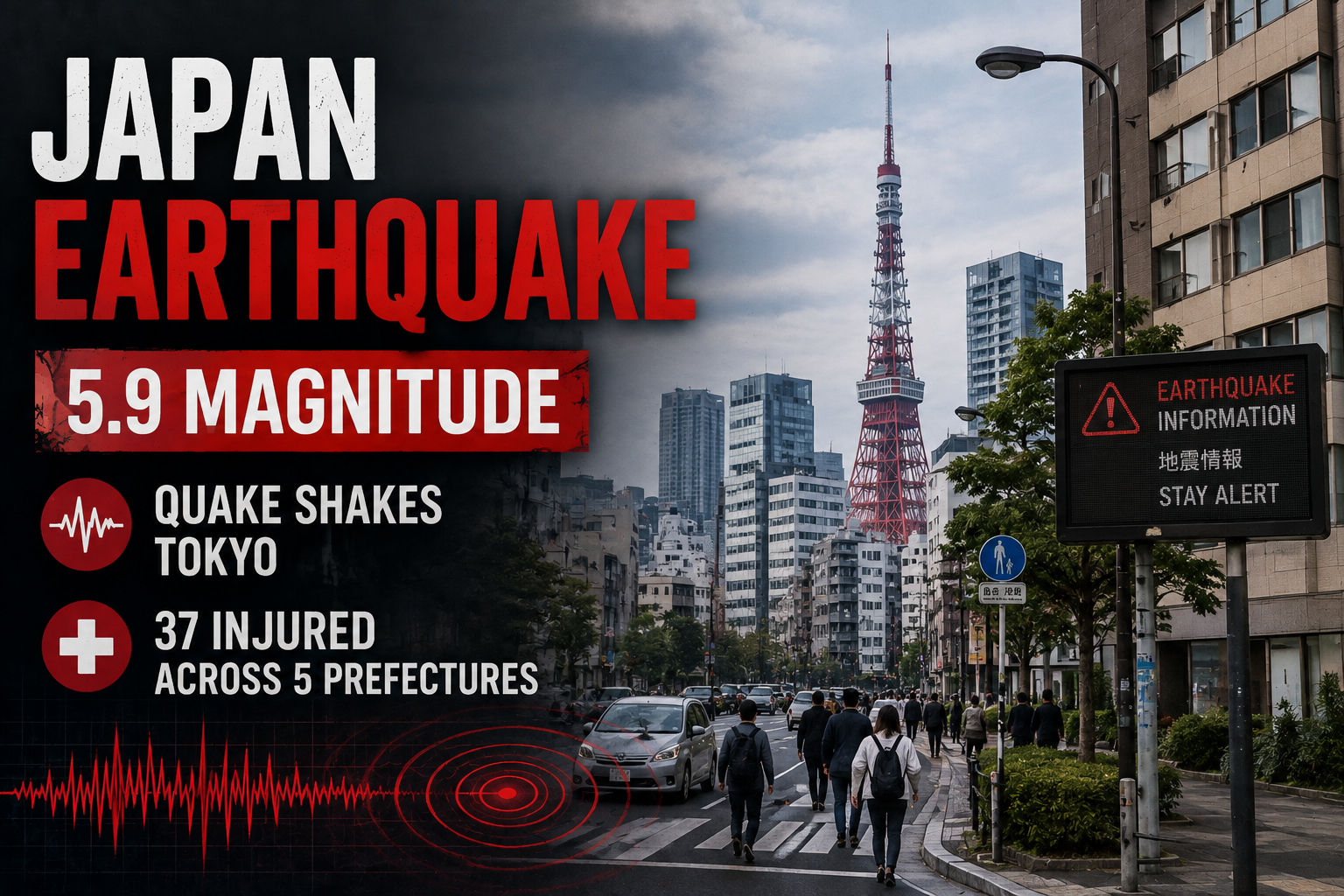
A magnitude 5.9 earthquake struck eastern Japan early on Sunday, August 23, 2026, jolting millions of people awake across the greater Tokyo region. The quake injured at least 37 people, ruptured a water pipe in central Tokyo, triggered blackouts in parts of the capital, and disrupted train services during the early morning hours.
No deaths have been reported. No tsunami warning was issued.
Where and When Did the Earthquake Strike?
The earthquake hit at 2:00 AM local time, with its epicenter located in southern Ibaraki Prefecture, roughly 38 kilometers east of Saitama and about 40 to 50 kilometers northeast of central Tokyo. The Japan Meteorological Agency (JMA) recorded the quake at a preliminary magnitude of 5.9, while the United States Geological Survey (USGS) estimated it at 5.8. The quake occurred at a depth of approximately 68 to 70 kilometers.
Shaking registered at an intensity of lower 5 on Japan’s 7-point shindo seismic scale in Tokyo’s Adachi Ward, as well as in parts of Ibaraki, Saitama, and Chiba prefectures. Level 4 shaking was recorded across other parts of Tokyo and in Tochigi, Gunma, and Kanagawa prefectures. At lower 5 intensity, objects fall from shelves and people instinctively grab onto something for support. In some areas, the shaking lasted up to a full minute.
Emergency earthquake alert systems went off on mobile phones seconds before the tremors hit, waking residents across the region with loud sirens and public announcements.
Injuries Across 5 Prefectures
Japan’s Fire and Disaster Management Agency confirmed that at least 37 people were injured across 5 prefectures. Tokyo recorded 15 injuries. Saitama reported 9. Kanagawa had 8. Chiba saw 4, and Ibaraki had 1.
Most of the injuries were minor. People were caught off guard while sleeping and fell out of bed, or hit themselves against furniture and doors while trying to move in the dark. The most serious case involved a woman in her 80s in Yokohama, Kanagawa Prefecture, who fell off her bed and suffered a hip injury that required hospital treatment.
In Tokyo, fire officials received reports of people trapped inside elevators after the shaking knocked out power to the lift systems. Minor injuries were also reported in the city of Kawasaki, south of the capital, where 3 people were hurt.
Damage to Infrastructure
An underground water pipe ruptured in the Kiyosumi area of Tokyo’s Koto Ward shortly after the quake. Video footage showed water pouring across the road surface. Repair crews were dispatched, and the leak was stopped later in the morning.
In the city of Ushiku in Ibaraki Prefecture, part of the ceiling at the city hall building collapsed. No one was reported inside the building at the time.
Around 460 homes in Tokyo lost electricity, according to TEPCO Power Grid. Power was restored to all affected households by Sunday morning.
The JMA also recorded long-period ground motion of Class 2 in Tokyo’s 23 wards, as well as in parts of Saitama and Chiba prefectures. Long-period seismic waves travel slowly and cause tall buildings to sway for longer periods, even after the strongest shaking has stopped. Residents in high-rise apartments and offices would have felt prolonged movement, with furniture and fixtures shifting on upper floors.
Train Services Hit Hard
The earthquake disrupted rail services across the Kanto region during early morning hours. JR East reported delays and speed restrictions on several key lines, including the Joban, Keihin-Tohoku, Shonan-Shinjuku, Musashino, Chuo-Sobu, and Sotobo lines. Express trains connecting Tokyo to Narita Airport were also delayed.
However, Shinkansen bullet trains continued to run on schedule, according to East Japan Railway Co. Most local services were back to normal by Sunday morning after safety inspections cleared the tracks.
Nuclear Facilities and Government Response
Japan’s Nuclear Regulation Authority confirmed that no abnormalities were detected at approximately a dozen nuclear power plants and other nuclear-related facilities across the region. Operators at the Tokai No. 2 plant in Ibaraki Prefecture, as well as the Fukushima Daiichi and Fukushima Daini stations in northeastern Japan, all reported normal operations following the quake.
Within an hour of the earthquake, Prime Minister Sanae Takaichi posted on X that efforts were underway to confirm the extent of the damage. She announced that a liaison office had been established at the Prime Minister’s Office Crisis Management Center. A government task force was set up to assess possible damage across the affected region.
Takaichi urged residents in areas that experienced strong shaking to remain alert. “I ask that you continue to remain vigilant for the possibility of another earthquake of similar magnitude,” she said.
The JMA backed that warning, advising residents to stay cautious for at least the next week. The agency noted that another moderate quake of similar strength could follow in the coming days.
A Nervous Nation After Kumamoto
Today’s earthquake comes less than a month after a far more destructive 7.1 magnitude quake struck Kumamoto Prefecture on Japan’s southern island of Kyushu on July 28. That disaster killed at least 39 people, injured over 360, destroyed more than 1,500 buildings, and damaged nearly 20,000 others. Over 6,000 people were still living in evacuation shelters as of mid-August.
The back-to-back earthquakes have put the country on edge. The wider Asia-Pacific region has also seen destructive seismic events this year, including a 7.7 magnitude quake off Indonesia’s Flores Island that killed at least 20 people. Japan sits at the junction of 4 major tectonic plates on the Pacific Ring of Fire, making it one of the most seismically active nations on the planet. The country records thousands of earthquakes every year. Roughly 10% of all quakes worldwide with a magnitude of 6 or higher occur in or around Japan.
Strict building codes, regular drills, and one of the most advanced early warning systems in the world have helped keep casualties low in moderate quakes like today’s. The alert that sounded on millions of mobile phones seconds before the shaking began gave residents just enough time to brace for impact. But for a nation still processing the losses from Kumamoto, every new tremor carries a weight that numbers alone cannot capture.