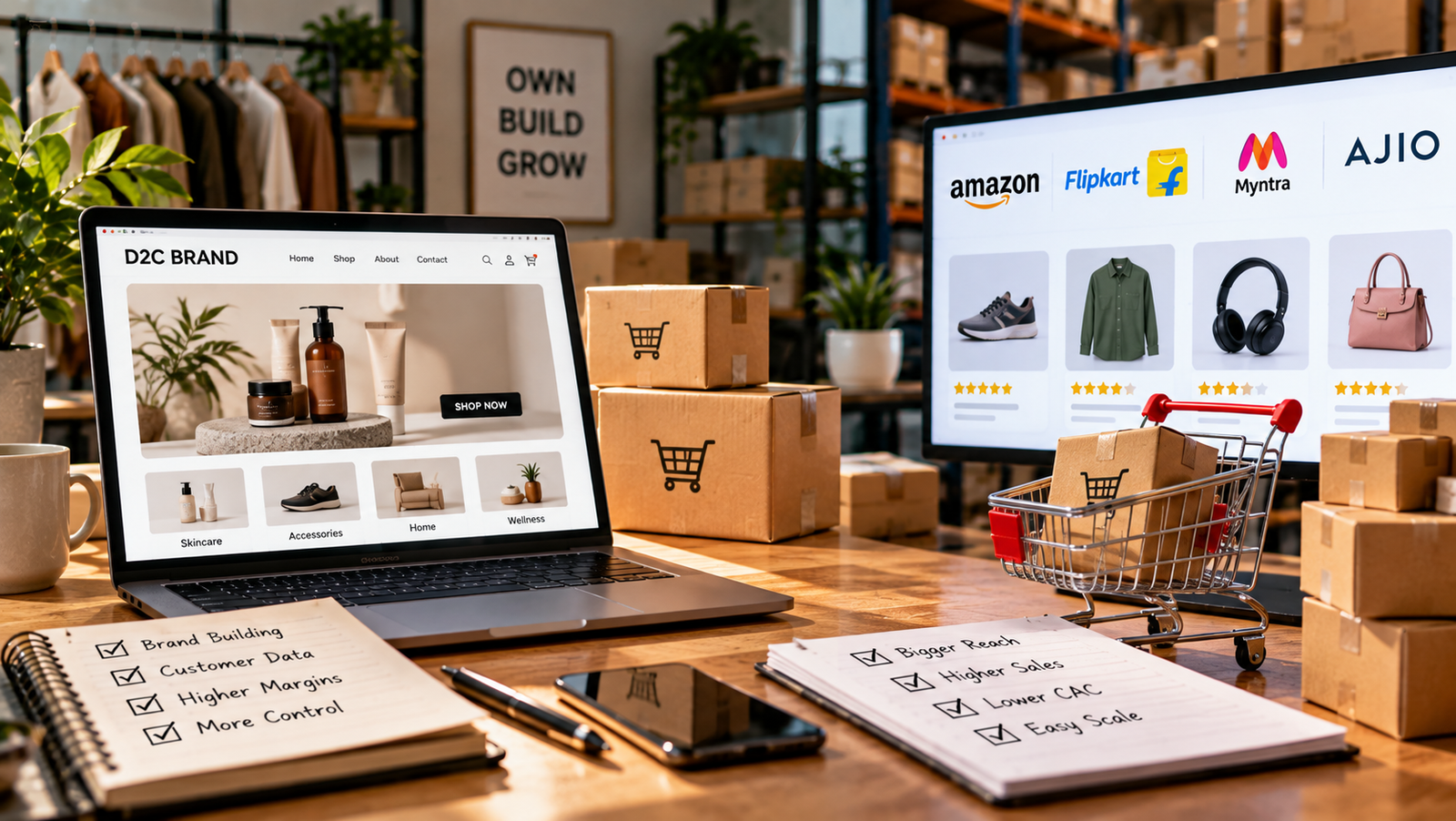
For the last five years, every founder pitch deck in India carried the same line: “We’re going direct-to-consumer.” Marketplaces were the villain. Commissions were killing margins. Amazon owned your customer. Flipkart owned your data. The only path to a real brand, apparently, was your own website, your own checkout, and your own Meta ad account.
Then something quiet happened. The same D2C brands that spent crores building standalone stores are now stocking their listings back on Amazon, Flipkart, Myntra, and Nykaa. Some are even shutting their own sites down. If you’re planning your 2026 strategy, this shift matters more than the LinkedIn thought-leader crowd is admitting. Before we dig in, if you’re new to the ecosystem, the complete guide to selling online in India in 2026 is a solid map of the platforms, logistics partners, and margin math behind every decision below.
The D2C Dream vs the D2C Reality
The pitch was seductive. Cut out the middleman, own the customer, keep the margin. Somewhere between 2019 and 2023, thousands of Indian brands built Shopify stores, hired a performance marketing agency, and started buying Meta ads at ₹40 CPMs.
It worked. For a while.
Then Meta ad costs tripled. iOS 14.5 broke attribution. Return rates on cash on delivery orders climbed above 30 percent. Warehousing was eating 8-12 percent. Payment gateway fees: 2 percent. Tech stack subscriptions, another lakh a month. Suddenly the “commission-free” model was paying 45 percent to Zuckerberg instead of 25 percent to Bezos.
What Actually Changed in 2025 and 2026
Three shifts pushed brands back to marketplaces, and none of them made headlines the way the D2C boom did.
1. Customer Acquisition Cost Broke the Model
A category-agnostic number worth remembering: CAC on Meta and Google for most Indian D2C brands has moved from ₹250-400 in 2021 to ₹900-1,600 in 2026. For a product with a ₹1,200 AOV and 40 percent gross margin, you’re losing money on the first order. You need repeat purchases to survive, and most D2C repeat rates in India sit under 20 percent.
2. Marketplaces Got Better (Quietly)
Amazon’s Brand Registry, A+ content, Sponsored Brand Video, and Posts feature now let sellers do something they couldn’t do in 2019: tell a brand story inside the marketplace. Flipkart’s Shopsy, Myntra’s M-Now 30-minute delivery, and Nykaa’s influencer engine have turned platforms into destinations, not just search boxes.
3. The Trust Gap Widened
An Indian shopper in a Tier 2 city will happily spend ₹3,000 on Amazon at 11 pm. Getting them to do the same on a brand they’ve never heard of, on a Shopify checkout, at the same hour, is a different battle. Amazon’s return promise is worth 15 percent conversion on its own.
The Brands Quietly Reversing Course
Look at the category leaders. Beauty brands that once refused to list on Nykaa are now running their launch SKUs there first. Apparel labels that swore off Myntra are back with exclusive collections. Personal care founders who spent 2022 on stage bashing Amazon are now running Amazon Live sessions themselves.
The pattern is consistent:
- Own website kept alive, but treated as a brand showroom, not the primary revenue engine
- 60-75 percent of GMV shifted back to marketplaces
- Performance marketing budget cut by half and redirected to Amazon Ads and Flipkart PLA
- Quick commerce (Blinkit, Zepto, Instamart) treated as a third pillar
The Real Math: Why Marketplaces Win Again
Let’s take an honest, unglamorous comparison for a ₹1,000 product.
| Cost Head | D2C (Own Site) | Amazon FBA |
|---|---|---|
| Customer acquisition | ₹350 | ₹80 (Ads + organic) |
| Payment gateway | ₹20 | Included |
| Shipping | ₹75 | Included in FBA fee |
| RTO/returns | ₹90 (blended) | ₹40 |
| Platform/commission | ₹0 | ₹150 (15%) |
| Tech stack (allocated) | ₹30 | ₹0 |
| Total cost per order | ₹565 | ₹270 |
That’s a rough back-of-the-envelope, but it tracks with what most category founders will admit off the record. The “marketplace tax” is real, but so is the D2C tax, and no one wanted to name it.
What This Means If You Are Selling Online in 2026
Whether you’re a first-time seller with a single SKU or a Series A brand doing ₹40 crore a year, the strategy has changed. The purist “D2C-only” model and the old “marketplace-only” model are both dead. What’s working is a layered stack, and the sequence you build it in matters more than most founders realise. If you want the operational side (which marketplace to start with, warehousing options, how to handle returns), the 2026 platform and logistics breakdown covers the pieces below in detail.
Start Where Discovery Happens
For 90 percent of new brands, that’s Amazon or the category-native marketplace: Myntra for apparel, Nykaa for beauty, FirstCry for kids. Your first 1,000 customers should come from a place where trust is already built.
Build the Website as a Brand Layer, Not a Sales Layer
Your own site is where you tell the story, run subscriptions, launch limited drops, and reward loyalists. It doesn’t have to carry 100 percent of your GMV to be worth the effort. Twenty to thirty percent is a healthy number for most categories.
Treat Quick Commerce as a Distinct Channel
Blinkit and Zepto are not “another marketplace.” They’re a different shopping occasion: impulse, top-up, forgot-something. Packaging, pricing, and pack sizes may need to change. Don’t just copy-paste your Amazon listings.
Own the Data You Can, Rent the Rest
Marketplaces won’t hand over customer emails. Accept it. Use insert cards, QR codes, and post-purchase WhatsApp flows to pull buyers into a first-party relationship where the second and third purchase can happen on your terms.
The Contrarian Read
Everyone still talking about “pure D2C” in 2026 is either running a very high AOV, very high margin category (think ₹8,000 skincare kits or ₹15,000 furniture), or hasn’t looked at their P&L closely enough. For everyone else, marketplaces aren’t a compromise. They’re the smartest, cheapest customer acquisition channel available, and the founders quietly leaning back into them are the ones still hitting profitability targets.
The D2C brand isn’t dying. The D2C-only brand is.
What to Do This Quarter
If you’re a seller reading this and wondering whether it’s too late to shift, it isn’t. Three moves make sense in the next 90 days:
- Audit your CAC honestly. Include content, agency fees, and creative production, not just ad spend.
- Pick one marketplace where your category already sells well. List 3-5 hero SKUs with proper A+ content and start with Sponsored Products.
- Move quick commerce from “someday” to “this quarter” if your product fits the impulse or replenishment pattern.
The brands winning in 2026 aren’t the ones with the prettiest websites. They’re the ones showing up wherever the customer is already scrolling, whether that’s Amazon at midnight, Zepto at 8 am, or Myntra during the End of Reason Sale. If you want the fuller playbook, including the current commission structures, logistics partners, and platform-by-platform pros and cons, the Must Read Digest guide to selling online in India in 2026 is the resource I’d point every founder to first. The channel wars are over. The channel mix is what pays.