India’s online retail market is not just growing. It is exploding. With over 350 million active online shoppers, digital payments becoming the default, and tier 2 and tier 3 cities finally catching up, 2026 is shaping up as the single best year to start selling online in India.
But here is the thing. Starting an online business in India is easy. Making it profitable is a completely different challenge. Between platform commissions, GST compliance, logistics headaches, and intense competition, most new sellers either burn through cash or give up within the first six months.
This guide is designed to fix that. Whether you are a first-time seller figuring out which platform to pick, a small business owner looking to go digital, or someone with a product idea and zero experience, this article walks you through every decision you need to make, every cost you need to plan for, and every trap you need to avoid.
No fluff. No generic advice. Just what actually works in 2026.
India’s Ecommerce Market in 2026: The Numbers That Matter
Before you invest a single rupee, it helps to understand the size of the opportunity you are stepping into.
India’s ecommerce market is projected to reach approximately $200 billion in 2026, growing at over 12% year on year. That makes it one of the fastest growing digital retail markets anywhere in the world. But the raw market size only tells part of the story. What matters more for sellers is where that growth is coming from.
Three trends are driving the surge.
Tier 2 and tier 3 cities are the new growth engine. About 50% of all incremental ecommerce orders now come from smaller cities. Places like Jaipur, Lucknow, Coimbatore, Indore, and Bhopal are not afterthoughts anymore. They are primary markets. If your product catalog only speaks to metro buyers, you are leaving half the market on the table.
Gen Z is running the show. Shoppers between 18 and 27 account for roughly 40% to 45% of all online buyers in India and nearly half of all new orders. These buyers are mobile first, heavily influenced by social media, and far more comfortable with online payments than any generation before them.
Quick commerce is rewriting expectations. The quick commerce segment, led by Blinkit, Swiggy Instamart, and Zepto, has crossed the $6 billion to $7 billion mark. Over 8 million daily active users now expect deliveries within 10 to 30 minutes. Even if you are not selling groceries, this speed expectation is spilling over into every product category. Customers want things fast, and platforms that deliver faster get rewarded with repeat purchases.
For context on how India’s broader economic fundamentals are powering this digital boom, take a look at our deep dive into India’s economy in 2026 and the real story behind the growth numbers.
Legal Essentials: What You Need Before You List a Single Product
This is the section most guides rush past, and it is exactly where most new sellers get tripped up. India’s ecommerce regulations are not optional, and platforms enforce them strictly.
GST Registration Is Non-Negotiable
If you plan to sell on any marketplace, whether it is Amazon, Flipkart, Meesho, or even ONDC, you need a GSTIN. Under Section 24 of the CGST Act, GST registration is mandatory for anyone supplying goods or services through an ecommerce operator, regardless of turnover.
Read that again. Even if your monthly sales are just a few thousand rupees, you still need to register. The usual turnover exemptions of 40 lakh for goods and 20 lakh for services do not apply to marketplace sellers.
Every major platform, from Amazon to Flipkart to Meesho, requires a valid GSTIN before they activate your seller account. Payment gateways will also freeze settlements if your GST details are missing or mismatched.
The registration process itself is straightforward. You apply through the GST portal at gst.gov.in with your PAN, Aadhaar, address proof, bank account details, and a photograph. Once verified, you receive your GSTIN, and you are ready to go.
Once registered, you will need to file GSTR-1, GSTR-3B, and the annual GSTR-9 returns. Marketplaces also collect 1% TCS (Tax Collected at Source) on the net value of your sales, which gets deposited with the government and appears in your GSTR-2A for you to claim.
Other Documentation You Will Need
Beyond GST, here is what you should have ready before onboarding on any platform.
- PAN card of the business entity or proprietor
- Current bank account in the business name
- Trade license or Shop Act registration (required in many states)
- Brand authorization letter or trademark certificate if you are selling branded products
- FSSAI license if you are selling food, beverages, or supplements
Getting these sorted before you start saves weeks of delays and back-and-forth with platform support teams later.
Choosing Your Platform: Where Should You Actually Sell?
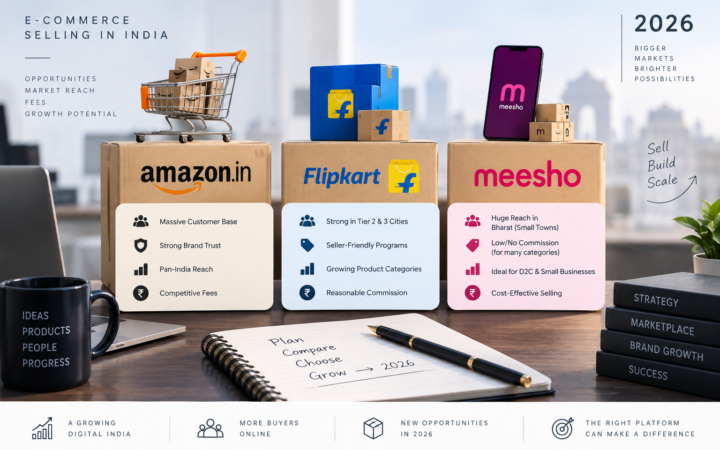
This is the biggest decision you will make, and it is not one-size-fits-all. Each platform attracts a different kind of buyer, charges different fees, and rewards different types of sellers. Here is an honest breakdown of the major options in 2026.
Amazon India
Amazon remains the go-to marketplace for sellers targeting premium and metro customers. It offers unmatched logistics infrastructure through Fulfillment by Amazon (FBA), which handles storage, packing, and delivery for you. The platform dominates in electronics, books, premium personal care, and private label products.
The tradeoff? Fees are significant. Between referral commissions, closing fees, FBA charges, and advertising costs, your effective margin on a product priced under 500 rupees can shrink fast. Amazon works best when your product has at least a 40% to 50% gross margin before platform fees.
Amazon has also moved to 0% commission on most products priced under 1,000 rupees, which helps lower-priced SKUs, though other charges still apply.
Flipkart
Flipkart is India’s largest homegrown marketplace and leads in online revenue. It is particularly strong in mobile phones, electronics, appliances, and fashion. Where Amazon skews metro, Flipkart has deeper penetration in tier 2 and tier 3 markets, which makes it a better choice if your audience is outside the top 8 cities.
Flipkart’s logistics arm, Ekart, provides solid delivery coverage, and the platform’s massive sale events like Big Billion Days can generate enormous volumes for well-prepared sellers. Fee structures are comparable to Amazon, with category-specific referral fees plus fixed and collection charges.
Meesho
Meesho is the platform most often underestimated by serious sellers, and that is a mistake. With over 160 million app users and a genuine zero-commission model across most categories, Meesho has created a unit economics story that no other marketplace can match for products priced under 500 rupees.
The platform thrives on ultra-affordable listings in fashion, kitchen items, cosmetics, and home accessories. Its reseller model has plugged millions of first-time sellers and buyers into the digital economy, especially in smaller cities. Some categories even allow sellers without a GSTIN, though this is limited to select products like fashion accessories and handcrafted items.
Meesho is best treated as a volume play. Margins per unit are thin, but the sheer order volume and low operational costs make it viable for sellers who can source cheaply and ship efficiently.
Your Own D2C Store (Shopify, WooCommerce)
Running your own store is the dream for most sellers, and for the right business, it delivers. Margins of 40% to 60% are achievable when you own the customer relationship and do not pay marketplace commissions.
Shopify is the most popular choice for D2C brands in India, thanks to its ease of use, pre-built templates, and strong app ecosystem. WooCommerce is a solid alternative if you want more customization and are comfortable with WordPress. Monthly costs for either range from 1,500 to 3,000 rupees, depending on your setup.
But here is the catch that most guides do not mention: every single visitor to your store has to be earned. You are paying for traffic through ads, SEO, influencer partnerships, or social media, and that customer acquisition cost adds up fast. A D2C store works best when you have a differentiated brand story, a product with repeat purchase potential, and a marketing budget you are willing to invest for 6 to 12 months before expecting meaningful returns.
India now has over 800 D2C brands generating over 100 crore in annual revenue, so the model clearly works at scale. But it demands patience and capital that a marketplace listing does not.
ONDC: The Government’s Big Bet
The Open Network for Digital Commerce is the Indian government’s initiative to break marketplace monopolies and create an open, interoperable commerce layer. Think of it as UPI for ecommerce. Any seller can connect through a seller app and be discoverable across multiple buyer apps, without being locked into any single platform.
ONDC’s commission structure is the lowest in the market, ranging from 0% to 3%. Registration requires a PAN, GSTIN, bank account, and Aadhaar. The network crossed 16 million monthly orders in mid-2025, and while it is still early, the strategic direction is clear.
For MSMEs and local businesses, ONDC offers a low-cost entry point into digital selling without the heavy fee burden of traditional marketplaces. It is worth setting up alongside your primary channel, even if it does not drive large volumes yet.
What Actually Sells Online in India in 2026
Choosing the right product is more important than choosing the right platform. You can pick the perfect marketplace and still fail if you are selling something nobody wants or something with razor-thin margins. Here is what the data tells us about the categories that are consistently performing well.
Fashion and Apparel
Clothing remains the single largest segment in Indian ecommerce, accounting for roughly 35% of all online sales revenue. Women’s ethnic wear, men’s casual clothing, and children’s apparel lead the pack. Return rates in fashion are high, sometimes exceeding 25% to 30%, so pricing needs to factor in that cost from day one.
Mobile Phones and Electronics
Smartphones and accessories generate the highest sales volumes on platforms like Flipkart and Amazon. However, margins are extremely thin unless you are selling accessories like cases, screen protectors, chargers, and earphones, where markups are healthier and the volume is massive.
Beauty and Personal Care
Sunscreens, serums, hair oils, and natural lip balms are moving fast, especially when ingredient lists are transparent and clearly displayed. Ayurvedic and natural skincare brands have a built-in advantage in India, and this category also performs well with NRI buyers internationally.
Health and Wellness
From protein supplements and fitness equipment to immunity boosters and organic teas, health products are seeing consistent demand. The post-pandemic focus on personal health has not faded, and consumers are willing to pay a premium for trusted brands in this space.
Home Decor and Kitchen
Items like storage organizers, kitchen gadgets, wall art, and bedding are solid performers, especially on Meesho and Amazon. These products tend to have lower return rates than fashion and decent margins if sourced well.
Digital Products
Templates, ebooks, online courses, design presets, and productivity tools like Notion dashboards require almost no inventory investment and have near-zero marginal costs. For creators and educators, digital products are one of the most profitable things you can sell online in 2026.
A smart approach is to start with one or two categories where you can source competitively, test demand, and then expand based on what the numbers tell you, not on gut feeling.
Logistics: Getting Products to Customers Without Losing Money
Shipping can make or break an ecommerce business in India. On thin margins, the difference between a profitable order and a loss-making one often comes down to three things: shipping cost, packaging weight, and whether the customer returns the product.
The Major Logistics Players
If you are selling on Amazon, Fulfillment by Amazon handles everything, but at a price. For Flipkart, their Ekart logistics network provides similar infrastructure. But if you are selling on Meesho, ONDC, your own D2C store, or across multiple channels, you need to sort out your own logistics.
The big names in Indian ecommerce logistics include Delhivery, Blue Dart, Ecom Express, XpressBees, and DTDC. Each has different strengths. Delhivery has the widest network and strongest tech integration. Blue Dart is known for express and same-day delivery in metro areas. XpressBees offers competitive pricing for high-volume sellers.
Why Shipping Aggregators Matter
The smartest move for most sellers, especially when starting out, is to use a shipping aggregator rather than locking into a single courier. Aggregators like Shiprocket, NimbusPost, and Eshopbox bundle multiple courier partners into a single dashboard, letting you compare rates across carriers for every shipment based on destination, weight, and speed.
Shiprocket, for example, integrates with over 25 courier partners and offers fulfillment services where you can store inventory in their warehouses for faster delivery. Rates start as low as 16 rupees per order with some providers. Different pin codes and weight slabs have different optimal carriers, so the ability to switch dynamically is a genuine cost saver.
Managing Returns
Returns are the silent margin killer. In India, around 81% of online shoppers have returned something they bought in the past year. Fashion has the highest return rates, while electronics and home goods tend to be more manageable.
Reducing returns starts with accurate product descriptions, high-quality images from multiple angles, clear size charts for apparel, and honest reviews. On the logistics side, using a reverse logistics provider that handles returns efficiently and offers RTO (Return to Origin) protection can save significant money at scale.
Payments: UPI, COD, and What Indian Buyers Actually Prefer
The payments landscape in India has transformed dramatically, and understanding it is critical for your pricing and cash flow planning.
UPI now dominates online payments with roughly 73% of all ecommerce transactions. Cash on delivery, which used to be the default for most Indian online shoppers, has dropped to about 18%. Credit and debit cards, net banking, and wallet payments fill the rest.
For marketplace sellers, payments are handled by the platform. Your settlements typically come in 7 to 15 day cycles, depending on the marketplace and whether the order was prepaid or COD.
If you are running a D2C store, integrating a payment gateway like Razorpay, Cashfree, or PayU is essential. All of them support UPI, cards, and EMI options. Transaction fees usually range from 1.5% to 2% per payment. Offering multiple payment options, especially UPI and no-cost EMI for higher-ticket items, directly improves your conversion rate.
COD still matters for reaching new customers in smaller cities where trust in online payments is still building. But COD orders carry higher risk because of non-delivery attempts and returns. Many experienced sellers offer a small discount for prepaid orders to nudge buyers toward online payment.
Marketing: How to Get Your First 100 (and First 1,000) Customers
Listing a product is not selling a product. Whether you are on a marketplace or running your own store, you need a plan to get eyeballs on your listings.
On Marketplaces
Your product listing is your storefront. Invest time in writing keyword-rich titles, detailed bullet points, and clear product descriptions. Use high-resolution images with white backgrounds and lifestyle shots that show the product in use.
Amazon and Flipkart both offer sponsored product ads that work on a cost-per-click basis. Start with a modest daily budget of 200 to 500 rupees, target your most competitive products, and scale based on the ACOS (advertising cost of sale) numbers. A healthy ACOS for most categories falls between 15% and 25%.
Collect reviews aggressively in the early days. Products with 15 or more reviews consistently convert better than those with fewer. Follow up with buyers politely and make the review process easy.
For D2C Stores
Your customer acquisition toolkit is broader but also more expensive. The core channels that work for Indian D2C brands in 2026 include Instagram and Facebook ads, Google Search and Shopping ads, influencer collaborations (micro-influencers with 10,000 to 50,000 followers often deliver better ROI than big names), WhatsApp marketing for repeat purchases and abandoned cart recovery, and SEO-driven content marketing that brings in organic traffic over time.
The typical customer acquisition cost for a new D2C brand in India ranges from 200 to 800 rupees, depending on the product category and competition. Plan for this in your unit economics from the start, not as an afterthought.
India’s startup ecosystem has created a massive support network for new online businesses. If you want to understand the broader landscape of how Indian startups and small businesses are scaling, our coverage of India’s startup growth over the last decade provides useful context.
Financial Planning: What It Actually Costs to Start Selling Online
One of the biggest misconceptions about selling online is that it is free. It is not. Here is a realistic breakdown of what you should budget for.
GST registration: Free if you do it yourself through the portal, or 1,000 to 3,000 rupees if you hire a CA to handle it.
Product sourcing and initial inventory: This varies wildly by category, but plan for at least 20,000 to 50,000 rupees for a small initial batch if you are selling physical products.
Platform fees: Zero upfront for marketplaces. Commissions are deducted from your settlements. For Shopify, expect around 2,000 to 5,000 rupees per month. WooCommerce hosting starts at about 300 to 500 rupees per month.
Product photography: Professional photos cost 200 to 500 rupees per product. You can do it yourself with a smartphone and a ring light, but quality matters more than most new sellers realize.
Packaging: Branded packaging with your logo, thank-you cards, and proper protective material runs 15 to 40 rupees per order, depending on the product size.
Advertising budget: Start with at least 5,000 to 10,000 rupees per month for marketplace ads or social media campaigns. Scale based on returns.
Shipping: Varies by weight, distance, and carrier. Expect 30 to 100 rupees per order for standard domestic shipping through an aggregator.
All in, a realistic starting budget for a small marketplace-based business is 50,000 to 1,00,000 rupees. For a D2C store with paid marketing, budget 1,50,000 to 3,00,000 rupees for the first three months.
Getting your financial foundation right from the start makes everything else easier. For a broader perspective on managing money and building wealth alongside your business, our guide on investing in India from your first SIP to long-term wealth is worth reading.
Common Mistakes That Kill New Ecommerce Businesses
After looking at hundreds of seller stories and industry reports, the same patterns keep showing up. Here are the mistakes that trip up the most people.
Skipping GST registration and compliance. This is not something you can figure out later. Platforms will block you, and the penalties for non-compliance add up quickly.
Choosing products based on gut feeling instead of data. Use tools like Google Trends, Amazon Best Seller lists, and keyword research to validate demand before you invest in inventory. What feels like a great idea is often a category with brutal competition or tiny margins.
Ignoring return rates in your pricing. If your category has a 25% return rate and you have not priced for that, you will lose money on every fourth order. Factor in returns, shipping both ways, and restocking costs from the start.
Spreading too thin across platforms. Start with one or two channels, master them, and then expand. Trying to manage listings, inventory, and customer service across five platforms simultaneously is a recipe for operational chaos.
Underinvesting in product images and descriptions. Your listing is the only thing standing between your product and the back button. Low-quality images, vague descriptions, and missing size or specification details kill conversion rates.
Not tracking unit economics. Know your cost per unit, platform fees, shipping cost, return rate, and customer acquisition cost for every product. If the math does not work at a unit level, volume will not save you. It will just make you lose money faster.
The Road Ahead: What Is Coming Next for Indian Ecommerce
Several shifts are worth watching as you build your business through 2026 and beyond.
ONDC will continue to scale. The government is committed to the open commerce model, and as more buyer and seller apps join the network, it will become a serious channel for MSMEs. Early movers who establish a presence now will have an advantage as the network matures.
Social commerce is becoming a real channel. Selling directly through Instagram, WhatsApp, and YouTube is growing fast, especially for fashion, beauty, and handmade products. Platforms are making it easier to close transactions without leaving the app.
AI is reshaping the seller experience. From AI-powered product descriptions and pricing recommendations to automated customer service chatbots and demand forecasting, the tools available to small sellers in 2026 are better than what large companies had five years ago.
Sustainability is becoming a selling point. Consumers, especially younger buyers, are increasingly looking for eco-friendly packaging, responsibly sourced products, and brands that stand for something beyond profit. Building sustainability into your brand story early gives you a competitive edge that is hard to replicate.
The fee war between platforms is structural. As ONDC lowers switching costs and quick commerce opens new channels, marketplaces are competing harder than ever for seller participation. Expect further fee reductions, faster settlements, and more tools for small sellers across all major platforms.
Final Thoughts
Selling online in India in 2026 is not a get-rich-quick opportunity. It is a real business that requires real planning, consistent effort, and a willingness to learn from data rather than assumptions.
The opportunity is enormous. A $200 billion market with 350 million shoppers, growing at double digits, with half the growth coming from cities and towns that were barely online five years ago. The tools, platforms, and logistics infrastructure available today make it possible for anyone with a good product and a solid plan to build a profitable online business.
Start with the basics. Get your GST sorted. Pick one platform. Choose a product based on data, not hype. Price it right. Ship it fast. Collect reviews. Reinvest profits into better inventory and smarter marketing.
That is the playbook. The rest is execution.