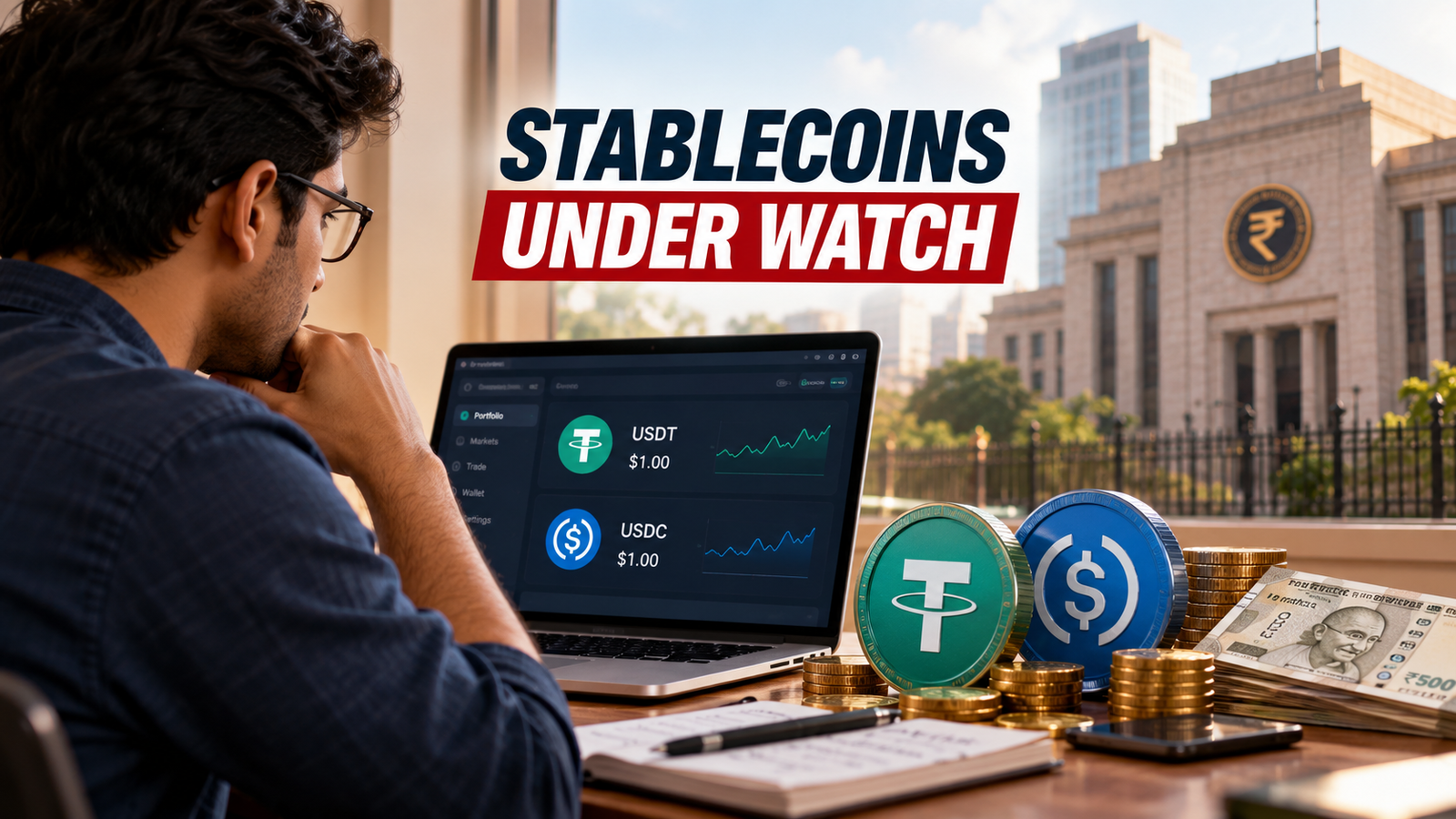
Ask a crypto trader in Bengaluru or Pune what they actually hold, and there is a good chance the answer is not Bitcoin. It is USDT. Stablecoins have quietly become the plumbing of Indian crypto. They are where people park money between trades, how some freelancers get paid by overseas clients, and the go-to escape hatch when everything else in the market is bleeding red.
If you are still getting your bearings, our complete guide to crypto in India in 2026 covers the legal and tax basics. This piece zooms in on one narrower question: what stablecoins really are, and why the Reserve Bank of India keeps bringing them up in speeches and reports.
What Is a Stablecoin, in Plain Terms?
A stablecoin is a crypto token designed to hold a fixed value, almost always one US dollar. Bitcoin can swing 8% before lunch. A stablecoin is supposed to sit at $1.00 on Monday, $1.00 on Friday, and $1.00 next year.
How it holds that price depends on what sits behind it:
- Fiat-backed: The issuer holds cash and short-term US Treasury bills roughly equal to the tokens in circulation. USDT and USDC work this way.
- Crypto-backed: Tokens like DAI are backed by other crypto, locked up at more than 100% of their value to absorb price drops.
- Algorithmic: These try to hold the peg with code and incentives instead of reserves. The most famous one, TerraUSD, collapsed in May 2022 and wiped out roughly $40 billion in value within days.
The simplest way to think about a fiat-backed stablecoin: it is a digital IOU for a dollar, issued by a private company, that moves on a blockchain 24 hours a day without asking any bank for permission.
That last part is the whole story, as you will see.
USDT vs USDC: Same Dollar, Different Promises
Both tokens target $1. Both are backed mostly by cash and Treasuries. But the companies behind them run very different playbooks.
USDT (Tether)
Tether is the biggest stablecoin in the world by a wide margin, and it dominates trading on Indian exchanges and peer-to-peer (P2P) desks. It has the deepest liquidity and works on almost every blockchain.
The catch has always been transparency. Tether publishes quarterly attestations, not a full independent audit, and it paid a $41 million settlement to the US Commodity Futures Trading Commission in 2021 over past claims about its reserves. It has kept its peg through several crises, but trust in USDT rests more on track record than on paperwork.
USDC (Circle)
USDC is issued by Circle, a US company that went public in 2025. It leans hard into regulation: monthly reserve reports checked by a major accounting firm, and reserves held largely in a fund managed by BlackRock.
It is not bulletproof, though. In March 2023, when Silicon Valley Bank failed, Circle had $3.3 billion stuck there. USDC briefly dropped to around 87 cents before recovering. Even the “clean” stablecoin depends on the banking system underneath it.
| Feature | USDT (Tether) | USDC (Circle) |
|---|---|---|
| Market size | Largest by far | Second largest |
| Reserve reporting | Quarterly attestations | Monthly attestations |
| Regulatory posture | Offshore, lighter touch | US-regulated, compliance-first |
| Popularity in India | Dominant on exchanges and P2P | Smaller, growing slowly |
| Biggest scare | Reserve questions, 2021 CFTC fine | SVB depeg, March 2023 |
How Indians Actually Use Stablecoins
Very few Indians buy USDT hoping it goes up. It is not supposed to. People use it as a tool:
- A parking spot: Traders sell Bitcoin or altcoins into USDT instead of cashing out to rupees, which avoids bank delays and keeps money ready for the next trade.
- Getting paid from abroad: Some freelancers and remote workers accept USDT from foreign clients because it lands in minutes, not days, and skips wire fees.
- A dollar hedge: When the rupee weakens, holding a dollar-pegged token feels like holding dollars, minus the paperwork of a foreign bank account.
- Cross-border transfers: Sending USDT to family or business contacts abroad is faster than most bank routes.
Read that list again with a central banker’s eyes. Nearly every use case is a way of moving money around rules that exist for a reason.
The Capital Controls Angle Nobody Explains
India does not have a fully convertible rupee on the capital account. In simple terms, you cannot freely move unlimited money out of the country. The rules come from FEMA, the Foreign Exchange Management Act.
Here is how the official route works:
- Under the Liberalised Remittance Scheme (LRS), a resident can send up to $250,000 a year abroad.
- Every rupee goes through an authorised bank, which reports it.
- Tax Collected at Source (TCS) kicks in on many remittances above ₹10 lakh a year.
- The purpose of the transfer has to be declared and permitted.
Now compare that with a stablecoin. You buy USDT with rupees on an Indian app, move it to a private wallet, and send it anywhere on earth in under a minute. No bank declares the purpose. No LRS counter ticks up. No TCS is collected on the transfer itself.
That is why a stablecoin is, functionally, a dollar account that lives outside the banking system. For a country that manages its currency carefully, that is a big deal. If you want to understand why the RBI guards the rupee’s exchange rate so closely in the first place, this explainer on why currencies rise and fall lays out the forces at play.
One telling detail: on Indian P2P markets, USDT often trades a few rupees above the official dollar rate. That premium is basically the price people are willing to pay for a dollar that comes without paperwork.
Why the RBI Is Watching Stablecoins So Closely
The RBI has been one of the most openly sceptical central banks on crypto, and its officials have singled out stablecoins more than once. Their concerns fall into four buckets.
1. Dollarisation by the back door
If millions of people start saving and settling payments in dollar tokens, the rupee loses ground in its own home. The RBI’s control over interest rates and money supply weakens when a chunk of the economy runs on someone else’s currency. This has already happened in places like Argentina, Turkey, and Nigeria, where USDT is effectively a shadow savings account.
2. Capital flight that nobody can see
LRS limits only work if money moves through banks. Stablecoins create a parallel pipe. In a crisis, when the rupee is falling and people rush for the exit, that pipe could drain foreign exchange far faster than the RBI can respond.
3. Run risk on private money
A stablecoin is only as safe as its reserves and the company managing them. TerraUSD and the USDC scare both showed how quickly a $1 promise can wobble. If Indian households held large amounts of one token and it broke, there would be no deposit insurance and no Indian regulator to call.
4. Competition with the e-rupee
The RBI has been piloting its own central bank digital currency, the e₹, since late 2022. It offers much of what stablecoins promise, digital cash with fast settlement, but issued by the central bank and denominated in rupees. Every rupee that flows into USDT is, in a sense, a vote against that project.
What the Rest of the World Did (and Why India Is Different)
Other big economies chose to regulate stablecoins rather than fight them:
- European Union: Its MiCA framework has applied stablecoin rules since mid-2024, including reserve and licensing requirements.
- United States: The GENIUS Act, signed in July 2025, created a federal framework for dollar stablecoins with full reserve backing.
- Hong Kong and Singapore: Both now run licensing regimes for stablecoin issuers.
Notice the pattern. The US is happy to see dollar stablecoins spread worldwide because each one extends the dollar’s reach. For India, that same spread is the problem. A friendly rulebook for dollar tokens would, in effect, invite a foreign currency into the domestic economy.
So India has no stablecoin-specific law yet. Stablecoins are simply treated as virtual digital assets (VDAs), taxed like any other crypto, with exchanges required to register with the Financial Intelligence Unit under anti-money-laundering rules.
What This Means for You as an Indian Investor
None of this makes holding USDT illegal. But there are practical things to keep in mind:
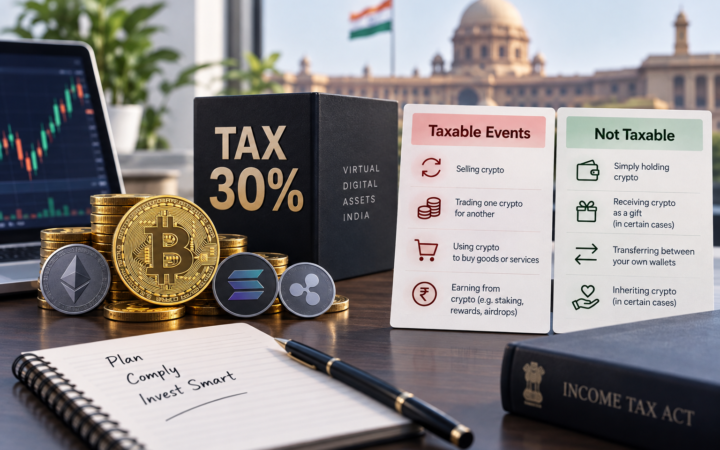
- It is taxed like any crypto. Gains face a flat 30% tax plus cess, and 1% TDS applies on transfers. Even small gains from the P2P premium count.
- Losses do not offset gains. A loss on one VDA cannot be set off against profit on another.
- Use FIU-registered platforms. Unregistered offshore apps have been blocked in India before, and funds can get stuck.
- It is not a savings account. There is no deposit insurance, no interest by default, and no Indian authority backing the peg.
- Be careful with foreign transfers. Using stablecoins to move large sums abroad can raise FEMA questions. If the amounts are serious, talk to a chartered accountant first.
Quick Answers
Is it legal to buy USDT in India?
Yes. There is no ban on buying or holding stablecoins. They are treated as VDAs and taxed accordingly.
Is USDC safer than USDT?
USDC is more transparent and more heavily regulated. USDT has more liquidity and a longer record in India. Neither is risk-free.
Could the RBI ban stablecoins?
Only the government can pass that law, but the RBI’s views weigh heavily. Tighter rules on stablecoin use are more likely than an outright ban.
The Bottom Line
Stablecoins look boring on a price chart, and that is exactly why they matter. They turn the US dollar into something any Indian with a phone can hold and send, outside the system of banks, LRS limits, and reporting that keeps the rupee steady.
For you, USDT or USDC can be a useful tool. Just treat it like the rest of crypto, not a bank balance. Before you trade in and out of it, make sure you understand what counts as a taxable event under India’s 30% crypto tax, because even a dollar-pegged token can leave you with a tax bill. And keep an eye on the RBI. When it comes to stablecoins, it is not going quiet anytime soon.