When spot Bitcoin ETFs went mainstream, plenty of people wrote the obituary for hardware wallets. Why fumble with seed phrases when a broker can do it for you? Two years on, that obituary looks premature. Wallet downloads did not collapse. On-chain balances held by long-term holders kept climbing. If you are still mapping out where crypto fits in your portfolio, our complete guide to crypto in India for 2026 is a good place to get your bearings first.
This piece answers one narrow question properly: in a Bitcoin ETF vs self-custody comparison, what exactly are you trading away when you pick the easy option?
The One-Line Difference Nobody Explains Clearly
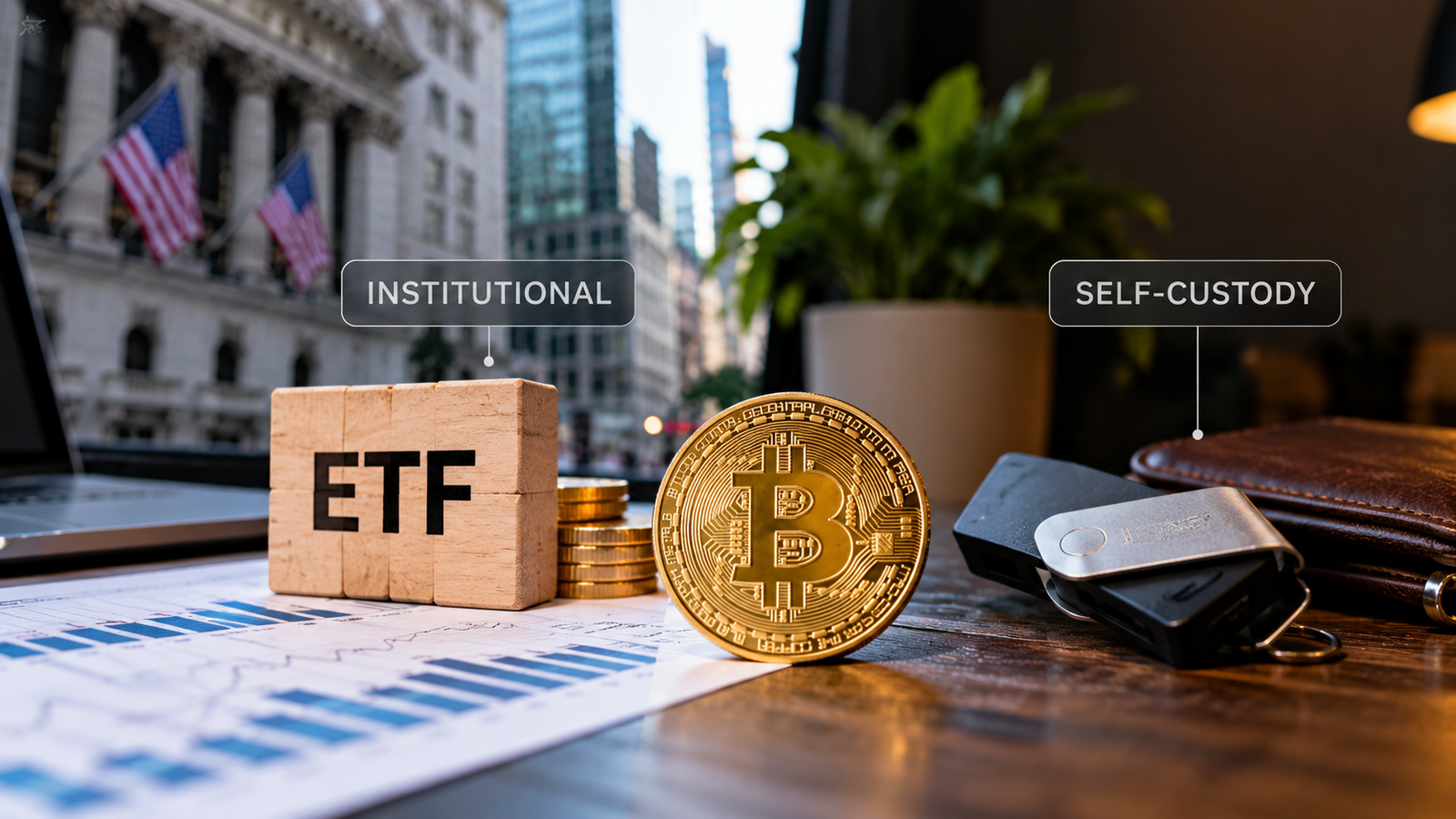
A Bitcoin ETF gives you exposure to Bitcoin’s price.
Self-custody gives you Bitcoin.
That sounds like wordplay. It is not. One is a claim on a fund that holds an asset through a custodian. The other is the asset itself, controlled by a key only you hold. Everything else in this article flows from that single distinction.
What a Bitcoin ETF Actually Gives You
Let us be fair to the product. ETFs solved real problems, and they solved them well.
- No key management. Nothing to lose, nothing to back up, nothing to hide in a drawer.
- Familiar tax paperwork. Your broker issues statements. Your accountant does not panic.
- Regulated custody. Institutional-grade storage, insurance layers, audit trails.
- Retirement account access. In several markets you can hold it inside tax-advantaged wrappers.
- Estate planning that works. Your family inherits a brokerage account, not a puzzle.
For a large slice of investors, that list is genuinely enough. If Bitcoin is 3% of your portfolio and you never intend to touch it, the ETF is a reasonable answer.
What You Quietly Give Up With ETF Exposure
Here is the part the fund marketing skips.
1. You Cannot Move It
ETF shares trade when the exchange is open. Bitcoin trades every minute of every day. When something breaks on a Saturday night, and in this market something eventually does, ETF holders wait for Monday. Self-custodied coins move in ten minutes.
2. You Cannot Verify It
You can verify your own UTXO on a public ledger in seconds. You cannot verify a fund’s holdings yourself. You verify the auditor, who verifies the custodian, who verifies the wallet. That is three layers of trust replacing a thing you could have checked with a block explorer.
3. You Cannot Use It
Bitcoin in your own wallet can be sent, spent, used as collateral, routed over Lightning, or moved across borders in a way no bank controls. ETF shares can be sold. That is the whole feature list.
4. You Pay Rent Forever
Expense ratios look tiny. Run the arithmetic over twenty years and a 0.25% annual fee on a position that compounds meaningfully turns into a serious number. Self-custody has a one-time cost, a hardware wallet under ₹10,000, and then nothing.
5. You Inherit Counterparty Risk You Did Not Sign Up For
Most spot ETFs concentrate on a small handful of custodians. That is a single point of failure sitting quietly under a product marketed as safe. Bitcoin was designed specifically to remove that layer. An ETF puts it back.
6. You Miss Forks, Airdrops and Optionality
Rare, unpredictable, and usually the fund keeps or liquidates them on your behalf. A small point, but it is another line in the give-up column.
Bitcoin ETF vs Self-Custody: Side by Side
| Factor | Bitcoin ETF | Self-Custody |
|---|---|---|
| Trading hours | Market hours only | 24/7/365 |
| Ongoing cost | Annual expense ratio | One-time device cost |
| Who holds the keys | A third-party custodian | You |
| Can you verify holdings | Through audit reports | Directly, on-chain |
| Can you spend or send | No | Yes |
| Counterparty risk | Real | Effectively zero |
| Risk of user error | Very low | Real and permanent |
| Inheritance | Straightforward | Needs a written plan |
| Tax reporting | Done for you | Your responsibility |
What You Give Up With Self-Custody
This is not a sermon. Self-custody has a real bill attached, and pretending otherwise is how people lose money.
- Mistakes are final. Wrong address, lost seed phrase, damaged device with no backup. There is no support line, no chargeback, no recovery.
- You become the target. Phishing, fake wallet apps, malicious firmware, and in extreme cases physical coercion. Custody makes you personally interesting to attackers.
- Record-keeping is on you. Every transfer, every cost basis, every disposal, tracked yourself.
- Your family needs instructions. A seed phrase nobody can find is indistinguishable from coins that never existed.
That last point deserves emphasis. More Bitcoin has been lost to bad backups than to exchange hacks.
The Tax Angle Most Indian Investors Get Wrong
A common assumption is that self-custody is somehow softer on tax. It is not. Moving coins between your own wallets is not a disposal, but selling, swapping or spending absolutely is, and the flat rate applies either way. Before you decide anything, read our breakdown of what actually counts as a taxable event under India’s 30% crypto tax, because the difference between a transfer and a disposal is where most notices start.
The practical gap is paperwork, not liability. An ETF hands you a clean statement. Self-custody hands you a spreadsheet and a deadline.
Why ETF Money Made Self-Custody Stronger
Here is the counterintuitive bit. ETFs did not compete with self-custody. They fed it.
- They legitimised the asset. Conversations that used to end at “isn’t that for criminals” now start at “what’s the allocation.”
- They created a pipeline. People buy the ETF, get curious, learn how it works, and a slice of them graduate to holding coins directly.
- They tightened supply. Funds buy real Bitcoin and park it. Less float, more pressure on the remaining coins.
- They sharpened the argument. Every time a regulated institution stumbles, the case for holding your own keys gets easier to make.
The two products serve different needs. Treating it as a winner-take-all fight was the mistake.
Which One Fits You?
Pick the ETF if: Bitcoin is a small satellite position, you want it inside a retirement or brokerage wrapper, you have no appetite for key management, or your estate planning needs to be boring and legible.
Pick self-custody if: Bitcoin is a meaningful conviction position, you want to hold across decades, you care about censorship resistance and verifiability, or you may want to actually use the asset rather than just watch its price.
Pick both if: you are like most sensible investors. This is the honest answer.
The Split Most People Land On
A structure that works well in practice:
- Core in self-custody. The long-term position, on a hardware wallet, with a tested backup stored separately from the device.
- Satellite in an ETF. The tactical slice you might trim or add to, sitting in the account you already log into.
- Nothing meaningful on an exchange. Exchanges are for buying and selling, not storing.
You get the convenience where convenience matters and sovereignty where it counts.
Quick Answers
Is a Bitcoin ETF safer than self-custody? It removes user error and adds counterparty risk. Safer against your own mistakes, riskier against institutional failure.
Can I convert ETF shares into actual Bitcoin? No. Spot ETF shares are not redeemable for coins by retail holders.
How much Bitcoin justifies a hardware wallet? A rough rule: if the position is worth more than several months of your income, the device pays for itself in peace of mind.
Do I still need an exchange if I self-custody? Yes, to buy. Withdraw to your own wallet afterwards.
The Bottom Line
ETFs did not kill self-custody because they were never solving the same problem. One gives you a price chart in a regulated wrapper. The other gives you an asset nobody can freeze, seize, or lose on your behalf. The right answer depends entirely on why you bought Bitcoin in the first place.
If you bought it as a portfolio hedge, the ETF is fine. If you bought it because you wanted something outside the system, an ETF is the system, politely repackaged. And if you are curious about earning coins rather than buying them, our look at the cryptocurrencies you can still realistically mine in 2026 covers what is left for ordinary hardware.
Whatever you choose, choose it knowingly. Not because a fund brochure made the decision feel automatic.