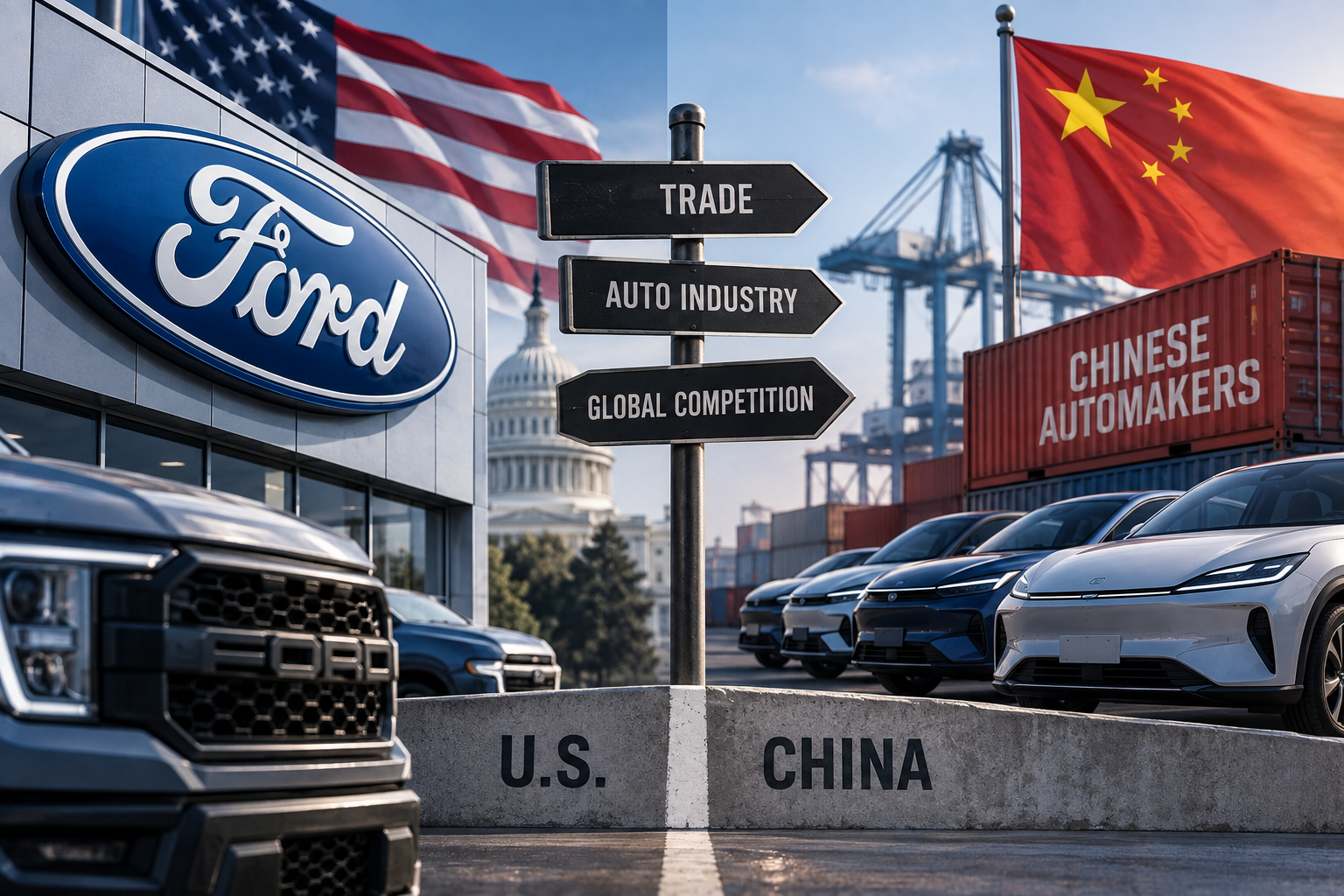
Ford CEO Jim Farley is not usually the guy who picks public fights with Washington. So when he goes out of his way to call out a sitting cabinet secretary by pointing to what he described as “basic misunderstandings” about Chinese automakers, it lands with a thud that the entire industry can hear.
Speaking on a podcast this week, Farley pushed back sharply on comments from the U.S. Transportation Secretary about how easy or hard it would be for Chinese carmakers to enter the American market. Farley’s message, delivered in that half-frustrated, half-worried tone he tends to use when talking about China, was blunt: the people setting policy do not fully grasp what is actually coming across the Pacific.
What Farley Actually Said
Farley’s frustration was aimed at the suggestion that Chinese automakers would struggle to meet U.S. safety, emissions, and crash standards, and therefore would not be a real threat to Detroit any time soon. According to Farley, that view leans on outdated assumptions.
He has toured Chinese factories personally. He has driven the cars. He drove a Xiaomi SU7 home from work for months as a test. And his takeaway, repeated at nearly every investor event this year, is that Chinese EVs are not cheap knockoffs anymore. They are cheaper, faster to build, packed with software, and, in many cases, better than what U.S. brands are shipping in the same price band.
So when a top federal official implies that regulatory hurdles will keep BYD, Geely, Chery, and Xiaomi out of American driveways, Farley hears something dangerous: complacency. He argues those companies can adapt to U.S. standards far faster than Washington assumes, and that the real barrier right now is tariffs, not engineering.
Why This Fight Matters Right Now
The context is important. The Trump administration slapped triple-digit tariffs on Chinese EVs to keep them out. But tariffs are a wall, not a moat. Chinese automakers are already setting up plants in Mexico, Brazil, Hungary, Thailand, and Morocco. From there, they can quietly move parts, technology, and even fully assembled cars through third countries.
This is exactly the kind of workaround that Washington has been trying to close down. The U.S. recently accused more than 40 nations of helping China dodge tariffs through what it called a shadow transshipment network, a story we broke down in detail in our earlier piece on the U.S. shadow transshipment network naming India and 40 other countries. Farley’s warning fits into the same puzzle. If policymakers keep assuming that tariffs alone are enough, and that Chinese cars cannot pass U.S. safety tests, they may wake up one morning to find Chinese brands sitting in dealer lots badged as something else entirely.
The Numbers That Have Detroit Nervous
The scale is what makes Farley’s comments so pointed. China now builds roughly one in three cars sold worldwide. BYD alone sold more than 4 million vehicles last year, more than Ford’s global output. Chinese EV batteries cost around 30 percent less to produce than American ones, and Chinese automakers can bring a new model from sketch to showroom in about 18 months. Ford, GM, and Stellantis still take three to four years for the same lap.
That cost gap is not a rounding error. It is the reason Ford’s CEO has been begging Washington to take the threat seriously instead of dismissing it. According to a Reuters report earlier this year, Farley told investors that Chinese automakers represent “the most humbling thing” he has ever seen in the industry.
The Political Angle
Publicly criticizing a cabinet secretary is not a small move for a Fortune 20 CEO. Detroit lives and dies by federal policy, from EV tax credits to CAFE fuel economy rules to steel tariffs. Farley knows this. Which is exactly why the phrase “basic misunderstandings” matters. He picked it deliberately. It is a signal to Washington that the auto industry does not feel heard, and that the people writing the rules may not know what they do not know.
There is also a strategic layer here. Ford is asking for continued support on EV production, battery manufacturing tax credits, and access to critical minerals. If the government convinces itself that China is not a real threat, that support gets pulled or trimmed. Farley is trying to keep the pressure on.
What Happens Next
Expect the Transportation Secretary’s office to respond, probably with a version of “we hear the CEO, but our data shows the tariffs and standards are working.” Expect Farley to keep repeating this line at every earnings call and investor day until it sticks. And expect a lot of quiet backchannel meetings between Detroit lobbyists and the Department of Transportation over the next few weeks.
The bigger question is whether anyone in Washington actually listens. Farley has been sounding this alarm for two years. If “basic misunderstandings” is what it takes to finally get attention, so be it. But the countdown for Detroit is not measured in years anymore. It is measured in the next model cycle.