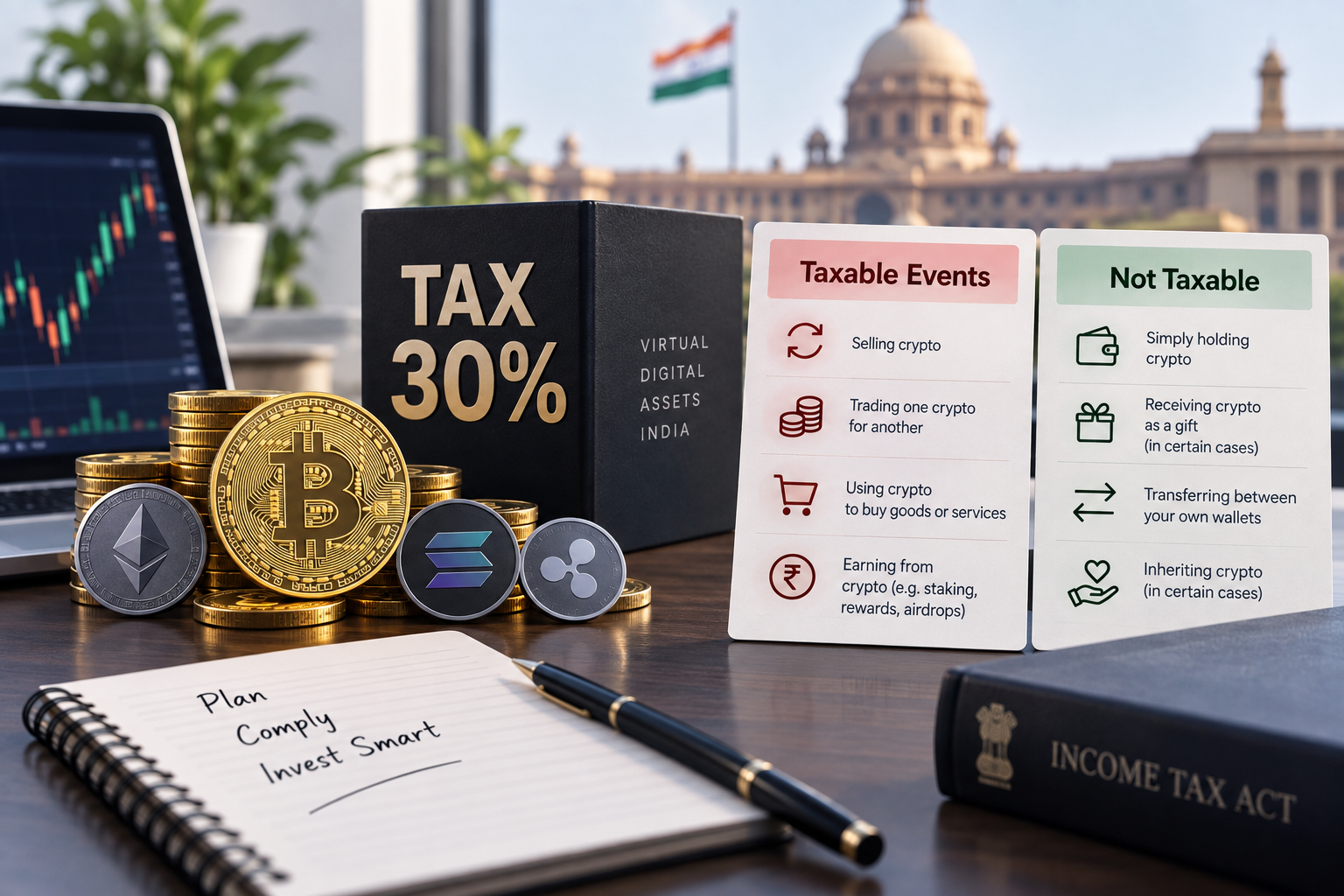
Most people who lose money to India’s crypto tax do not lose it by evading anything. They lose it by not realising a transaction was taxable at all. They swap one token for another, never touch a rupee, never withdraw to a bank account, and then find out at filing time that the swap triggered a 30% bill. If you want the full lay of the land on what is legal and how to invest, our guide to crypto in India in 2026 covers it end to end. This piece does one job: it draws a clean line between what the taxman counts as a taxable event and what he does not.
The Two Rules Everything Else Hangs On
India’s crypto tax rests on two sections of the Income Tax Act, and once you understand both, most confusion disappears.
Section 115BBH taxes income from transferring a Virtual Digital Asset at a flat 30%, plus surcharge and a 4% health and education cess. For most people that works out to an effective 31.2%.
There is no short-term or long-term distinction. Hold Bitcoin for eleven days or eleven years, the rate is identical.
Section 194S imposes a 1% TDS on the transfer of a VDA. This is not an extra tax. It is an advance payment collected at source, and you claim credit for it when you file.
A “Virtual Digital Asset” is broad. It covers Bitcoin, Ethereum, altcoins, stablecoins like USDT, NFTs and most tokens. If it lives on a blockchain and has value, assume it is a VDA until a chartered accountant tells you otherwise.
What Counts as a Taxable Event
Here is the list that actually matters.
1. Selling crypto for rupees
The obvious one. You bought ETH at ₹1.8 lakh, sold at ₹2.6 lakh, you owe 30% on the ₹80,000 gain.
2. Swapping one crypto for another
This is the one that ruins people. Trading BTC for SOL is treated as a disposal of your BTC. You realised a gain in the eyes of the law even though no rupee moved and nothing hit your bank account.
Active traders who make hundreds of swaps a year can generate a very large tax liability while their portfolio value has barely moved. The tax is on each individual gain, not on where you ended up.
3. Spending crypto on goods or services
Paying for a laptop, a subscription or a freelancer in crypto is a transfer. The gain between what you paid for those coins and their value when you spent them is taxable.
4. Selling an NFT
NFTs sit squarely inside the VDA definition. Same 30%, same rules.
5. P2P trades
Trading directly with another person on a P2P platform or off-exchange does not change anything. The transfer happened. It is taxable, and the TDS obligation still exists.
6. Converting to stablecoins
Moving from ETH into USDT feels like “going to cash.” Legally it is a crypto-to-crypto swap and it is fully taxable. A lot of Indian traders park in USDT during volatility without realising they are booking a taxable gain every time they do it.
What Does Not Count as a Taxable Event
Equally important, and a genuine relief once you know it.
- Buying crypto with rupees. Acquisition is not a transfer. Nothing is owed at purchase.
- Holding. Unrealised gains are not taxed. Your portfolio can 10x on paper and you owe nothing until you dispose of something.
- Moving crypto between your own wallets. Exchange to hardware wallet, hot wallet to cold wallet, one exchange to another. No change of ownership, no tax. Keep records proving both wallets are yours.
- Depositing crypto onto an exchange. Same logic. It is still yours.
- Unrealised losses. Watching a coin fall 80% gives you no deduction. The loss only exists once you sell, and even then the rules are harsh.
- Gifts from specified relatives. Crypto received from a spouse, sibling, parent or certain other defined relatives is exempt, as are gifts on the occasion of your marriage.
The Middle Category: Taxed, But Not at 30%
This is where even careful filers get it wrong, because a different rate applies.
When you receive crypto without buying it, the receipt is generally taxed as income from other sources at your normal slab rate, based on fair market value on the day it lands. Then, when you later sell it, the additional gain is taxed at 30% under 115BBH.
Two events, two rates.
This applies to:
- Airdrops — valued at market price when credited to your wallet
- Staking rewards — valued as they accrue
- Mining rewards — valued when mined, with no deduction allowed for your electricity or hardware costs
- Gifts above ₹50,000 from anyone who is not a specified relative
The mining treatment deserves a flag. You pay slab-rate tax on the market value of what you mine and cannot deduct a single rupee of the rig or the power bill that produced it. If you are weighing whether a setup still pays for itself, our rundown of which coins are still worth mining in 2026 is worth reading alongside these numbers, because the tax treatment changes the maths considerably.
Three Rules That Make India’s Regime One of the Harshest
The 30% headline is not really the problem. These three are.
Losses cannot be set off against anything
Not against your salary. Not against capital gains from stocks. Not even against gains from other crypto.
Make ₹5 lakh on Bitcoin and lose ₹5 lakh on Solana in the same year and you are flat overall, but you still owe 30% on the ₹5 lakh Bitcoin gain. You are taxed on your winners and get nothing for your losers.
Losses cannot be carried forward
Equity investors can carry losses forward for eight years. Crypto losses die at the end of the financial year. A bad year gives you nothing to offset a good one.
Only the cost of acquisition is deductible
You can subtract what you paid for the asset. That is it. Exchange trading fees, gas fees, transfer charges, subscription costs for portfolio tools, interest on money borrowed to invest — none of it is deductible.
How the 1% TDS Actually Works
TDS is deducted on the transfer of a VDA, not on your profit. It applies to the transaction value.
The thresholds: it kicks in above ₹50,000 in a financial year for specified persons, and above ₹10,000 for everyone else. Indian exchanges deduct it automatically and it shows in your Form 26AS.
Two things trip people up. First, TDS applies even on a loss-making trade, because it is charged on value rather than gain. Second, on P2P deals and foreign platforms, the deduction obligation can fall on you as the buyer, and plenty of people simply never do it.
What Changed in 2026
The compliance environment tightened considerably, and this is the part most casual investors have missed.
From 1 April 2026, a mandatory reporting obligation kicked in for crypto platforms. Exchanges, custodians, wallet providers and broker-dealer platforms serving Indian users must now furnish user-level transaction data directly to the Income Tax Department. The provision was introduced as Section 285BAA and carried into the re-codified Act.
From 1 April 2027, India implements the OECD’s Crypto-Asset Reporting Framework. That extends the net internationally, meaning holdings on offshore exchanges get reported back to Indian authorities through automatic information exchange.
Translated: the department will increasingly know what you did before you tell them. And undisclosed crypto gains can attract penalties that push the total liability far above the headline 30%.
Filing: Schedule VDA
Crypto gets its own schedule in the ITR, and it is not an aggregate figure. Schedule VDA asks for each transfer individually: date of acquisition, date of transfer, cost, consideration, and the income.
If you made four hundred trades, that is four hundred rows. Export your full transaction history from every exchange and wallet you used, keep records of self-transfers so they are not misread as disposals, and reconcile the TDS in Form 26AS against your own records before you file.
The Bottom Line
Buying and holding is free. Moving your own coins between your own wallets is free. Everything that disposes of an asset — selling, swapping, spending, even parking into a stablecoin — is a taxable event at 30% plus cess. Airdrops, staking and mining are taxed twice over, first at slab rate on receipt and again at 30% on the eventual gain.
The practical takeaway is that in India, trading frequency is expensive in a way it is not in most markets. Every swap books a gain the government can tax and a loss it will ignore. That asymmetry, more than the rate itself, is what quietly erodes returns.
Which is why crypto deserves a defined, modest slice of a portfolio rather than the centre of one. If you are still working out how much of your money should sit where, our complete roadmap for Indian investors lays out a sensible framework. Get the allocation right first, then let the tax rules shape how often you actually trade.
This article is for general information and is not tax advice. Crypto tax positions can be fact-specific, so consult a qualified chartered accountant before filing.