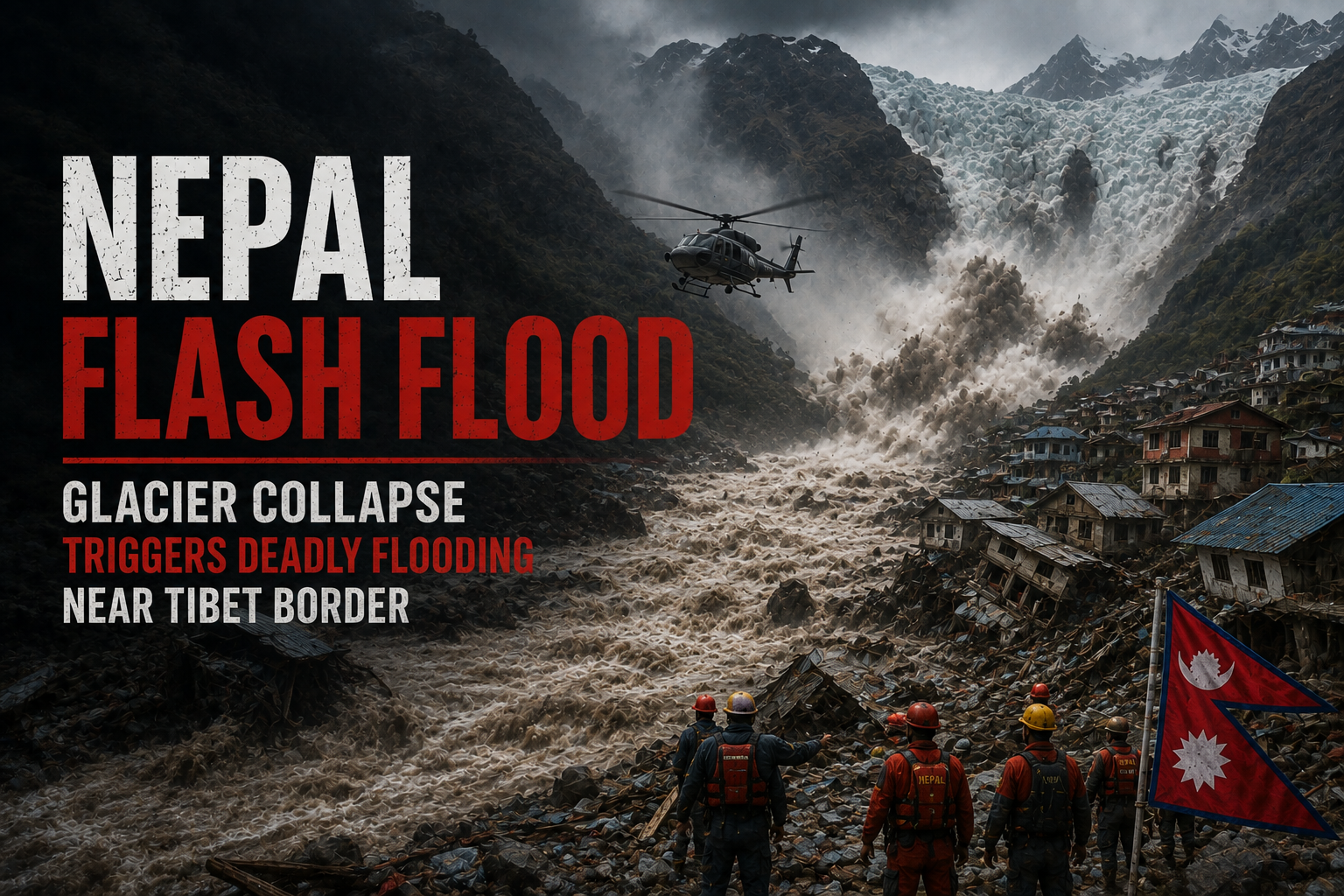
A catastrophic flash flood triggered by a glacier collapse tore through Nepal’s Rasuwa and Nuwakot districts on the morning of August 26, 2026, killing dozens of people and leaving hundreds missing. The disaster, one of Nepal’s deadliest in recent years, has also affected Tibet’s Gyirong County on the Chinese side of the border, where additional deaths were confirmed.
Hundreds of foreign tourists, many on pilgrimage to Mount Kailash in Tibet, are among those unaccounted for. Search and rescue operations are underway, but damaged roads, destroyed bridges, and continuing hazardous conditions are slowing progress.
What Caused the Nepal Flash Flood?
The Bhotekoshi River surged without warning around 9 a.m. local time on Wednesday, despite dry weather conditions in the Rasuwa district. Scientists at Nepal’s Department of Hydrology and Meteorology believe an ice and rock avalanche from a glacier on the Nepal side blocked the Lhende Khola River, a tributary of the Bhotekoshi. Water accumulated behind the debris dam before bursting through and sending a wall of mud, rock, and water downstream.
The U.S. Geological Survey initially recorded a magnitude 4.4 earthquake in Tibetan territory approximately 25 km from the Nepal border, around 8:37 a.m. However, the USGS later clarified that the seismic signal was not a tectonic earthquake but rather the energy released by the massive glacial collapse and resulting debris flow.
Experts at the Kathmandu-based International Centre for Integrated Mountain Development (ICIMOD) confirmed the Lhende Khola experienced maximum flooding. This marks the second time in 14 months that the same river system has flooded catastrophically. In July 2025, a glacial lake outburst in neighboring Tibet caused a similar surge, killing several people and destroying a bridge connecting Nepal and China.
Scale of Destruction
The floodwaters carved through dozens of settlements, burying multi-story buildings, trucks, and vehicles under enormous quantities of mud and debris. The districts of Rasuwa and Nuwakot bore the worst impact, with the town of Trishuli Bazar left partially submerged. Hydropower projects, roads, and bridges along the Bhotekoshi and Trishuli rivers sustained severe damage, cutting off access to many affected communities.
Authorities issued warnings to residents across multiple districts, urging people to stay away from the banks of the Bhotekoshi, Trishuli, and Narayani rivers as floodwaters continued moving downstream.
Nepali police recovered dozens of bodies by late Wednesday, while Chinese authorities confirmed deaths and hundreds missing in Tibet’s Gyirong County. The Gyirong Port area, a key gateway for cross-border trade and tourism between Nepal and China, suffered significant damage.
Hundreds of Foreign Tourists Missing
Nepal’s Ministry of Culture and Tourism reported that hundreds of tourists were unaccounted for, including a large number of foreign nationals. The missing foreigners include citizens from India, Australia, Malaysia, the Netherlands, Portugal, South Africa, South Korea, the United Kingdom, and the United States.
Most of the missing tourists were believed to be on the Kailash Mansarovar pilgrimage route, which passes through Nepal’s Rasuwa district before crossing into Tibet. While the monsoon season is typically less popular for general trekking in Nepal, it coincides with the peak season for the Kailash pilgrimage, a journey sacred to Hindus.
South Korean officials confirmed that several of their citizens working on a hydropower construction project in Nepal were also among the missing. Malaysia’s Foreign Ministry reported losing contact with several Malaysians believed to have been in the Rasuwa district.
Rescue Operations and International Response
Thousands of army and police personnel have been deployed for search and rescue. By Thursday, rescuers had retrieved dozens of survivors, including several foreigners. However, the extent of infrastructure damage is making operations extremely difficult.
Nepal’s government spokesperson Sasmit Pokharel confirmed that the country has requested assistance from both India and China. Nepal’s Prime Minister Balendra Shah traveled by road to Bidur in Nuwakot district on Thursday to assess the situation firsthand.
Australian Prime Minister Anthony Albanese acknowledged that a number of Australians were among the missing. Multiple countries, including the United States, United Kingdom, and South Korea, are coordinating with their embassies in Kathmandu to locate their citizens.
Survivors have shared harrowing accounts of the disaster. One man described being rescued by helicopter after clinging to debris for hours while his wife was buried beneath the mud. Another survivor recounted being saved by grabbing onto a mango tree as the building where he had been working was swept away.
Climate Concerns and Recurring Risk
The 2026 Nepal flash flood highlights the growing threat that glacial instability poses to Himalayan communities. Nepal’s steep river valleys serve as critical economic lifelines and travel corridors, but they become extremely dangerous when glacial events send sudden surges of water through narrow gorges.
The Bhotekoshi corridor has now experienced two major flood events in just over a year, both linked to glacial activity rather than heavy rainfall. Climate scientists warn that rising temperatures are accelerating glacier melt across the Himalayas, increasing the frequency of glacial lake outbursts and ice avalanches. The region contains several large glacial lakes that remain under close monitoring.
Nepal has faced a year of devastating natural disasters across Asia, with earthquakes, floods, and extreme weather events displacing thousands and straining emergency response systems. The growing frequency of climate-driven disasters worldwide is putting pressure on governments to invest in early warning systems and disaster preparedness.
This is a developing story. Death tolls and missing figures are expected to change as rescue operations continue. Last updated: August 27, 2026.