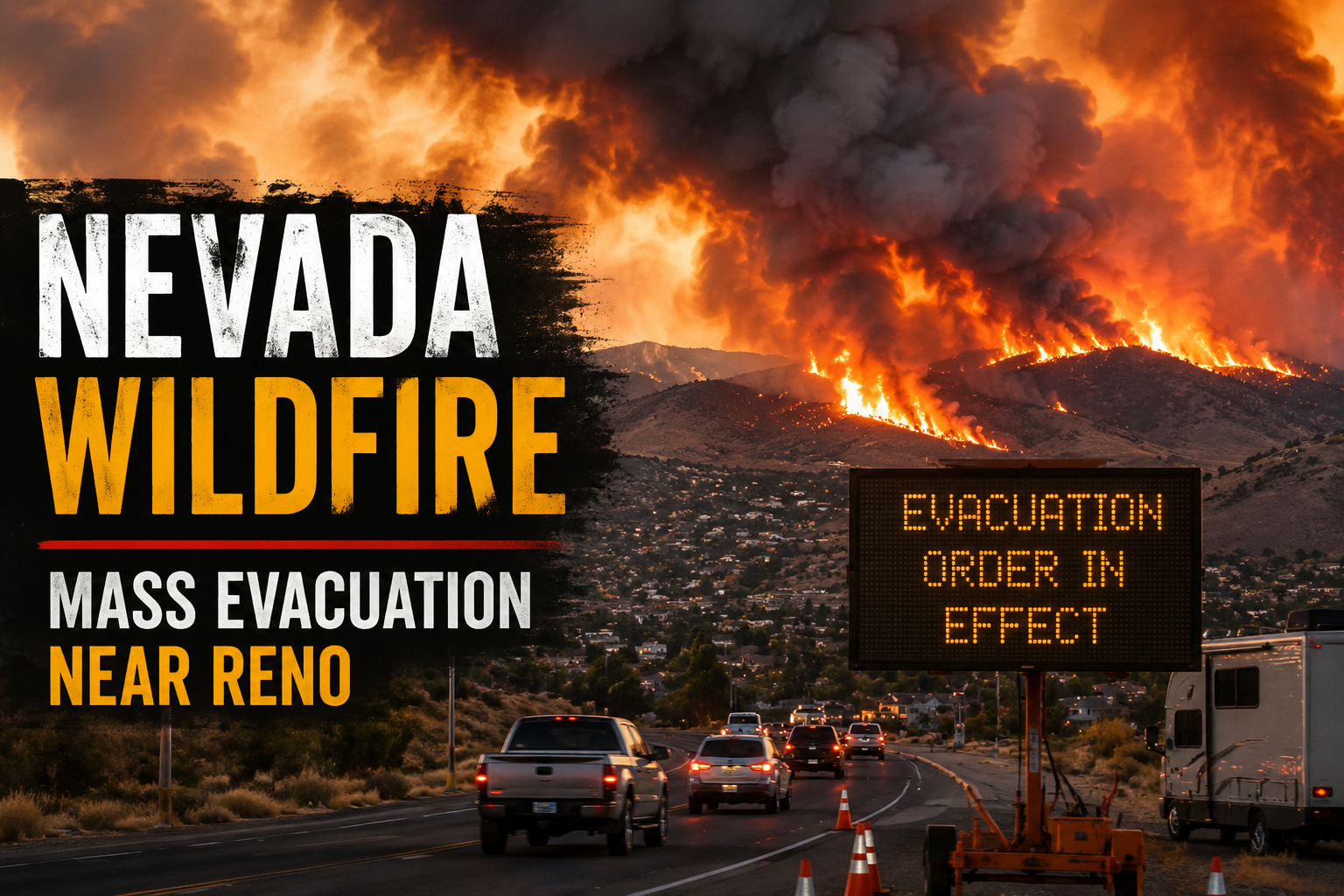
A fast-moving wildfire in northern Nevada has burned through more than 15,000 acres near Reno, forced 42,000 residents out of their homes, and left another 45,000 bracing for possible evacuation. The blaze, known as the Hawk Fire, remains at 0% containment as of Sunday evening, August 24, 2026, making it the third major fire to strike Washoe County in less than 3 weeks.
How the Hawk Fire Started
The Hawk Fire was first reported around 11:25 a.m. on Saturday, August 22, near the Hawk Meadow Trail in the Somersett area, roughly 5 miles northwest of downtown Reno. Investigators have confirmed the fire was caused by human activity, though the exact circumstances have not been disclosed. Officials have not indicated that the fire was set on purpose.
What began as a small hillside brush fire that residents barely noticed on Saturday morning turned into a full-blown crisis within hours. Strong, gusty winds, single-digit humidity levels, and bone-dry vegetation combined to push the fire down from the Sierra foothills toward residential neighborhoods at an alarming pace. By Saturday evening, it had already consumed 2,500 acres. Within 24 hours, that number jumped past 10,500.
15,000 Acres Scorched, 0% Containment
As of Sunday evening, the Hawk Fire had expanded to over 15,000 acres, tearing through a rugged section of the Humboldt-Toiyabe National Forest around Peavine Mountain. The terrain, thick with dry brush and short grass, fed the fire’s rapid advance. Wind shifts throughout Sunday complicated firefighting efforts, pushing the blaze in multiple directions and creating unpredictable conditions for the 800 personnel on the ground.
Dozers worked along the southern and eastern flanks of the fire to carve out fuel breaks between the flames and nearby residential areas. 10 aerial resources, including helicopters and air tankers, dropped water and fire retardant across the front lines. Despite these efforts, the blaze remained completely uncontained.
42,000 Evacuated, 90,000 Affected
Approximately 13,700 homes fell within the fire’s evacuation perimeter. Authorities issued mandatory “GO NOW” evacuation orders for 42,000 residents, while another 45,000 received “GET SET” warnings to pack essential items and be ready to leave on short notice.
The evacuation zone expanded rapidly through Saturday night and into Sunday, reaching the edge of the University of Nevada, Reno campus by Sunday evening. University officials said the campus remained outside the evacuation zone but confirmed that emergency response plans were in place should conditions shift.
The Reno-Sparks Convention Center opened as the primary evacuation shelter, where the American Red Cross reported that 465 people spent Saturday night. An additional 200 displaced residents slept in their cars and RVs in the convention center parking lot. Small animals were directed to Washoe County Regional Animal Services, while large animals, including horses and goats, were taken to the Ironwood Event Center in the Palomino Valley area.
6 Injured, Structures Destroyed
The Hawk Fire has injured 6 people so far, 3 civilians and 3 first responders. Fire officials confirmed that residential structures near the base of Peavine Peak were destroyed, particularly along Blackfoot Way and Seneca Drive. However, damage assessment teams have not yet been able to enter the worst-hit areas to provide exact numbers.
NV Energy reported that roughly 10,000 customers across northern Nevada lost power, partly because the utility shut off electricity as a safety precaution in evacuation zones and partly because fire damaged power lines and poles. The Washoe County School District cancelled all classes for Monday, August 24, while the University of Nevada confirmed that its Reno, Redfield, and Lake Tahoe campuses would remain operational.
State of Emergency and Military Response
Nevada Governor Joe Lombardo declared a state of emergency for Washoe County on Saturday evening, unlocking federal resources and directing all state agencies to support the firefighting effort. The Nevada National Guard deployed 60 response force personnel along with 2 helicopter crews, one flying a CH-47 Chinook and the other a UH-60 Black Hawk, to assist with aerial firefighting and help local law enforcement secure evacuated neighborhoods.
California Governor Gavin Newsom also weighed in, noting that state and local partners had been deployed to coordinate efforts across the state line. Evacuation warnings extended into Sierra County, California, though the fire had not crossed into the state as of Sunday afternoon.
Third Major Fire in 3 Weeks
The Hawk Fire marks the third large wildfire to hit northern Nevada since early August. The Bug Fire, which broke out on August 8 just north of the Hawk Fire’s location, burned nearly 94,000 acres before reaching 94% containment. The Stallion Fire, which started 2 days later, scorched over 40,000 acres and is now 98% contained. Together, these 3 fires have consumed well over 140,000 acres across Washoe County and neighboring areas in less than a month.
The cluster of fires reflects a broader national trend. According to the National Interagency Fire Center, more than 7.7 million acres have burned across the United States so far in 2026, the largest year-to-date total in a decade. Hot, dry conditions, persistent drought, and invasive cheatgrass have turned Nevada’s Great Basin landscape into a tinderbox that ignites with little provocation.
What Comes Next
The weather forecast for the coming days offers little relief. Minimum relative humidity is expected to hover between 11% and 21% around the northern Sierra Front, with southwest wind gusts reaching up to 25 mph on Monday. From August 25 through August 27, stronger afternoon winds with gusts up to 40 mph are forecast, raising the possibility of elevated to locally critical fire weather conditions.
The Bureau of Land Management has a statewide fire prevention order in effect through October 31, 2026, banning fireworks, explosives, and tracer ammunition on all public lands in Nevada. The nearby Tahoe National Forest entered Stage 2 fire restrictions on August 14, prohibiting campfires outside designated recreation sites.
Residents in affected areas are urged to monitor real-time updates through the Watch Duty app for live wildfire tracking and evacuation zone information. Those in the “GET SET” zone should have go-bags ready, keep vehicle fuel tanks full, and be prepared to leave at a moment’s notice.
A community meeting for Hawk Fire evacuees is scheduled for Monday, August 24, at 7 p.m. at 75 Cowan Street in Reno. The meeting will also be livestreamed on the Official Hawk Fire Information Facebook page.
The Bigger Picture
Northern Nevada’s repeated brush with catastrophic fire in August 2026 underscores a pattern that fire scientists have warned about for years. Rising temperatures, prolonged drought cycles, and the explosive spread of cheatgrass, an invasive weed that dries out right before fire season, have created conditions where a single spark can displace tens of thousands of people within hours. The Hawk Fire is not an isolated event. It is part of a fire season that has stretched resources thin across the entire western United States, with more than 29,000 firefighting personnel currently deployed nationwide.
For now, 90,000 residents of Reno and surrounding areas wait, watch the smoke, and hope the winds shift in their favor.