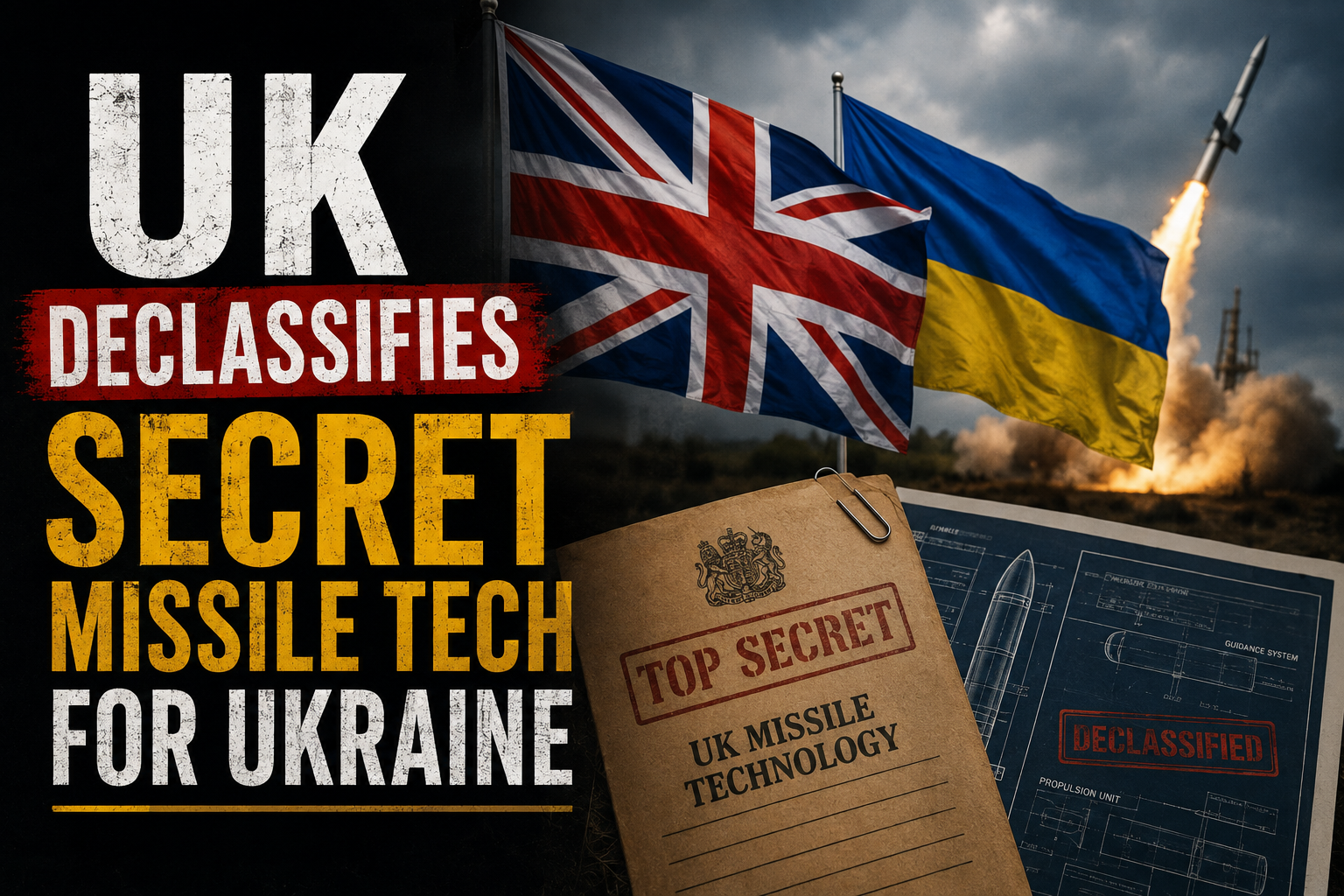
On August 24, 2026, while Ukraine marked its 35th Independence Day, British Prime Minister Andy Burnham landed in Kyiv with 2 announcements that sent shockwaves through Moscow. Britain would hand over classified missile technology to Ukraine and sign a first-of-its-kind AI defense partnership that gives British researchers access to real battlefield data collected during 4 years of war against Russia.
The visit was Burnham’s first trip abroad as Prime Minister. And it was anything but symbolic.
Britain Unlocks Secret Missile Data for Ukraine
The biggest headline from the Kyiv visit was Britain’s decision to authorize defense manufacturer MBDA to release classified technical information about British-made components used in the SCALP cruise missile. SCALP is the French-produced version of Britain’s Storm Shadow, a low-flying, precision-guided weapon designed to destroy hardened targets like military bunkers and command centers.
The missile stretches about 5.1 meters long, flies at low altitude to dodge air defenses, and carries a range of over 250 kilometers. Both SCALP and Storm Shadow share French and British technology, which is exactly why this announcement matters. France had already agreed to help Ukraine set up domestic production lines for SCALP missiles, with plans to begin assembly before the end of 2026. But because key components originate in Britain, Paris could not legally share all the information needed without London’s approval.
That barrier is now gone.
With British authorization in hand, Ukraine and France can push forward on building SCALP missiles inside Ukrainian territory. If production ramps up as planned, it would mark a turning point in Ukraine’s ability to sustain long-range strikes deep inside Russia without relying entirely on Western deliveries.
Ukraine has already deployed Storm Shadow and SCALP missiles against Russian command posts, ammunition depots, airfields, and key infrastructure far behind the front lines. Earlier this year, Ukraine also launched its largest drone attack of 2026 against Russian targets, signaling a clear shift toward expanding its offensive reach.
But Experts Say Results Will Take Time
Despite the political weight of the announcement, defense analysts have tempered expectations. Douglas Barrie, a senior fellow at the International Institute for Strategic Studies, noted that any real impact will depend on how quickly Ukrainian-assembled SCALP missiles can actually enter service. Arun Dawson, a researcher at King’s College London, went further, stating the missiles would not help Ukraine through this winter and would likely not start making a difference until 2027 at the earliest.
What Ukraine needs right now, Dawson emphasized, is protection from Russian ballistic missile attacks targeting its cities and energy grid. Long-range cruise missiles serve a different purpose, and the production timeline does not address the immediate crisis on the ground.
The Avengers AI Deal: Britain Gets Battlefield Intelligence Gold
The second major announcement was the signing of an AI defense partnership between Zelenskyy and Burnham. Under the agreement, Britain becomes the first country in the world to gain access to Ukraine’s Avengers AI Labs, a platform built from roughly 5 million annotated battlefield images collected through Ukraine’s DELTA combat management system.
DELTA is a domestically developed situational-awareness platform that Ukraine’s military uses to coordinate operations in real time. The data it generates, including drone footage, sensor readings, and tactical observations, feeds directly into the Avengers AI system. That system can detect targets with about 70% accuracy and processes over 100,000 drone video feeds every month.
In return for access, Britain will bring its universities, researchers, and tech companies into the partnership. Several pilot projects are already underway. One involves Bristol-based company Sintela, which is developing technology that turns buried fiber-optic cables into massive AI-powered sensors capable of detecting movement around sensitive sites. The system is set for deployment at a UK defense base, with potential applications for airports, railways, prisons, and energy facilities.
A second pilot project will explore next-generation low-power AI chips designed to run drones, robotics, and autonomous weapon systems.
Moscow Hits Back Hard
The Kremlin wasted no time responding. Spokesman Dmitry Peskov accused Britain of directly participating in the war and deliberately escalating the conflict. The Russian embassy in London had already warned the previous week that the deeper Britain’s involvement grows, the higher the price it will pay.
Russian Foreign Minister Sergey Lavrov reinforced that message, stating that Moscow considers Britain’s role in supplying and now helping produce long-range weapons as direct participation in the war, with consequences to follow.
These warnings carry extra weight given the current global tensions. The ongoing standoff between the US and Iran has already disrupted global energy markets, pushed oil prices higher, and indirectly boosted Russia’s war revenues. With attention and resources split across multiple flashpoints, Britain’s decision to deepen its commitment to Ukraine reads as a deliberate signal that London will not back down regardless of pressure from Moscow.
What This Means Going Forward
The twin announcements in Kyiv form part of what both governments call the UK-Ukraine 100 Year Partnership. Defence Secretary Wes Streeting praised Ukraine for pushing the frontier of defense innovation during its fight against Russia and pledged continued British support.
For Ukraine, domestic missile production would reduce dependence on uncertain Western supply chains. The AI partnership could accelerate development of autonomous defense systems that give smaller forces an edge against a numerically superior enemy. And for Britain, access to the world’s largest live-conflict dataset positions its defense industry and research sector at the cutting edge of military AI.
But the road from announcement to operational impact remains long. Production lines need to be built. Engineers need to be trained. And Russia has shown no signs of letting up.
For now, what happened on August 24 in Kyiv was a handshake loaded with intent, a clear message that Britain is not just watching this war from the sidelines.