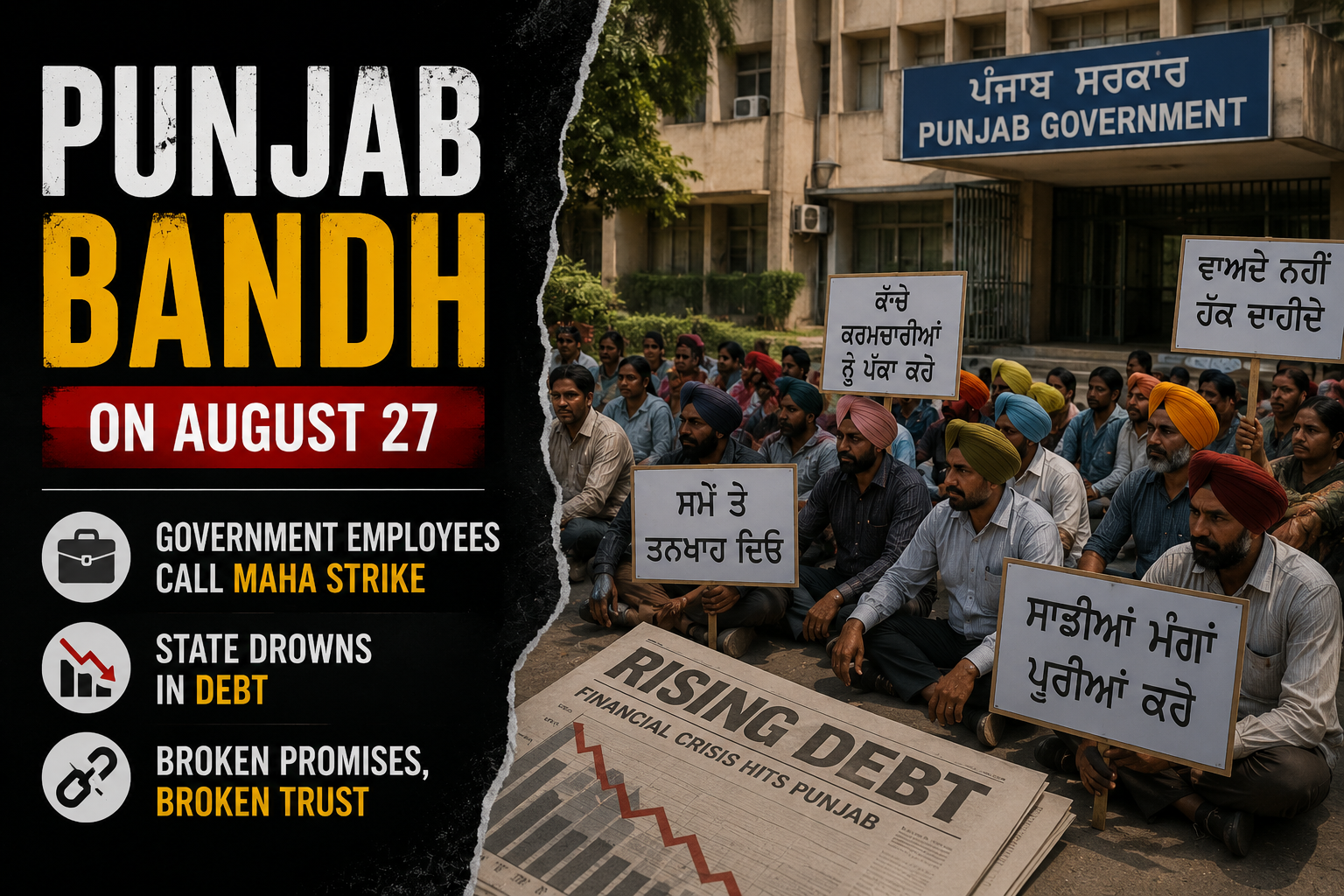
The Punjab bandh on August 27 is now confirmed. Thousands of government employees will walk off the job on August 27, 2026, in what unions are calling a “Maha Bandh.” Schools, colleges, electricity offices, tehsils, hospitals, transport services, and the Punjab Civil Secretariat could all shut down for the day. More than 50 government departments are expected to be hit, making this one of the biggest strikes Punjab has seen in recent years.
With a crippling debt crisis, a garbage strike still fresh in memory, and 2027 Assembly elections closing in, the AAP government in Punjab is running out of room to manoeuvre.
Why Are Punjab Government Employees Going on Strike?
The demands behind the Punjab bandh on August 27 have been building for years. Employees and pensioners want the release of pending Dearness Allowance (DA) instalments, implementation of the Old Pension Scheme (OPS), salary scales on par with the Central Government, and removal of the 3-year probation rule for new recruits.
Thousands recently marched from Tolewal grain market in Sangrur to Satauj, the home village of Chief Minister Bhagwant Mann. A massive protest at Sector 39 in Chandigarh earlier this month ended with police using water cannons to stop the crowd from reaching the Punjab Vidhan Sabha.
The government has invited the Sanjha Mulazam Manch and Purani Pension Bahali Sanjha Manch for talks on August 27 itself. But union leaders have made it clear: they will call off the strike only if demands are accepted, not just discussed.
The Garbage Crisis Set the Stage
Before the employee unrest, Punjab was already dealing with a sanitation crisis. Workers from over 150 urban local bodies walked off the job on July 8, 2026, demanding ₹40,000 monthly wages and job regularisation. For nearly 3 weeks, garbage piled up in every town and city. The Punjab and Haryana High Court warned of a public health emergency.
The strike ended only after the government agreed to raise wages to ₹20,500 per month from August 1. But the weeks of rotting waste exposed a state struggling with basic infrastructure and essential services. Now, barely a month later, an even bigger shutdown is at the door.
Punjab’s Debt Has More Than Doubled
At the heart of all this is money Punjab simply does not have. The state’s public debt has more than doubled in a decade, climbing from roughly ₹2.1 lakh crore in 2017 to a projected ₹4.48 lakh crore by 2027. That is nearly 45% of Punjab’s entire Gross State Domestic Product (GSDP), placing it among the most indebted states in India.
Revenue receipts for 2026-27 are estimated at ₹1,26,190 crore, but total expenditure stands at ₹1,66,161 crore. The fiscal deficit is ₹39,971 crore, or 4.1% of GSDP, well above the 3% limit considered acceptable under India’s fiscal rules. The monthly salary bill alone is roughly ₹2,916 crore. Annual pensions cost nearly ₹19,800 crore. Interest payments could cross ₹29,000 crore this year. Electricity subsidies through PSPCL are budgeted at ₹15,550 crore. After all committed spending, only ₹10,000 to ₹12,000 crore remains for actual development.
Successive governments over the past 2 decades, from the SAD-BJP alliance to Congress to AAP, have all added to this debt spiral without reversing the trend. The end of the GST compensation scheme has made things worse, leaving Punjab with an unbudgeted shortfall of ₹10,000 to ₹12,000 crore.
AAP’s Political Problem Before 2027
The timing is brutal for AAP. The party swept Punjab in 2022 with 92 of 117 seats but has since lost power in Delhi. Punjab is now its only state government, and the 2027 election will decide whether the party stays relevant nationally. Punjab has a historical pattern of voting out incumbent governments, and the warning signs are already visible. Seven Rajya Sabha MPs have left AAP for BJP. In the 2024 Lok Sabha polls, AAP won just 3 of 13 seats.
Congress chief Amrinder Singh Raja Warring said the employees who voted AAP into power are now marching against it. SAD president Sukhbir Singh Badal called it a message from the people who actually run Punjab’s government. The broader Indian economy may be growing at 7.6%, but Punjab’s finances tell a very different story.
AAP did perform well in the May 2026 municipal elections, winning 958 of 1,977 wards. Mann has also launched welfare schemes, including monthly cash transfers of ₹1,000 to ₹1,500 for women. But welfare costs money, and every new scheme adds to a debt pile that is already crushing Punjab’s ability to build anything for its future.
What Happens When the Punjab Bandh on August 27 Begins?
If last-minute talks fail, government offices from tehsils to the Secretariat will close. Schools and colleges will lose teachers. Hospital OPDs could be disrupted. Power and transport services may take a hit. The pattern from the sanitation strike is clear: workers had to protest for 3 weeks before getting even a partial deal. If the same playbook repeats, Punjab is in for a difficult stretch.
The Punjab bandh on August 27 is just one day on the calendar. But what it represents, a government caught between promises it cannot afford and people it cannot ignore, is the reality of Punjab right now.