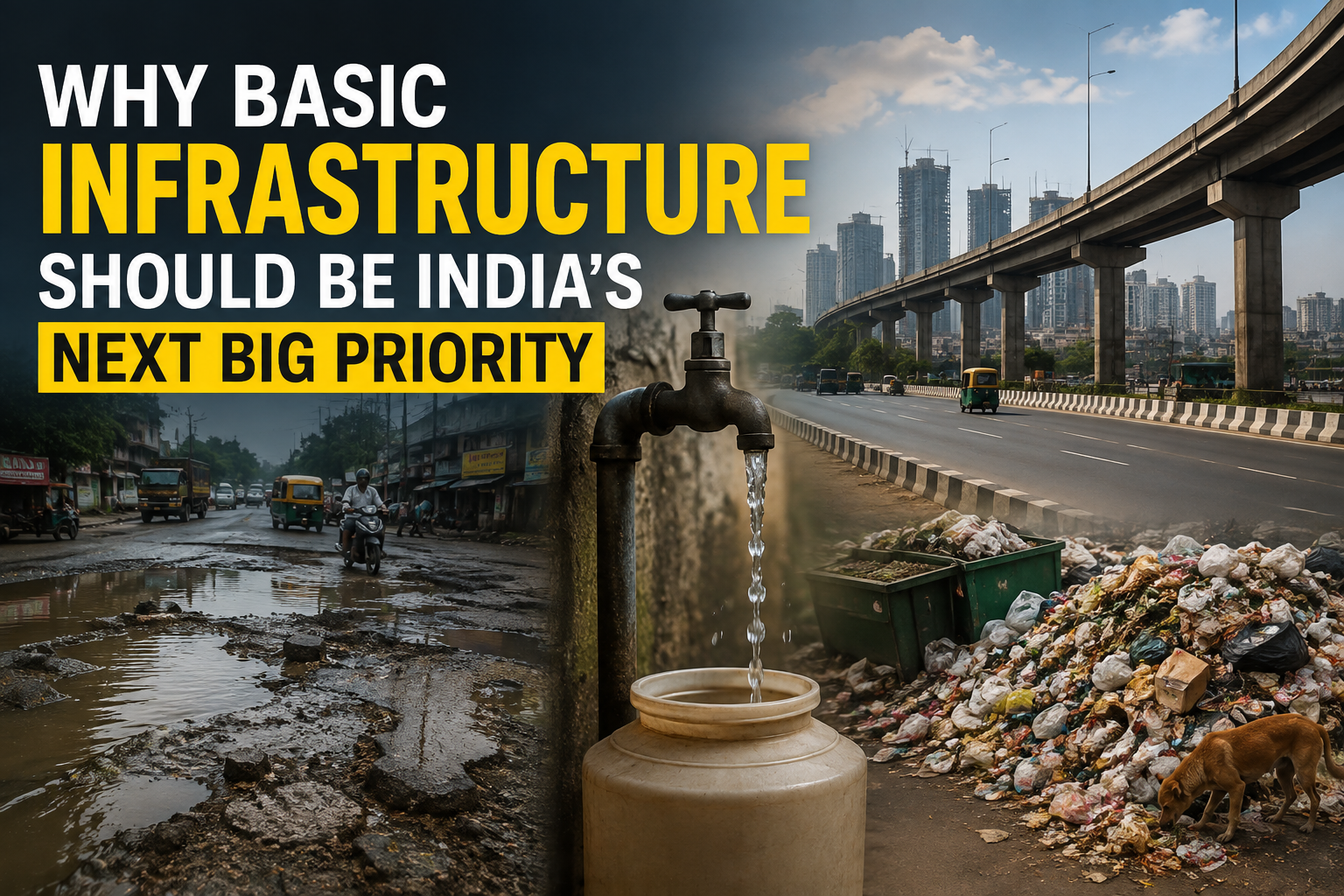
India sends satellites to the moon. It rolls out digital payment systems that entire continents study and try to copy. It builds expressways that stretch across states in record time. And yet, step outside your front door in most Indian cities and towns, and the story changes fast. A pothole greets you before your morning chai does. The footpath, if it exists, belongs to parked scooters and street vendors. The neighbourhood drain overflows every monsoon like clockwork. Nobody seems bothered.
That gap between ambition and everyday reality is where India’s next real priority should sit. Not another bullet train corridor. Not another smart city announcement. The unsexy, ground-level basics that shape how 1.4 billion people actually live their daily lives.
Roads That Fall Apart Before They Are Finished
Drive through any mid-sized Indian city and count the number of roads that have been dug up, patched, dug up again, and left half-done. Water supply departments dig trenches for pipelines. Telecom companies rip up fresh asphalt to lay cables. Municipal crews resurface it, sometimes. Then the gas line people show up and tear it open once more. There is no coordination between departments, no shared underground mapping, no accountability for leaving a road worse than they found it. In places like Delhi and Punjab, roads dug up across cities have become a visible enough crisis to turn into a political flashpoint.
The result is a patchwork of crumbling tar, exposed gravel, and mystery craters that swallow tyres and sometimes entire auto-rickshaws during the rains. Citizens pay road tax, vehicle tax, fuel surcharges, and tolls. What they get in return is a surface that would embarrass a dirt track in rural Europe.
Countries like Japan and the Netherlands treat roads as long-term public assets. They invest in durable materials, enforce strict contractor warranties, and coordinate utility work under a single planning window. India keeps treating roads as election-cycle projects. Lay them fast, cut the ribbon, move on. Nobody comes back to check if they survived 6 months.
Footpaths Built for Nobody
Walk through Bangalore, Pune, Lucknow, or Ludhiana and try to find an unobstructed footpath. Good luck. In most Indian cities, footpaths are an afterthought. When they do exist, they are either too narrow, broken, encroached by shop extensions, blocked by parked cars, or occupied by two-wheeler riders who find them more convenient than the actual road.
Pedestrians, the single largest group of road users in India, are the most ignored. Mothers with strollers walk on busy roads. Senior citizens dodge traffic because the pavement disappeared 3 blocks ago. School children share lanes with trucks. And when someone gets hurt, the conversation always turns to why were they walking on the road instead of asking why there was nowhere else to walk.
Cities in Denmark, Colombia, and even smaller economies like Rwanda have figured out that walkable streets improve public health, reduce pollution, support local businesses, and cut traffic congestion. India knows this too. It just never gets around to doing anything about it.
Waste Management That Begins and Ends With a Dustbin Nobody Can Find
India generates over 150,000 tonnes of municipal solid waste every single day, according to government data. The systems in place to handle that volume are nowhere close to adequate. In countless neighbourhoods, garbage collection is irregular, segregation at source barely exists, and open dumping remains the default.
Landfills in cities like Ghazipur in Delhi and Deonar in Mumbai have grown into literal mountains of waste, occasionally catching fire and sending toxic fumes across residential areas. Meanwhile, on street level, people toss wrappers out of car windows, spit paan on freshly painted walls, and dump construction debris on empty plots after midnight.
This is not just a systems failure. It is a culture gap. Singapore solved its waste problem with strict fines and efficient collection. Rwanda banned plastic bags outright and made monthly community cleanup drives mandatory. India has the policies on paper. The Swachh Bharat Mission moved the needle, genuinely. But the follow-through at the municipal level, the daily discipline of collection, processing, and enforcement, still has enormous distance to cover.
The Civic Sense Problem Nobody Wants to Talk About
Here is the uncomfortable part. Infrastructure is only half the equation. The other half is how people use it.
Brand new bus stops get vandalised within weeks. Public toilets, even well-maintained ones, are avoided because they are public. Dividers on roads become convenient U-turn spots. Zebra crossings are decorative paint. No parking zones are the most popular parking zones. People honk at red lights as if the signal will change faster under pressure.
Civic sense cannot be legislated overnight, but it can be built over a generation through 3 things: consistent enforcement, visible consequences, and education that starts in primary school. Countries that cracked this puzzle did not rely on appeals to morality. They made it expensive and inconvenient to break rules. Litter in Tokyo? You carry your trash home because there are barely any public bins. Park illegally in Amsterdam? Your car gets towed within the hour and you pay a steep fine to get it back.
India still operates in a system where rule-breaking carries almost no consequences, and the few rules that exist are enforced selectively. Until that changes, even the best infrastructure will degrade faster than it can be built.
Why This Matters More Than the Big Projects
None of this is to say India should stop building highways, metro networks, or airports. Those matter. But a country’s actual quality of life is not measured by how fast a train moves between 2 cities. It is measured by whether a 70-year-old woman can walk to the market and back without risking her life on a road with no pavement. It is measured by whether a child can play outside without stepping in garbage. It is measured by whether rainwater drains away or floods the ground floor of your house every July.
The big projects win awards, attract foreign investment, and make headlines. The small stuff — clean streets, working drains, a footpath that goes somewhere — determines whether people actually enjoy living where they live. And right now, for most Indians, that answer is complicated at best.
India has the engineering talent, the economic resources, and the administrative machinery to fix this. What it needs is a shift in priority. Less obsession with building the next showpiece. More commitment to maintaining what already exists and filling the gaps that millions of people navigate every single day.
The basics are not boring. They are the foundation everything else stands on. And right now, that foundation has cracks.