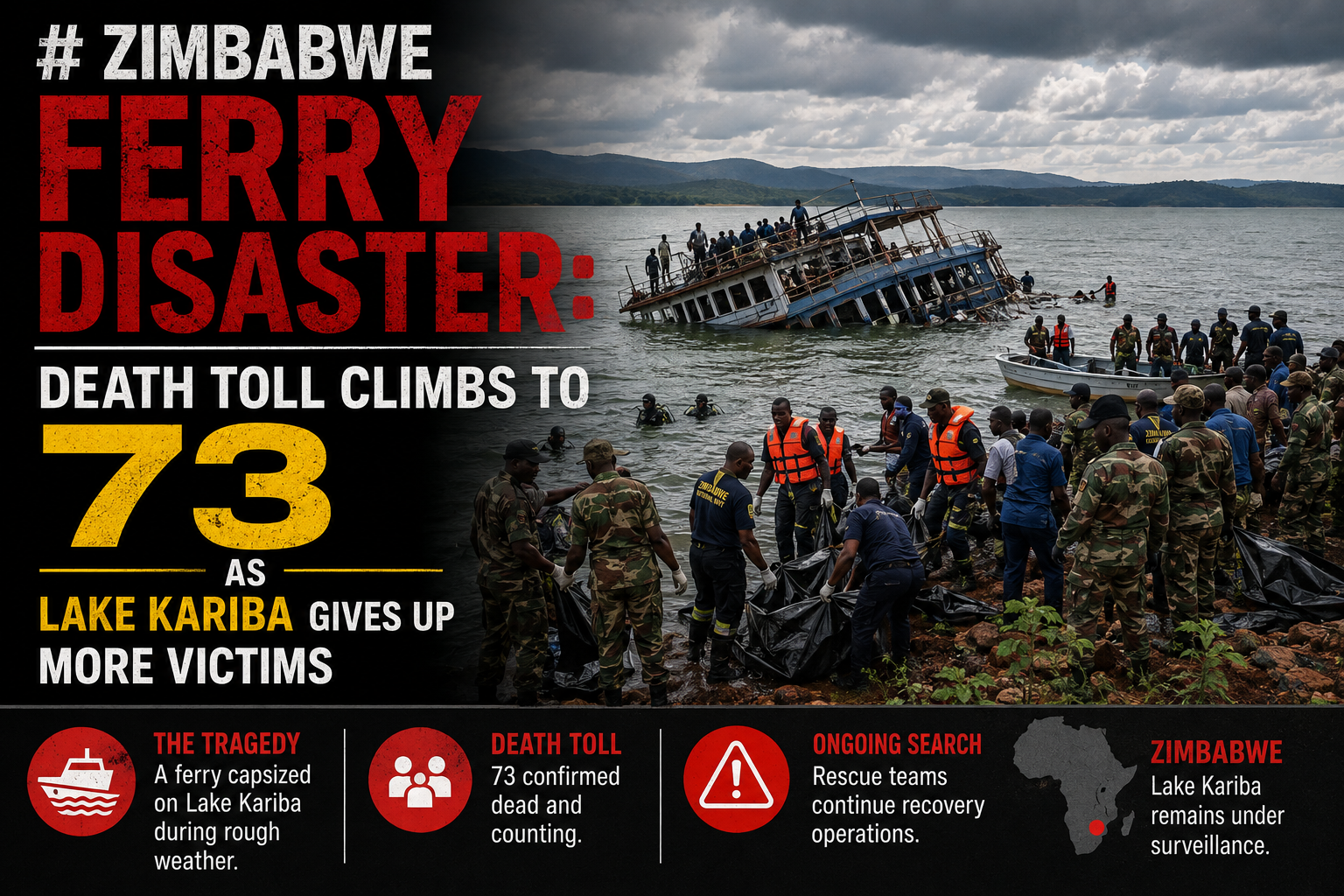
A 5-hour crossing that thousands of Zimbabweans have made without a second thought turned into the country’s deadliest maritime tragedy on August 11, 2026. The ferry Mbuya Nehanda, an aging vessel operated by the Rural Infrastructure Development Agency (RIDA), capsized on Lake Kariba after a powerful wave struck the overloaded boat near Long Island. As of August 16, rescue teams have pulled 73 bodies from the water, and dozens more remain missing.
The vessel was traveling its regular route from the lakeside town of Kariba toward the Chalala fishing camps in Mashonaland West province when it went down. It was carrying 114 ticketed adult passengers, 5 crew members, and an undetermined number of children too young to require a ticket. Conservative estimates place the total aboard at 153 people. The ferry was certified to carry 90.
A Disaster That Survivors Saw Coming
What makes this tragedy especially painful is that passengers sensed danger long before the boat left shore. Video footage that surfaced on social media, first shared by local Member of Parliament Mutsa Murombedzi, shows people on the dock watching the ferry depart with visible unease. Voices can be heard in Shona expressing concern about the rough water and whether the passengers would make it safely.
Survivors who lived through the capsizing have described a sequence of warnings that went unheeded. Multiple passengers reportedly pleaded with the ferry operator to turn back after the vessel began taking on water shortly after departure. Those pleas were ignored. By the time a large wave struck and flipped the boat, it was too late for most on board.
Chance Siyamavhu, a 45-year-old survivor, recounted the terrifying moments at a memorial service held on August 13 in Kariba. He described watching helplessly as fellow passengers scrambled for life jackets, most of them unable to figure out how to use them. His best friend and 7 of his relatives perished in the water. He survived only because a wave pushed the sinking hull upward long enough for him to climb on top of the overturned vessel.
Children Among the Dead
Of the 73 confirmed victims, 18 were children. 16 of those children were under the age of 10. Among the youngest victims were 3 toddlers, roughly 1 year old each: Wendy Ndandarika, McDonald Nyasha Gumpo, and Hailly Tauro. Their names appeared on an official police casualty list that has left families across the Kariba district devastated.
The captain of the Mbuya Nehanda was also among the dead. His death means that one of the most critical witnesses to the decisions made before and during the voyage is no longer available to investigators.
Rescue Operations and the Grim Recovery
Within hours of the capsizing, the Zimbabwean state broadcaster ZBC captured footage of speedboats racing toward the overturned ferry while a helicopter hovered overhead. A specialized aquatic rescue unit was airlifted to the scene, and Matusadonha rescue teams evacuated 77 survivors to Long Island before transferring them to the mainland.
The death toll has risen steadily throughout the week. Initial reports on August 11 confirmed 15 deaths. By August 12, that number jumped to 44. Police announced 46 deaths by August 13, then 68 on August 15 after 22 more bodies were recovered in a single day. 3 additional recoveries late on August 15 brought the count to 72, and by the morning of August 16, the Herald newspaper reported the toll had reached 73 with 27 more bodies pulled from the lake overnight.
Hundreds of people gathered at the Kariba district hospital on August 15 to identify their relatives. The scene, captured by Zimpapers media, showed families confronting rows of recovered remains, some decomposed after days in the water.
President Declares National Disaster
President Emmerson Mnangagwa invoked Section 27(1) of the Civil Protection Act to declare the capsizing a national disaster, unlocking additional government resources for search and recovery operations. In his public remarks, Mnangagwa went further than most expected. He acknowledged what he called “serious deficiencies” in Zimbabwe’s maritime safety capabilities and ordered agencies responsible for water transport safety to address the weaknesses the accident exposed.
A technical report on the disaster is expected to be presented to Cabinet on Tuesday. Preliminary investigations have begun pointing toward 3 contributing factors: a navigational error by the crew, the vessel being loaded well beyond its certified capacity, and a failure to respect adverse weather warnings issued before departure.
A localized weather bulletin for Lake Kariba on August 11 had flagged strengthening winds from a South Indian Ocean anticyclone. While general conditions appeared calm in the morning, the bulletin cautioned mariners about choppy conditions developing in exposed sections of the lake during the afternoon, precisely when the ferry capsized.
The Deeper Problem: Why Communities Have No Alternative
The Mbuya Nehanda was not a luxury vessel. It was a landing craft-type ferry, old and visibly worn, that served as the primary transportation link for remote fishing villages and rural communities scattered along Lake Kariba’s northern shore. The 50-kilometer stretch between Chalala and Siakobvu crosses some of the most difficult terrain in Mashonaland West. During heavy rains, roads become impassable entirely, leaving water transport as the only option.
Former government minister Walter Mzembi was among those who questioned how the vessel had been licensed for public transport in the first place, calling it visibly old and ill-equipped for regular commuting. Viral videos showing the ferry being routinely overloaded on previous trips have intensified scrutiny of RIDA’s operations and the inspection history of the vessel.
By February 2025, the government had reduced the ferry fare from $15 to $10 after community complaints about affordability. That fare cut acknowledged the dependence these communities have on the service, but it did nothing to address the safety of the vessel itself.
The tragedy has now left those communities without any ferry service at all, and with no clear alternative for reaching markets, health services, or the town of Kariba.
A Nation in Mourning
An emotional memorial service took place at Nyamhunga Stadium in Kariba on August 13, where mourners gathered before 44 coffins. Burials began shortly afterward, with more funerals expected as additional bodies continue to be identified.
Lake Kariba, the world’s largest man-made lake by volume, stretches more than 200 kilometers along the Zimbabwe-Zambia border. Built in the late 1950s by damming the Zambezi River, it has long served as both an economic lifeline and a source of danger for communities that depend on water transport. This disaster is now regarded as the deadliest maritime incident in Zimbabwe’s recorded history.
As the search continues and the technical inquiry takes shape, the 73 confirmed dead, the dozens still missing, and the families left waiting for answers represent a reckoning that extends far beyond a single ferry crossing. The questions now facing Zimbabwe’s government are not just about one overloaded boat on one rough afternoon. They are about decades of infrastructure neglect that left entire communities with no safe way to travel.
Also read: Deadly 7.4 Magnitude Earthquake Strikes Western Colombia, Killing Over 160 People