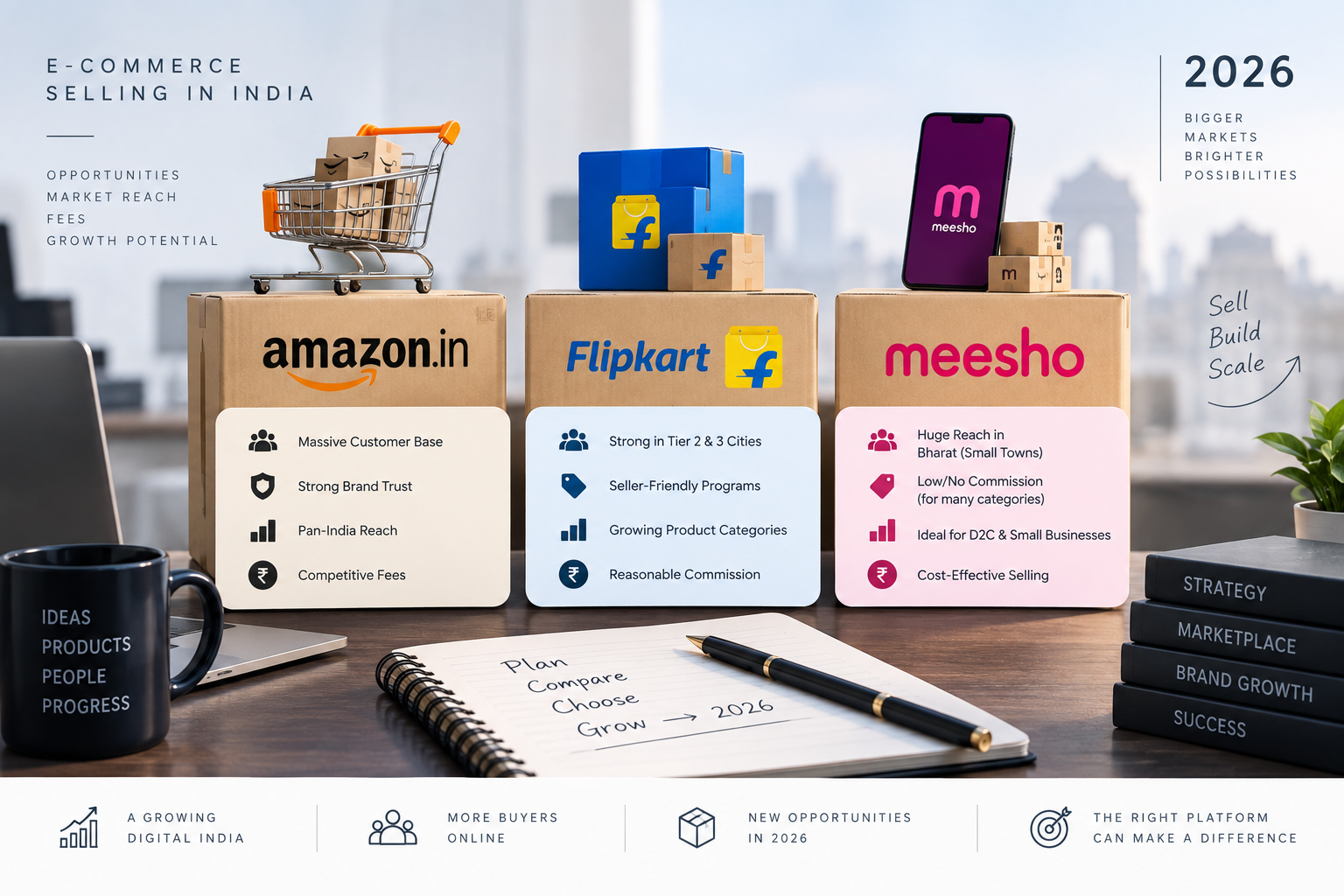
If you are trying to figure out where to list your products this year, the honest answer is that not every marketplace suits every seller. Amazon India, Flipkart, and Meesho each pull in a different kind of buyer, charge fees very differently, and treat returns in ways that can quietly eat your margins. Before we compare them, it helps to zoom out and understand the wider selling landscape covered in our complete guide to selling online in India in 2026. Once you have that big picture, the choice between these three platforms becomes far less confusing.
The Quick Verdict Before We Dive In
Here is the shortest possible answer for busy sellers:
- Amazon India — best for branded, premium, and Tier-1 metro buyers who care about delivery speed and reviews.
- Flipkart — best for mid-priced electronics, fashion, and home goods with strong Tier-2 and Tier-3 pull.
- Meesho — best for low-ticket, unbranded, price-sensitive volume, especially in Bharat markets and reseller networks.
Most serious sellers eventually list on more than one, but the platform you start with should match your product, your pricing power, and honestly, your patience for returns.
Fees: Where Your Margin Actually Goes
Fees are the first place sellers get burned, because the sticker rate is never the full story. You have commission, closing fees, shipping fees, storage, and returns processing to think about.
Amazon India Fees in 2026
Amazon charges a referral fee that varies by category, typically between 2% and 17%. Books and low-value grocery items sit at the lower end, while jewellery, accessories, and beauty products can touch the ceiling. On top of that:
- Closing fee — flat charge based on order value, usually ₹5 to ₹40.
- Weight handling — depends on Easy Ship, Self Ship, or FBA.
- Storage fees for FBA — monthly, and it spikes during Oct-Dec.
Realistic total take rate for a mid-priced product on Amazon: 18% to 28% before ad spend.
Flipkart Fees in 2026
Flipkart’s commission structure looks similar on paper but is often 1-3% cheaper in most categories. It also charges:
- Collection fee — smaller than Amazon’s closing fee for orders under ₹500.
- Fixed fee — replaces closing fee, tiered by order value.
- Shipping fee — Flipkart Smart Fulfillment adds a fulfilment charge similar to FBA.
Realistic total take rate: 15% to 25%. For sellers moving 500 units a month of a ₹499 product, that difference is real money.
Meesho Fees in 2026
Meesho’s big pitch has always been zero commission, and technically that is still true in 2026. What you actually pay is:
- Shipping charge — passed to the buyer, but sensitive to weight and pincode.
- Payment gateway fee — around 2%.
- Return-to-origin (RTO) charges — this is the killer, and we will get to it.
Effective take rate stays around 5% to 10% on delivered orders, but once you factor in returns, sellers often see it climb to 20% or more.
Who Is Actually Buying? Customer Demographics That Matter
This is where a lot of sellers guess wrong. Each platform pulls in a distinct crowd, and if your product does not match the buyer, no amount of ads will save you.
Amazon India’s Buyer
Skews urban, English-comfortable, 25-45 years old, and higher household income. Prime members are the loyal core. They compare specs, read long reviews, and pay a premium for faster delivery. Categories that thrive here: electronics, kitchen appliances, branded personal care, books, and pet supplies.
Flipkart’s Buyer
Broadest reach across metros and Tier-2 cities. Big Billion Days shaped a generation of Indians who wait for sales to buy phones, TVs, and fashion. Flipkart Plus members are slightly more value-focused than Prime users. Great for mid-market electronics, ethnic wear, home decor, and school-age fashion.
Meesho’s Buyer
Heavy Tier-2, Tier-3, and rural presence. Many buyers are women shopping for apparel, kitchenware, and beauty at sub-₹500 price points. Also huge among resellers who buy in small lots and sell through WhatsApp and Instagram. If you cannot sustain a low sticker price, this is not your platform.
India’s consumer base has changed enormously over the past decade, and if you want the wider context, our piece on India’s startup boom over the last decade shows how quickly buying behaviour shifted online.
Returns Policy: The Silent Margin Killer
Ask any experienced seller what really hurts, and the answer is rarely fees. It is returns.
Amazon India Returns
Standard 7 to 10 day return window on most categories, 30 days on select electronics. Amazon runs strict SAFE-T claims where sellers can be reimbursed for damaged returns, but only if you document unboxing. Fashion returns are high — typically 25-35%. Electronics returns run 8-15%.
Flipkart Returns
Similar 7 to 10 day window, with easier replacement flows for the buyer. Flipkart’s Seller Protection Fund is decent for damaged returns, but claims processing can drag. Fashion returns are similar to Amazon. Home goods returns are lower, around 5-10%.
Meesho Returns
Return rates are the highest of the three. Combined RTO and return-after-delivery numbers routinely hit 25% to 40%, particularly in apparel. Cash on delivery drives a lot of this — buyers reject at the door if they change their mind. Meesho has tightened penalties on repeat returners, but sellers still bear reverse shipping costs on many SKUs.
The lesson: price your Meesho SKUs assuming a third of them will come back. If the math still works, list it. If not, do not.
FBA vs Flipkart Fulfillment: Head to Head
Fulfilment is the make-or-break decision after fees. Here is how the two big players compare in 2026.
Amazon FBA (Fulfilment by Amazon)
- Prime badge on your listings — significant conversion lift.
- Multi-city warehouse network, faster next-day delivery in metros.
- Storage fees rise steeply Oct-Dec — plan inventory carefully.
- Amazon handles returns, customer service, and reverse logistics.
- Best for products under 5 kg with steady weekly velocity.
Flipkart Smart Fulfillment (F-Assured)
- F-Assured badge boosts trust and search ranking.
- Slightly cheaper storage fees than FBA, especially for bulky items.
- Fulfilment centres are strong in North and West India, weaker in the Northeast.
- Reverse logistics is improving but still a step behind Amazon.
- Better for fashion and mid-weight home goods.
What About Meesho?
Meesho’s Valmo network has expanded, but most sellers still ship through third-party couriers Meesho arranges. There is no equivalent of FBA. You pack, they pick up. Good for lean operations, bad if you want a fulfilment badge.
Decision Framework: Pick Based on Your Product
Here is a simple filter that works for most sellers:
- Selling anything above ₹1,500 with brand appeal? Start with Amazon. Add Flipkart in month three.
- Selling mid-priced fashion, gadgets, or home goods? Start with Flipkart. Add Amazon once reviews build.
- Selling anything under ₹500, especially unbranded apparel or accessories? Start with Meesho and be ruthless about pricing for returns.
- Selling handmade or niche premium? Amazon Karigar or Flipkart Samarth, not Meesho.
Advertising and Discoverability
Amazon’s Sponsored Products auction is expensive but precise. Cost per click on competitive keywords in beauty and electronics can run ₹15-40. Flipkart PLA (Product Listing Ads) tends to cost 20-30% less for comparable placements. Meesho charges commission on ad-driven orders instead of CPC, which is friendlier to new sellers but harder to scale predictably.
Payout Cycles and Cash Flow
Cash flow decides whether you can restock in time.
- Amazon — payouts every 7 days for most sellers, 14 days for new accounts.
- Flipkart — payouts every 7 to 15 days depending on category and seller tier.
- Meesho — payouts every 15 days, after RTO reconciliation, which can feel slow when you are scaling.
So, Which One Should You Sell On?
If you can only pick one platform, choose the one where your product’s natural buyer already spends time. A ₹299 kurti will not thrive on Amazon no matter how good the photos are, and a ₹4,000 pair of headphones will get crushed by returns on Meesho. Match the product to the platform first, then optimise fees and fulfilment.
For most sellers with room to run on two platforms, the sensible combo in 2026 is Amazon + Flipkart for anything branded and mid-to-premium, or Meesho + Flipkart for volume-driven, price-sensitive categories. Very few sellers thrive on all three simultaneously without a dedicated ops team, so do not spread yourself thin in the first year.
Whatever combination you land on, keep your unit economics visible on a single sheet — commissions, shipping, returns, ads, and payout lag. That sheet is the difference between a side hustle and a sustainable business. As selling online gets more automated and AI-driven, the sellers who win are the ones who understand their numbers and adapt. Our take on running a business in the AI era is worth a read if you are thinking about how tools, pricing engines, and automation will reshape your seller workflow over the next couple of years. Pick your platform on evidence, review your economics every quarter, and be willing to walk away from a channel that is not paying its rent.