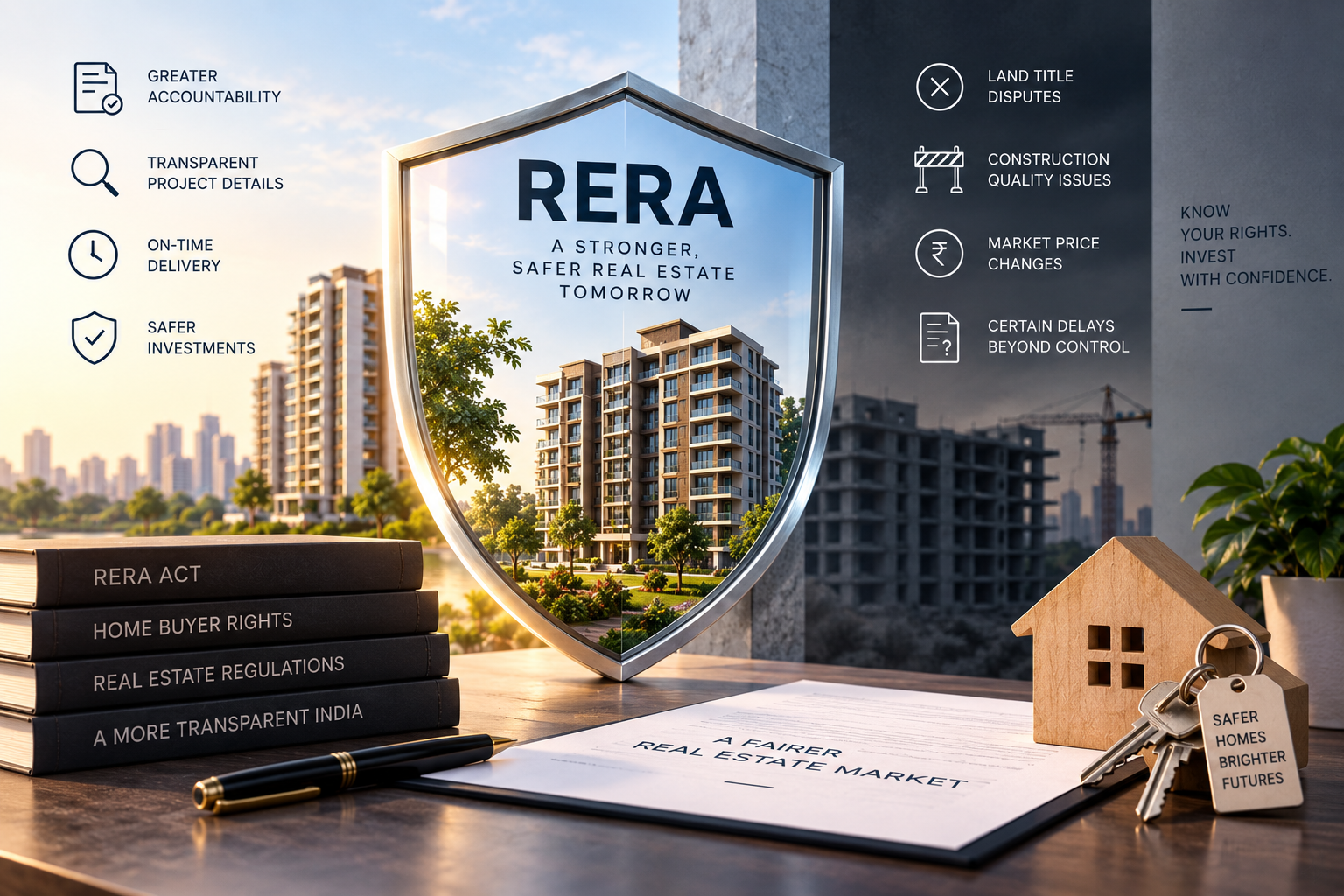
Ask any Indian home buyer who bought property before 2016, and you will hear the same story. The builder promised possession in three years, delivered in seven, and there was almost nothing anyone could do about it. Then RERA arrived, and the balance of power shifted. But how much did it really shift? If you are about to sign a builder-buyer agreement, or you are already stuck in a delayed project, you need to know exactly what RERA covers and where it quietly stops. This is not a legal textbook. This is what actually matters when you are the one writing the cheque. For a wider view of how the market is behaving right now, our 2026 real estate guide on buying, renting, and investing in India is a useful companion read.
What RERA Is, In Plain English
The Real Estate (Regulation and Development) Act, 2016, is the law that finally forced builders to answer to somebody. Every state has its own RERA authority. Every project above a certain size has to register with it. And every promise the builder makes on the brochure has to match what is filed with RERA. That is the theory. The practice is more interesting.
RERA gave buyers three things they never really had before: a public record of the project, a formal complaint mechanism, and a builder who can actually be fined or jailed for cheating. That is not small. But RERA is not a shield against every bad decision you can make in real estate. Let us break it down.
What RERA Actually Protects You From
1. Delayed Possession
This is the big one. If the builder promised possession by December 2025 and it is now June 2026 with no keys in sight, RERA gives you two clear options:
- Stay in the project and claim interest for every month of delay, usually at SBI MCLR plus 1 to 2 percent.
- Exit the project and demand a full refund with interest.
You do not need to prove the builder acted in bad faith. Delay is delay. The registered completion date filed with RERA is what counts, not the softer date the builder later whispers over WhatsApp.
2. Quality Defects (The Five-Year Rule)
Section 14(3) of the RERA Act is the section most buyers do not know about. For five years after possession, the builder is legally responsible for fixing any structural defect, workmanship issue, or service failure at no cost to you. Cracks in the wall, leaky plumbing, faulty wiring, seepage from the terrace — if you report it within thirty days of noticing it, the builder has to fix it within thirty days of your notice.
Most buyers never invoke this. Builders count on that. Do not be that buyer.
3. Title Issues and Land Ownership
Before RERA, builders could sell you a flat on land they did not fully own. Sometimes the land was under litigation. Sometimes the approvals were fake. RERA requires the builder to declare, on the public portal, the full title status of the land, all encumbrances, and every approval. If the builder lies, you can claim compensation and, in serious cases, get the project deregistered.
4. Changes Without Your Consent
Builder wants to reduce the size of the swimming pool? Add two more floors? Swap Italian marble for local vitrified tiles? Under RERA, they need written consent from two-thirds of the allottees. No more silent downgrades between brochure and possession.
5. Fund Diversion
Seventy percent of the money you pay must sit in a dedicated escrow account and can only be used for that specific project. Builders can no longer take your money in Bengaluru to fund a project in Pune. This is the single biggest reason project completion rates have improved after RERA.
6. Carpet Area Transparency
The days of paying for super built-up area you cannot see are over. RERA mandates pricing on carpet area — the actual usable floor space inside your flat. If a builder still quotes in super built-up, that is a warning sign, not a marketing tactic.
The Gaps: What RERA Does Not Cover
Now the part nobody puts on the brochure. RERA is powerful, but it has real blind spots. If your dispute falls into one of these buckets, you may need a different route — consumer court, civil court, or plain hard negotiation. Before you assume RERA has your back, check that you are actually inside its shade. If you want the bigger picture of where these gaps sit inside overall property decision-making, our India real estate 2026 guide puts them in context.
1. Small Projects Are Exempt
Projects on plots smaller than 500 square metres, or with fewer than eight apartments, do not need to register under RERA. A large chunk of tier-2 and tier-3 city construction falls right into this gap. If you are buying in a small boutique building, you are largely on your own.
2. Projects Completed Before RERA
If your project got its completion certificate before RERA came into force in your state, RERA cannot help you. Your options are consumer court or civil court. Both are slower and less specialised.
3. Resale Properties
RERA is a relationship between the buyer and the original builder-promoter. When you buy a resale flat from an individual, RERA has very little to say. Title checks, encumbrance certificates, and society dues are on you and your lawyer.
4. Plotted Developments Without Amenities
Pure plot sales, especially unauthorised layouts, often slip outside the RERA net. Some states have plugged this. Many have not. Ask the state authority directly before you pay a token amount.
5. Post-Possession Society Disputes
Once the residents’ welfare association takes over the project, disputes about maintenance, common areas, and internal governance move into cooperative society law, not RERA. RERA can still handle unfinished common amenities the builder promised, but the day-to-day housekeeping is somebody else’s problem.
6. Force Majeure Loopholes
Builders got extremely creative during and after the pandemic. Any decent RERA lawyer will tell you that force majeure claims are the single most common defence to a delay complaint. Adjudicating officers usually see through the weak ones, but expect the builder to argue that the sky itself delayed your kitchen.
7. State-Level Variations
This one bites. RERA is a central law, but every state has diluted or strengthened it differently. Maharashtra RERA (MahaRERA) is famously strict. Some states have quietly weakened the escrow requirement or given builders longer extensions. Before you rely on a rule, check the version your state actually implemented.
How to Actually File a RERA Complaint
Most buyers assume this needs a lawyer. It does not, though a lawyer helps. Here is the practical path:
- Go to your state RERA website. Search for the project by name or registration number.
- Download the standard complaint form. Fill it in with dates, payment proof, and the specific promise the builder broke.
- Pay the filing fee. It is usually between 1,000 and 5,000 rupees.
- Upload documents. Attach the builder-buyer agreement, payment receipts, and any WhatsApp or email admissions from the builder.
- Attend hearings, mostly online now. Cases are usually decided within 60 to 90 days, though appeals stretch it.
If the builder ignores the order, you can escalate to attachment of property, and repeat violators can lose their registration entirely. That is the teeth RERA has that older laws did not.
The Real-World Verdict
RERA is not perfect. Enforcement varies. Some state authorities are understaffed. Big builders with in-house legal teams still delay proceedings. But compared to the wild west that Indian real estate was in 2015, buyers today have real leverage — as long as they know it exists and are willing to use it.
The single biggest mistake buyers make is not reading their state RERA portal before they book. Every filing, every complaint, every completion date is public. Take 30 minutes before you sign anything. Search the project. Search the builder. Look for red flags in past filings. That one habit protects you more than any signature on a contract.
If you are still weighing whether to buy, rent, or wait out the current cycle, our detailed India real estate 2026 breakdown on buying, renting, and investing walks through the numbers that actually matter this year. RERA gives you the safety net. That guide helps you decide whether you need to jump at all.
Bottom Line
RERA protects you from delayed possession, hidden quality defects, dodgy titles, silent design changes, and misused funds — provided your project is registered and your paperwork is clean. It does not protect you from small unregistered projects, resale disputes, force majeure games, or your own decision to skip due diligence. Know the shape of the shield before you go into battle. That is the difference between a buyer who wins their case and one who spends five years learning the law the hard way.