The Real Impact of AI on Your Business (It’s Not What You Think)
Most business owners hear “AI” and imagine robots doing their job. That’s one layer, but it’s not the most important one.
The actual impact plays out in three ways:
1. Your Competitors Are Getting Faster
If you’re in software, marketing, design, or content, someone—maybe several someones—is already using AI to produce more work, faster, with fewer people. They’re not replacing their entire team. They’re multiplying what each team member can do. A marketing team of 5 that was producing 100 pieces of content a year is now producing 300. They’re split testing ideas faster. They’re personalizing customer communications at scale. They’re catching problems before complaints arrive.
This isn’t theoretical. It’s happening right now. And if your business model depends on being the low-cost producer, you’ve got a real problem.
2. Your Customers’ Expectations Are Rising
Customers are now interacting with AI-powered experiences—better search, instant recommendations, personalized shopping, customer support that works at 3 AM. When they come back to your business and get a clunky, slow, or one-size-fits-all experience, the friction is obvious.
They don’t care about your constraints. They don’t care that you have a small team or limited budget. They just know your experience feels dated compared to the AI-native businesses they’ve started using.
3. New Skills Are Becoming Non-Negotiable
Your existing team—no matter how talented—is working with tools and methods designed for the pre-AI world. Prompting an AI effectively is different from writing an email. Understanding what AI can and can’t do is different from traditional analysis. Knowing how to edit and refine AI output is a distinct skill from creating it from scratch.
This doesn’t mean everyone needs to become an AI expert overnight. But it does mean that the businesses winning right now are the ones where people at every level understand enough about AI to use it without fear or false expectations.
The Fundamentals That Still Matter (More Than Ever)
Here’s what hasn’t changed, and probably won’t:
Your Unit Economics Still Rule Everything
AI can make you faster. It can’t make a bad business model good. If your margins are thin, your customer acquisition cost is high, and your retention is poor, AI might delay the reckoning, but it won’t solve it. You still need to know, with precision, whether you’re making or losing money on each customer. This is similar to how building lasting wealth requires understanding your financial fundamentals—AI doesn’t replace sound business basics any more than get-rich-quick schemes replace disciplined investing.
Customer Relationships Still Drive Growth
Every AI-optimized sales process still depends on trust. Every AI-assisted product still needs users who believe in what you’re building. The businesses that treat customer relationships as transactional are the ones getting disrupted by more human competitors. The ones that remember that behind every conversion is a person are the ones that last.
Clear Strategy Still Beats Talent Alone
You can have the smartest team in the world and still fail if you’re unclear about your position in the market, who you’re serving, and why they should choose you. AI doesn’t fix ambiguity. If anything, it punishes it. Vague competitive advantage gets crushed fast when your competitors can iterate 10 times before you’ve finished one cycle.
Execution Beats Speculation
The temptation right now is to over-invest in exploring “what AI could do” for your business. The smart move is to pick one or two clear problems AI can solve, implement solutions, measure impact, and iterate. Most businesses will still fail at execution, and they’ll fail loudly while chasing AI hype.
What You Should Actually Do Right Now
Audit Your Operating Model
Where does AI fit into what you do? Not where could it theoretically. Where does it actually make sense? Look for:
- Repetitive work that eats time but doesn’t require deep judgment
- Tasks where speed matters more than perfection (early-stage ideation, drafting, research summaries)
- Customer touchpoints where personalization or 24/7 availability matters
- Analysis and pattern-finding that a human does but a machine could do faster
Don’t force AI into creative or strategic work where human judgment is the whole point. Don’t use it to cut corners on things that shouldn’t be cut. But do use it everywhere it genuinely removes friction. Check out our complete guide to AI tools in 2026 to see which solutions might fit your workflow.
Train Your Team (Not in AI, in Your Business)
The teams that win aren’t the ones that took an AI course. They’re the ones that know their business so well that they instantly recognize how AI can help. Your content person doesn’t need to know how transformers work. They need to know how to spot when an AI draft is off-brand or misses the mark. If you’re evaluating which AI tools to adopt, understanding how different AI platforms compare helps you pick solutions that fit your team’s workflow, not the reverse.
This means your existing training and hiring process matters more, not less. You’re looking for people who understand your business, think critically about tools, and can operate in ambiguity.
Pick a Pilot. Not a Philosophy.
Don’t “become an AI company.” Pick a real, measurable problem—say, customer response time, content production bottleneck, or sales prospecting speed—and run a focused experiment. Give a team a budget and two months. Measure what changes. Then decide: double down, pivot, or kill it.
The businesses learning the most right now aren’t the ones reading whitepapers. They’re the ones building and iterating.
Rethink Your Competition
Your competition isn’t just other companies in your category. New entrants—possibly from different industries entirely—can now do things you do but faster and cheaper. You need to understand where AI is strongest (production, analysis, optimization) and where it’s weakest (trust-building, judgment calls, long-term strategy).
If your entire competitive advantage is “we’re faster at the thing AI does,” you’re in trouble. If your advantage is that you understand your customer’s problem better, or that you’ve earned their trust, or that your specific solution works in their specific context—you’re in a much stronger position.
The Uncomfortable Truth
Most businesses won’t adapt fast enough. Some will try to force AI into their process and create more problems. Some will ignore it and get lapped by competitors. The ones that win will be the ones that treat AI as a tool within their existing strategy, not a replacement for thinking about their strategy.
This isn’t a problem you solve once and move on from. It’s an ongoing process of learning what works, testing new tools, and staying alert to what’s changing in your market. That’s not new. That’s just business in 2026.
The good news: if you can still execute, if you still know your customer, and if you’re willing to learn, you’ve got an advantage over most competitors. AI levels the playing field on production. It doesn’t level the field on judgment, strategy, and persistence.
That’s still on you.
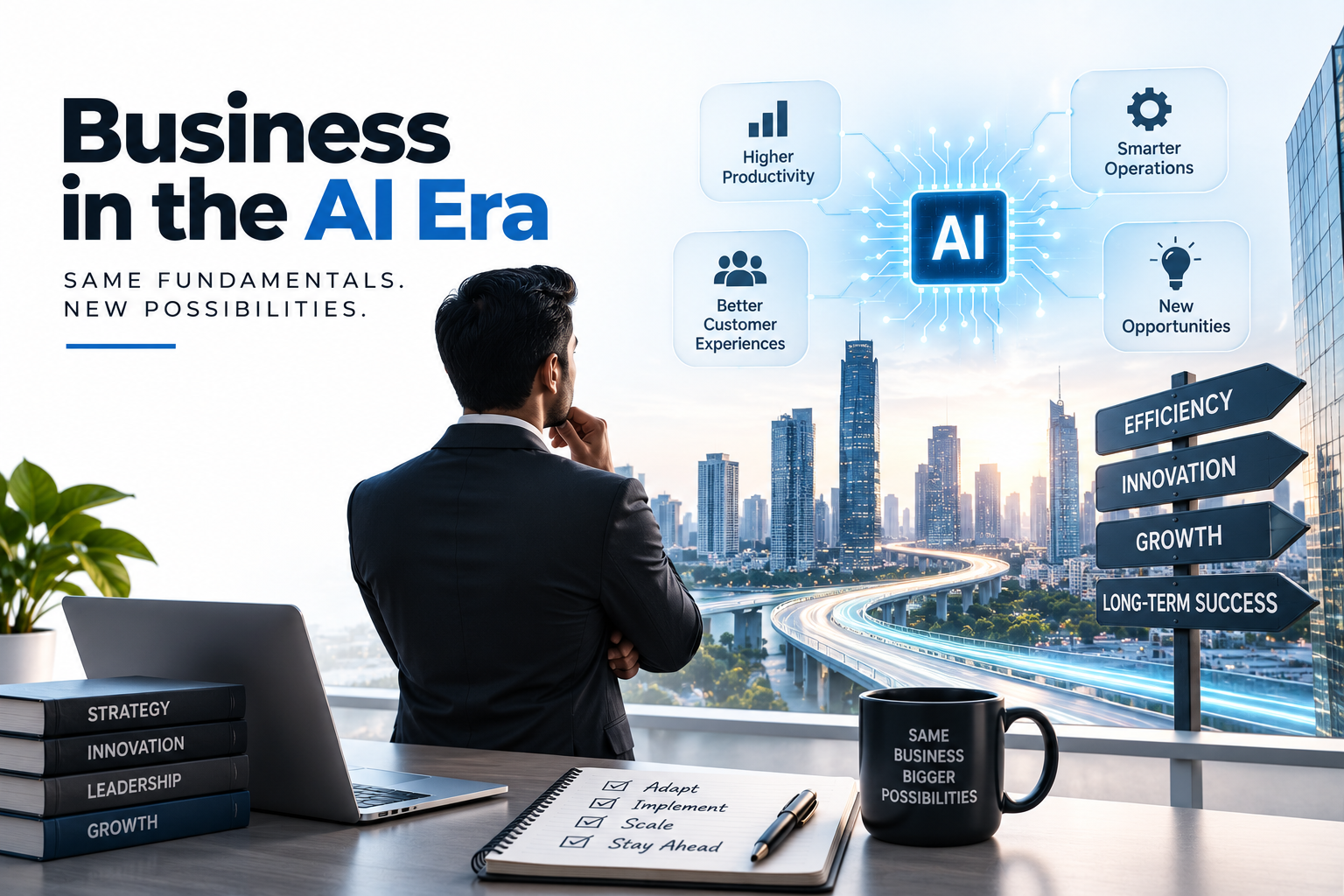
Key Takeaway: AI changes speed and scale, not fundamentals. The businesses winning right now are using AI to execute their strategy better, not replacing strategy with AI hype. Know your unit economics, stay close to your customers, have clear competitive positioning, and test before you scale. That was good advice in 2020 and it’s better advice now.