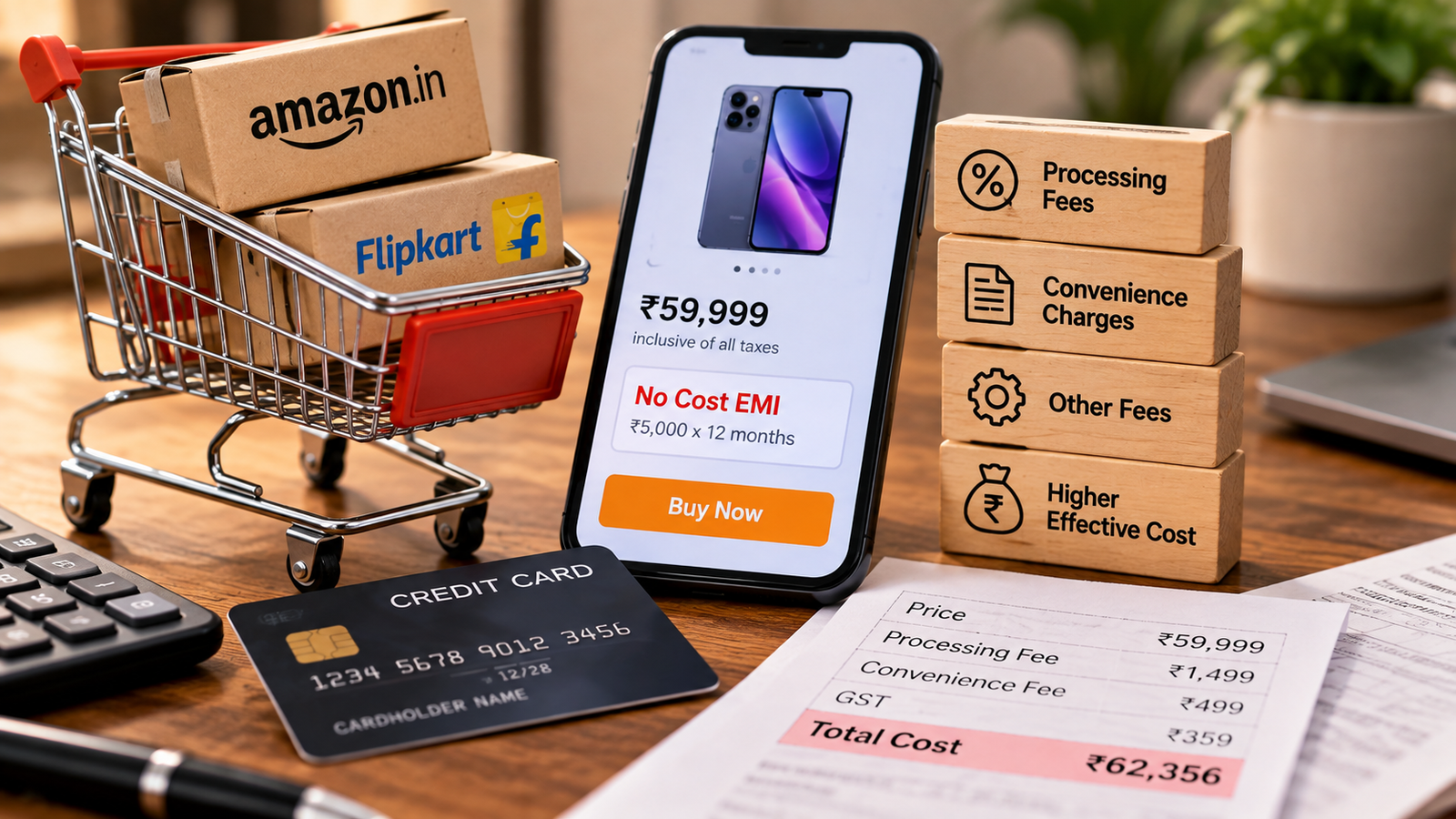
The festive sale banner says “No Cost EMI” in bold, the checkout shows a tidy monthly figure, and splitting a Rs 60,000 phone into six payments feels like a free loan. It isn’t quite. Before you tap that EMI button, check whether the monthly amount even fits your budget (our salary-based asset allocation guide helps with that), and then look at what the offer quietly costs you. Banks print these costs in their terms. Very few shoppers read them.
This guide explains how no-cost EMI works, lists the four charges that come with it, and runs the numbers on a Rs 60,000 purchase.
Is no-cost EMI really free?
Not fully. The bank still charges interest. The seller cancels it out with an equal discount. But you pay 18% GST on that interest, a processing fee plus GST, and you often lose cash-payment offers and reward points. Small amounts, but never zero.
How no-cost EMI actually works (the discount pays the interest)
There is no such thing as a zero-interest card loan. The RBI said so directly in a September 2013 circular on “pernicious practices” by banks, which stated that “the very concept of zero percent interest is non-existent.”
What actually happens at checkout:
- The bank lends you money at its normal EMI rate. SBI Card’s merchant EMI table (for transactions from 10 September 2026) lists 17% a year for a 6-month plan. HDFC Bank’s EasyEMI page shows 16% to 20%.
- The seller or brand gives you an upfront discount equal to the total interest for the tenure.
- The discount lowers the loan amount, so your EMIs add up to the original price.
So on a Rs 60,000 phone, you don’t borrow Rs 60,000. You borrow a little over Rs 57,000, pay interest on it, and the interest plus principal comes to Rs 60,000. The seller funds the gap because it wants the sale. The bank still earns its full rate.
Look at your card statement after the purchase. You’ll see the discount credited and interest debited each month. That interest line is where the extra costs come in.
The 4 hidden costs of no-cost EMI
1. Processing fee (plus GST)
Most issuers now charge a one-time fee to convert a purchase into EMI. Some current examples from bank terms pages:
- ICICI Bank: 2.99% of the transaction, capped at Rs 299 + GST, on Instant EMI (effective 1 September 2025).
- HDFC Bank: up to Rs 299 + GST for EMI at a merchant (since 1 August 2024).
- SBI Card: nil for 3 months; Rs 45 for 6 months, rising to Rs 169 for 24 months, on transactions of Rs 20,000 or more.
The seller’s discount does not cover this fee. And SBI Card’s terms say the fee is refunded only if the EMI is cancelled. It is not refunded if you foreclose.
2. GST on the interest
Interest on credit card EMIs is a financial service, and it attracts 18% GST. ICICI Bank’s terms say plainly that GST “will be applicable on processing fee, interest and foreclosure charges.” The seller’s discount matches the interest, not the tax on it. You pay the tax yourself, spread across your EMI months.
3. Lost cashback and reward points
This one is often bigger than the first two put together.
- Sale-period bank offers sometimes give a different discount for full payment and for EMI. Read the offer terms before choosing.
- Many cards don’t give reward points on EMI purchases. SBI Card stopped reward points on merchant EMI transactions from 20 November 2020. ICICI’s Instant EMI terms also exclude reward points unless the bank says otherwise.
4. Pre-closure (foreclosure) charges
Got a bonus and want to clear the EMI early? It costs you.
- HDFC Bank: 3% of the balance principal outstanding + GST.
- ICICI Bank: up to 3% of the outstanding principal plus the next month’s interest.
- SBI Card: 3% of the principal outstanding, plus taxes and interest adjusted to the request date.
Cancellation is different from foreclosure. ICICI lets you cancel within 15 days and reverses the charges. SBI Card cancels only after a full refund from the merchant within 45 days. If a no-cost EMI booking is cancelled, SBI Card’s terms say the merchant discount already credited “will be debited in full.”
Worked example: Rs 60,000 phone on a 6-month no-cost EMI
Here is the math on a typical festive-sale purchase. We’ve assumed a 16% annual rate (the bottom of HDFC’s published range) and a Rs 299 processing fee. Your bank’s figures will differ, but the structure stays the same.
| Item | Amount (Rs) |
|---|---|
| Listed price | 60,000.00 |
| Upfront “no-cost” discount (= total interest) | 2,703.35 |
| Actual loan amount | 57,296.65 |
| Monthly EMI × 6 | 10,000.00 |
| GST at 18% on Rs 2,703.35 interest | 486.60 |
| Processing fee Rs 299 + 18% GST | 352.82 |
| Extra you pay over the listed price | 839.42 |
That’s about 1.4% on top of the price. Now add the lost benefits. These figures are hypothetical, to show how fast they stack up:
- If the full-payment bank offer was Rs 1,500 higher than the EMI offer, that’s Rs 1,500 gone.
- If your card normally earns 1% back and EMI purchases earn nothing, that’s another Rs 600.
In that scenario, the “free” EMI costs about Rs 2,939 more than paying in full.
If you foreclose after two EMIs: roughly Rs 38,701 of principal is still outstanding. A 3% fee is Rs 1,161, plus Rs 209 GST, so Rs 1,370 extra. The processing fee isn’t refunded.
One more detail: your first EMI may not be exactly Rs 10,000. SBI Card’s terms explain that first-month interest is counted from the booking date to the first payment due date, so it can be slightly higher or lower than later EMIs.
The listed price itself also needs checking. A “no-cost” offer on an inflated MRP is just a regular price with extra steps. Our guide on how to spot fake discounts in festive sales shows how to check a product’s real price history before you buy.
Credit card EMI vs debit card EMI vs pay-later
| Credit card EMI | Debit card EMI | Pay later | |
|---|---|---|---|
| What it is | Purchase converted into instalments on your card | A pre-approved consumer loan linked to your savings account | A credit line from a bank or NBFC partner, used through an app or checkout |
| Credit limit | Full amount blocked; released as EMIs are paid | No card limit used | Uses your pay-later limit |
| Repayment | Added to your monthly card bill | Auto-debited from your bank account | As per the provider’s schedule |
| Who can use it | Credit card holders | Customers the bank pre-approves | Users the lender approves |
Debit card EMI is useful if you don’t have a credit card. But it is still a loan, with its own processing fee and foreclosure rules. HDFC’s debit card EasyEMI caps the processing fee at Rs 299 + GST, charges 3% + GST for pre-closure, and gives a 3-day cooling-off period.
For pay-later and other app-based loans, the RBI’s Digital Lending Directions, 2025 (issued 8 May 2025) require the lender to give you a Key Fact Statement before the loan. It must show the annual percentage rate (APR), all fees and the repayment schedule. You also get a cooling-off period of at least one day to exit by repaying the principal and the proportionate APR. Read the KFS: the APR tells you the real cost in one number.
Does no-cost EMI affect your CIBIL score?
Not directly, and not just because you took one. How you manage it is what counts:
- Credit utilisation goes up. SBI Card’s terms say the credit limit is blocked for the full transaction amount and freed up as EMIs are paid. A Rs 60,000 EMI on a Rs 1,00,000 limit means 60% utilisation from the first day. High utilisation can pull your score down until you pay it off.
- Missed EMIs hurt. The EMI is part of your minimum amount due. Miss it, and you get late fees and a late-payment mark on your credit report.
- Debit card EMI and pay-later are credit products too. They are loans from regulated lenders, so how you repay them shows up in your credit history.
- Too many at once looks like stress. Several EMIs running together tie up your limit and your monthly cash flow. That matters if you’re planning a home loan soon.
Paid on time, a no-cost EMI won’t hurt your score and can show steady repayment.
When no-cost EMI is genuinely worth it
It’s a good tool when:
- The full-payment offer and the EMI offer give you the same discount.
- Your card’s reward rate on the purchase is low or nil anyway.
- The processing fee is nil or small (a 3-month plan with SBI Card has no fee).
- Your money would otherwise earn more in a liquid fund or FD than the GST and fee cost you.
- You’re sure you won’t foreclose.
- The EMI is under about 10% of your monthly take-home pay and won’t push your card utilisation too high.
It’s a bad idea when you’re buying something you’d otherwise skip. The ease of small monthly payments is exactly what the seller is paying for.
Checklist before you tap ‘EMI’
- Compare the EMI offer with the full-payment offer on the same card.
- Check the processing fee on the payment page or in the SMS, and add 18% GST to it.
- Work out the GST on interest: total interest × 18%.
- Check whether the purchase will earn reward points as an EMI.
- Read the foreclosure charge and the cancellation window.
- Check how much of your credit limit will be blocked.
- For pay-later or app loans, read the APR in the Key Fact Statement.
- Check the product’s price history, so the “discount” isn’t on an inflated MRP.
FAQ
How does no-cost EMI actually work?
The bank charges its usual interest on the loan. The seller or brand gives you an instant discount equal to that interest, so your total EMIs add up to the product’s price. The interest is still charged. The seller pays for it.
Why is GST charged on no-cost EMI?
The interest the bank charges is a taxable financial service, so 18% GST applies to it. The seller’s discount covers only the interest, not the tax, so the GST shows up on your card statement. GST also applies to the processing fee and any foreclosure charge.
Does no-cost EMI affect my CIBIL score?
Only through how you use it. The full purchase amount blocks your credit limit, which raises utilisation until the EMIs are paid. Missed EMIs are reported as late payments. Paid on time, it doesn’t hurt your score.
Is debit card EMI cheaper than credit card EMI?
Not necessarily. Debit card EMI is a separate loan with its own interest, processing fee and foreclosure charges. Compare the total cost of both on the same product.
The bottom line
No-cost EMI is a real benefit, just not a free one. The interest is real, the GST is real, and the offers you give up can cost more than either. On a Rs 60,000 purchase the direct charges are under Rs 1,000. The bigger leak is the cashback and rewards you never see. Do the 2-minute check above, then decide.
The same habit of checking the full cost works for every money decision, from EMIs to SIPs. If you’re building that habit, start with our investing guide for India, from beginner to advanced.
Sources: SBI Card Merchant EMI and Convert2EMI terms and conditions; ICICI Bank Instant EMI terms and conditions; HDFC Bank EasyEMI terms; RBI circular RBI/2013-14/292 (17 September 2013); RBI (Digital Lending) Directions, 2025. Bank fees and rates change, so check your issuer’s current terms before you buy.