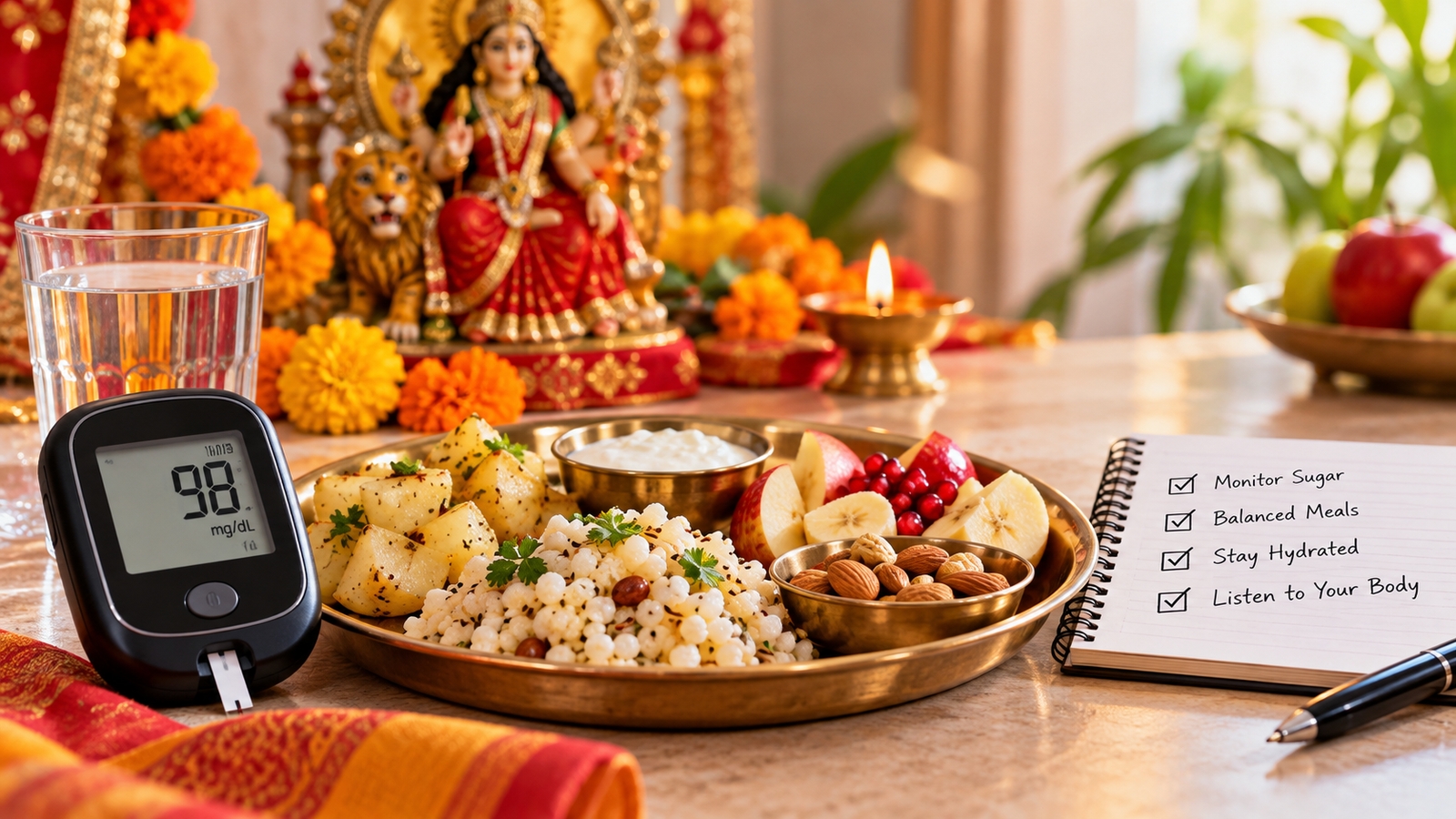
Sharad Navratri starts on 11 October and runs to 19 October. For nine days, a lot of Indian kitchens swap rice and roti for sabudana, kuttu, samak and aloo. If you live with diabetes, that swap matters more than the fast itself.
For most people, Navratri fasting for diabetics isn’t really about going without food. It’s about what replaces your usual meals and how long you go between them. Blood sugar is one part of the bigger picture in our complete guide to metabolic health. This post covers the nine days of vrat: which foods hit blood sugar hardest, who shouldn’t fast, sample plates, and the readings that mean you stop.
Read this first: this is general information, not medical advice. If you take insulin or tablets such as glimepiride or gliclazide, talk to your doctor before day one. Doses often need changing for a fast.
What 9 days of fasting does to blood sugar and muscle
There’s no single “Navratri fast”. Some families eat only fruit and milk (phalahar). Some eat one proper meal a day. Others eat small vrat meals through the day, and a few go nirjala, with no water at all. Indian endocrinologists class Navratri as an infrequent but prolonged fast, because it runs for eight or nine days in a row.
Whatever the pattern, blood sugar tends to swing both ways:
- Lows during the gaps. Long stretches without food can pull your sugar down, especially if you take sulfonylureas or insulin. These drugs keep lowering glucose whether you’ve eaten or not.
- Highs after the big meal. Many people break the fast with one heavy plate of sabudana vada, aloo, puri and mithai. That’s a lot of fast starch and sugar in one go, and it’s what drives the post-meal spikes.
- Dehydration. Going without fluids can cause dehydration, salt imbalance and low blood pressure. High sugar makes it worse, because your kidneys flush the extra glucose out with water.
This isn’t a niche problem. In a 2020 survey of 300 people with type 2 diabetes at three north Indian clinics, Navratri was the most commonly kept Hindu fast. Sweets and sugary drinks were common on fasting days, and only 1.35% of people had discussed their fasting diet with a doctor or dietitian.
Fasting and muscle loss
Vrat menus are low in protein. Dal, eggs and meat are off the plate, and the usual replacements (sabudana, potato, fruit) carry almost none. Nine days won’t wipe out your muscle, but low protein, fewer workouts and a calorie gap chip away at it, and that adds up over every Navratri, Ekadashi and weekly fast.
Fasting itself isn’t the muscle thief. In an eight-week trial, resistance-trained men who ate within an eight-hour window lost fat and kept their muscle and strength, because they still ate enough protein and kept lifting. That’s the part most vrat diets get wrong.
Navratri fasting and weight loss: read the scale carefully
If you’re a kilo or two lighter after nine days, much of that is usually water and less food in your gut, and it comes back within days. Plenty of people actually gain over Navratri, because fried vrat snacks and mithai are calorie-dense. Fat loss takes weeks of eating a little less than you burn.
Vrat foods ranked by glycaemic load (sabudana, kuttu, samak, rajgira, potato)
Two terms first. Glycaemic index (GI) tells you how fast a food’s carbs raise blood sugar compared with pure glucose. Glycaemic load (GL) also counts how much carb is on your plate: GI × grams of carbs ÷ 100. A GL of 20 or more is high, 11 to 19 is medium, and 10 or less is low. For a real meal, GL is the more useful number.
Navratri vrat foods and their glycaemic load
| Vrat food (typical serving) | Carbs | Protein | GI | GL per serving | Verdict |
|---|---|---|---|---|---|
| Sabudana khichdi (75 g dry sabudana) | ~66 g | <1 g | Not reliably measured* | ~35–50 (high) | Biggest spike risk. Halve it or skip it |
| Popped rajgira with 200 ml milk (30 g rajgira) | ~28 g | ~10 g | 97 in one small study† | ~21–28 (high) | Worse than rice. Avoid rajgira laddoos |
| Shakarkandi, boiled (150 g) | ~36 g | ~2 g | 63 | ~23 (high) | Lower GI than aloo, but more carbs per bite |
| Samak rice (60 g dry) | ~40 g | ~4–6 g | 42–50 | ~16–20 (medium) | Good default grain; watch the portion |
| Aloo, boiled (150 g) | ~22 g | ~2 g | 78 | ~17 (medium) | Once a day, not twice |
| Kuttu roti, 2 (60 g flour) | ~36 g | ~8 g | ~45‡ | ~16 (medium) | Good as roti or cheela, not puri |
| Banana (1 medium, ~100 g) | ~24 g | ~1 g | 51 | ~12 (medium) | One fruit, not three |
| Milk, no sugar (250 ml) | ~12 g | ~8 g | 39 | ~5 (low) | Steady, and adds protein |
Sabudana and blood sugar: the problem is the portion
Sabudana is made from tapioca starch, and it’s close to pure starch: about 88 g of carbohydrate in every 100 g of dry pearls, with almost no protein or fibre. Nobody has published a solid GI for it. The one small Indian test we found compared sago khichdi with bread rather than glucose, so it doesn’t give a GI score.
You don’t really need one. Even at a moderate GI, a normal khichdi plate lands deep in high-GL territory. If you can’t skip it, use 30–40 g of dry sabudana instead of 75 g, double the peanuts and vegetables, and eat it with curd. Skip sabudana vada: frying adds calories without fixing the starch problem.
The rajgira surprise
Rajgira (amaranth) is the protein star of the vrat grains, with about 13 g of protein per 100 g. But popped rajgira is fast. In a small study of people with type 2 diabetes in Hyderabad, popped amaranth with milk scored a GI of 97, against 69 for rice and 66 for wheat. Rajgira laddoos and chikki add jaggery on top, so they’re the worst way to eat it. Rajgira roti hasn’t been tested in people; if you eat it, pair it with paneer or curd.
Samak, kuttu and aloo
- Samak (barnyard millet) scored a GI of 50 in a small Indian study, and about 42 when the grain was heat-treated. It’s a sensible default grain for vrat days. Just keep the portion in check, around 40–60 g dry per meal.
- Kuttu (buckwheat) does better than its reputation. Boiled buckwheat groats raised blood sugar less than white bread did in a European study. Kuttu puri soaks up oil, so make cheela or roti instead.
- Aloo has a high GI (78 boiled) but only a medium load in a 150 g portion. The trouble is that vrat days often include it twice: sabzi at lunch, chips or tikki in the evening. Keep it to one potato dish a day.
- Shakarkandi (sweet potato) has a lower GI than potato but more carbs per bite, so a 150 g portion ends up with a higher load. “Healthy” doesn’t mean unlimited.
These spikes matter even if you haven’t been diagnosed with diabetes. If you have a growing waistline, high triglycerides or borderline sugar, read why doctors now say metabolic syndrome is more dangerous than obesity alone.
Navratri fasting for diabetics: who should not fast
There’s no blanket yes or no. Indian endocrinologists who’ve written on Navratri say fasting is reasonable mainly for people whose diabetes is well controlled, and that the decision should be made together with your doctor.
Don’t fast (or only with your doctor’s clear go-ahead) if:
- You’ve had a severe low in recent months, or you get lows without warning signs (hypoglycaemia unawareness).
- Your diabetes is poorly controlled.
- You’re pregnant.
- You have kidney disease, especially if it’s advanced.
- You’ve recently had diabetic ketoacidosis (DKA) or another diabetes emergency.
- You have a serious complication that puts a limb or organ at risk, such as an active foot ulcer.
- You’re unwell right now, with fever, infection, vomiting or diarrhoea.
Two groups need a specific plan rather than a simple yes or no:
- People on several insulin shots a day (basal-bolus), including most people with type 1 diabetes. A 2015 Indian consensus paper suggests this group reconsider fasting altogether.
- People on SGLT2 inhibitors (dapagliflozin, empagliflozin and others) who plan to cut fluids. These drugs make you pass sugar, and water with it, in your urine. Ask before going nirjala.
Who can usually fast, with care
People with well-controlled type 2 diabetes on diet alone or on medicines with a low risk of lows, such as metformin, are usually in a better position. The same 2015 consensus suggests that during Navratri, if regular meals are assured, daily medicines can continue, while sulfonylureas and insulin may be cut to about two-thirds of the usual dose. That’s your doctor’s call. Don’t work it out on your own.
Before day one
- See your doctor and agree on medicine doses for fasting days.
- Stock up on glucometer strips. Indian guidance on Hindu fasts notes that checking your sugar isn’t forbidden.
- Agree on your stop numbers (see below), and show your family what a low looks like.
Meal plan for diabetics: day plate examples
Indian dietary advice for Navratri is simple: small meals about every three hours instead of one big one, low-fat dairy and nuts for protein, whole fruit instead of juice, and grilling, roasting or steaming instead of frying.
The vrat plate
- Half the plate: vegetables your family allows on vrat, such as lauki, pumpkin, cucumber, tomato or spinach.
- A quarter: protein, such as paneer, curd, hung curd or peanuts.
- A quarter: one grain, such as samak, kuttu or rajgira roti.
A sample vrat day for diabetes
| When | What’s on the plate |
|---|---|
| Early morning | Tea or milk without sugar, 5–6 almonds |
| Breakfast | 2 small kuttu cheelas stuffed with paneer, mint chutney |
| Mid-morning | 1 apple or guava with a small bowl of curd |
| Lunch | Samak khichdi (40 g dry samak) cooked with lauki and peanuts, raita, cucumber |
| Evening | A small bowl of roasted makhana, a glass of chaas |
| Dinner | Paneer tikka or bhurji, pumpkin sabzi, 1 rajgira roti |
Busy professionals: the office version
Long meetings are where vrat days go wrong. You skip lunch, then eat everything at 9 pm. Pack samak pulao with paneer cubes, keep a fruit and a small box of roasted peanuts at your desk, and finish one bottle of water before lunch. Set a phone reminder for the 4 pm snack.
Meal plan for gym-goers: hitting 80–100 g protein on vrat food
The International Society of Sports Nutrition recommends 1.4 to 2.0 g of protein per kg of body weight a day for people who train. For a 60–70 kg lifter, the lower end works out to roughly 85–100 g. You can hit that on vrat food, but only if dairy does most of the work.
Vrat food protein, per serving
| Food | Serving | Protein |
|---|---|---|
| Whey protein (if your family counts it as vrat food) | 1 scoop (~30 g) | ~24 g (check label) |
| Greek yogurt or hung curd | 200 g | ~18–20 g (check label) |
| Paneer | 100 g | ~19 g |
| Cow’s milk | 250 ml | ~8 g |
| Peanuts | 30 g | ~7 g |
| Rajgira flour | 50 g | ~7 g |
| Kuttu flour | 50 g | ~6 g |
| Almonds | 20 g | ~4 g |
| Samak | 50 g dry | ~3–5 g |
| Sabudana | 75 g dry | <1 g |
A 100 g protein vrat day
| Meal | Food | Protein |
|---|---|---|
| Breakfast | 300 ml milk, 20 g almonds | ~13 g |
| After training | 1 scoop whey in 200 ml milk (or 200 g Greek yogurt) | ~30 g (~20 g) |
| Lunch | 2 rajgira rotis (60 g flour), paneer bhurji (100 g paneer), 150 g curd | ~32 g |
| Snack | 30 g roasted peanuts, cucumber | ~7 g |
| Dinner | Kuttu cheela (50 g flour) stuffed with 75 g paneer | ~20 g |
| Total | ~103 g (~93 g without whey) |
That’s 175 g of paneer across the day, so pick a low-fat paneer if you’re watching calories. Whether whey counts as vrat food depends on your family. If it doesn’t, Greek yogurt or hung curd covers most of the gap.
Training during Navratri
- Train after a meal, not at the end of a long gap.
- Keep lifting, even if you drop a few sets. Training is the signal that tells your body to hold on to muscle.
- If you have diabetes: Indian guidance on Hindu fasts advises limiting hard, optional workouts on fasting days. Walk instead, and check your sugar before you exercise.
Warning signs to break the fast
You’re allowed to break a fast for your health. These stop rules are adapted from the IDF and DAR International Alliance guidelines on fasting with diabetes. Check your sugar before meals, two hours after your main meal, and whenever you feel off.
- Blood sugar below 70 mg/dL: break the fast and treat the low straight away.
- Blood sugar above 300 mg/dL: break the fast, drink water and call your doctor.
- Signs of a low: shaking, sweating, a racing heart, sudden hunger or confusion, even before you can test.
- Signs of high sugar or dehydration: extreme thirst, passing urine very often, dizziness when you stand, very dark urine.
- Any acute illness: fever, vomiting or diarrhoea.
- Go to hospital for nausea with stomach pain, fast breathing, fainting or chest pain. These can signal ketoacidosis or another emergency.
How to treat a low
- Take 15 g of fast sugar: 1 tablespoon of sugar stirred into water, or half a glass (about 120 ml) of fruit juice.
- Recheck after 15 minutes. If you’re still below 70 mg/dL, repeat.
- Once you’re above 70, eat a proper snack or meal with some protein.
- If someone is too drowsy or confused to swallow safely, don’t force food into their mouth. Get medical help immediately.
FAQ
Can diabetics keep Navratri fasts?
Many people with well-controlled type 2 diabetes can, with a plan agreed with their doctor: adjusted medicine doses, small meals about every three hours, and regular sugar checks. People with frequent or unnoticed lows, poor control, pregnancy, kidney disease or a recent diabetes emergency should not fast.
Which vrat foods spike blood sugar the most?
Sabudana has the highest glycaemic load of the common vrat foods, because a normal khichdi plate carries about 66 g of almost pure starch. Popped rajgira, rajgira laddoos, sweet potato and anything made with sugar or jaggery come next. Samak, kuttu roti, milk, curd and paneer have a much smaller effect.
How do I keep my protein up while fasting?
Build every meal around dairy: paneer, curd, hung curd or milk. Add peanuts or almonds, and choose rajgira or kuttu over sabudana. A day with milk at breakfast, paneer at lunch and dinner, curd, peanuts and rajgira and kuttu rotis gets you to about 93 g of protein, or about 103 g if you add one scoop of whey.
The bottom line
Navratri fasting for diabetics works best when it’s planned, not improvised. Sort out your medicine doses with your doctor before day one. Lean on samak and kuttu, keep sabudana small, put dairy on every plate and know your stop numbers: under 70 or over 300 mg/dL.
And watch what the fast does to your body, not just your weight. Coming out of nine days lighter but weaker usually means some muscle went along with the water. That’s the same pattern behind people who look slim but have poor metabolic health, which we unpack in the difference between being skinny and being metabolically healthy. Muscle is one of the main places your body stores glucose, so protecting it pays off long after Dussehra.
This article is for general information and isn’t a substitute for advice from your doctor or dietitian.
Sources: Gupta et al., Indian J Endocrinol Metab 2017; Kalra et al., Indian J Endocrinol Metab 2015; north India fasting survey, US Endocrinology 2020; IDF–DAR guide to a safe fast; International GI tables, Diabetes Care 2008; Skrabanja et al. 2001 (buckwheat); Ugare et al. 2014 (barnyard millet); Chaturvedi et al. 1997 (amaranth); IFCT 2017, ICMR-NIN; USDA FoodData Central; ISSN protein position stand 2017; Moro et al. 2016 (time-restricted eating); American Diabetes Association (15-15 rule).