The dust from the 2026 World Cup final has barely settled, but FIFA has delivered its verdict, and it stings.
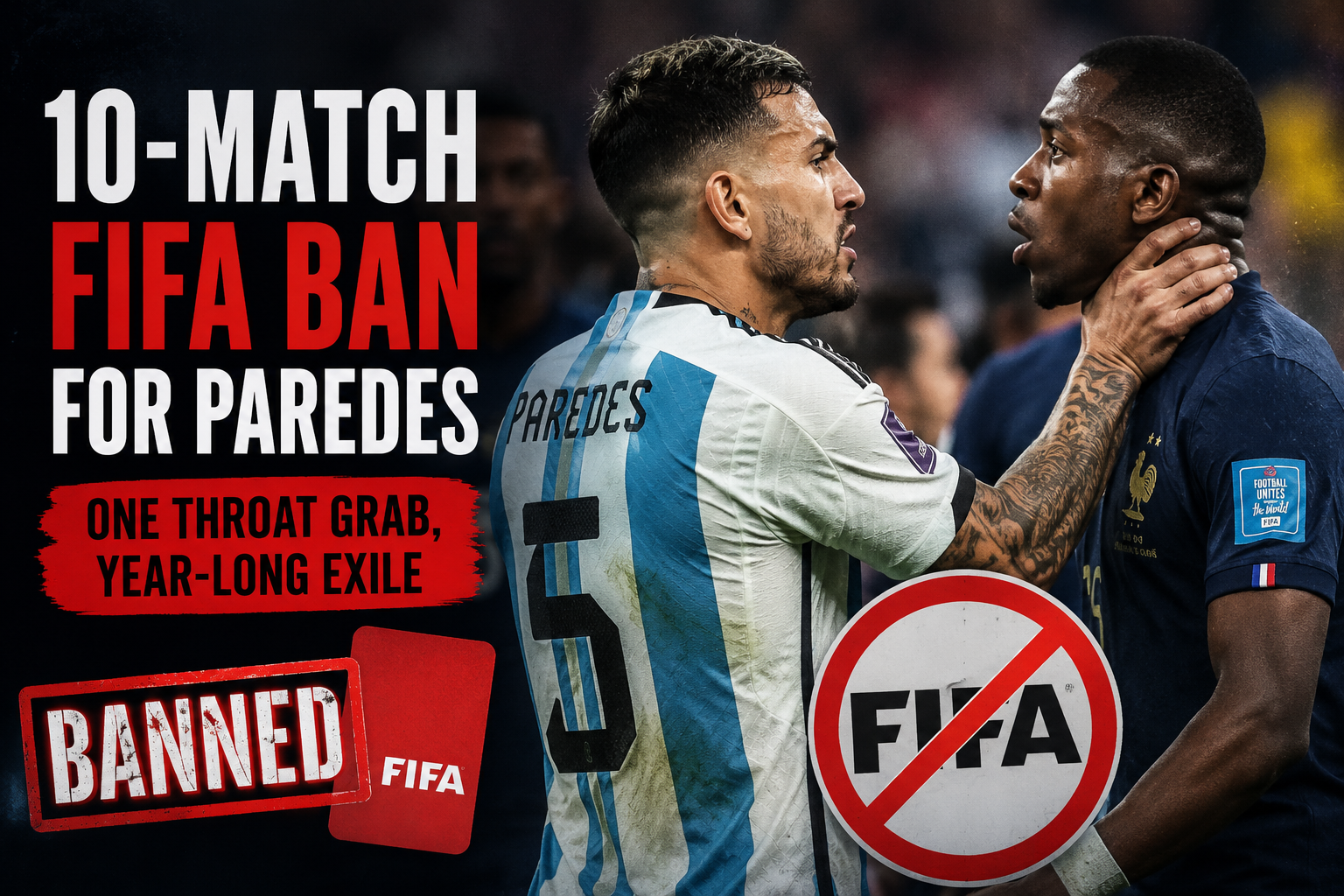
Leandro Paredes, the Argentine midfielder at the center of the ugly post-match brawl with Spain, has been banned for 10 international matches and slapped with a $90,000 fine. The punishment, announced on Friday, makes this one of the harshest disciplinary actions in World Cup history, sitting right alongside the four-month ban handed to Uruguay’s Luis Suarez for biting Giorgio Chiellini at the 2014 tournament in Brazil.
What Happened After the Final Whistle
Spain’s Ferran Torres struck in the 106th minute to seal a 1-0 extra-time victory at New York/New Jersey Stadium on July 19, giving La Roja their second World Cup title. Argentina, already reduced to 10 men after Enzo Fernandez picked up a second yellow card for a foul on Pau Cubarsi in stoppage time, fell short of becoming the first team since Brazil in 1962 to defend the trophy.
But the real chaos began after the final whistle.
As Spanish players and staff rushed onto the pitch to celebrate, Paredes went after Eric Garcia, grabbing the Spanish defender by the throat before knocking Gavi to the ground moments later. The 32-year-old’s aggressive outburst triggered a wider scuffle that pulled in players, coaches, and officials from both sides.
Nahuel Molina tried to shoulder Rodri as the Spanish captain ran past him during the celebrations. Assistant coach Roberto Ayala, a former World Cup defender himself, charged at Dani Olmo and reportedly attempted to punch the Spanish midfielder in the face. It took several minutes and the intervention of match officials to bring order back to the pitch.
The Full List of Punishments
FIFA’s Disciplinary Committee concluded its investigation on Friday and handed down penalties to multiple individuals as well as the Argentine Football Association (AFA) itself.
Paredes faces a 10-match suspension and a $90,000 fine. His ban effectively removes him from the national team until at least June 2027, since the FIFA international calendar includes roughly 10 fixtures between now and then. At 32, this could well mark the end of his Argentina career.
Molina received a 7-match ban along with the same $90,000 fine for his role in the melee. Thiago Almada was handed a 1-match suspension and fined $30,000. Ayala, now on Lionel Scaloni’s coaching staff, was banned from the touchline for 3 matches and fined $30,000.
On the Spanish side, Gavi also received a 1-match ban and $30,000 fine for his involvement in the scuffle.
The AFA was hit with a collective $321,000 fine. FIFA also ordered that Argentina’s next 2 home matches be played with only 50% of available seats occupied, a direct response to discriminatory chants and gestures from Argentine supporters during the tournament.
Beyond the Brawl: The Falklands Banner
The post-final fight was not the only charge on FIFA’s table. Following Argentina’s semifinal win over England in Atlanta, several players held up a banner reading “Las Malvinas son Argentinas” (“The Falklands are Argentine”) on the pitch. FIFA rules strictly prohibit political messaging at its events, and this was flagged as a breach of the disciplinary code.
This was the second time Argentina displayed the same banner at a major tournament. In 2014, the AFA paid a fine of roughly $33,000 for an identical display before a friendly against Slovenia. The 2026 incident carried far more weight because of its timing: a World Cup semifinal against England, the very nation Argentina fought in the 1982 Falklands War.
Argentine President Javier Milei called the players’ banner display “perfectly valid,” saying it reflected a sentiment shared across the country. FIFA clearly disagreed.
What This Means for Argentina Going Forward
For Paredes, the 10-match ban amounts to a full year away from international football. With Argentina’s squad heading into a generational transition ahead of the 2030 World Cup, his chances of wearing the blue and white shirt again look increasingly thin.
Scaloni’s team is entering uncharted territory. Lionel Messi, who turned 39 during the tournament and was visibly emotional after receiving his runner-up medal, appeared to play his last World Cup match. The eight-time Ballon d’Or winner admitted after the final that Spain deserved the win, saying simply, “I feel sad. They were better, to be honest.”
The reduced stadium capacity for home matches adds another layer of difficulty. Argentina’s passionate home support has always been a powerful advantage during South American World Cup qualifying campaigns. Playing 2 fixtures with half-empty stands at iconic venues strips away that edge during the early stages of the 2030 qualifying cycle.
FIFA’s message through these sanctions is loud and clear: no nation, regardless of its footballing pedigree, gets a free pass on the rules of fair play. Whether Argentina internalizes that lesson before the next qualifying window opens is another question entirely.