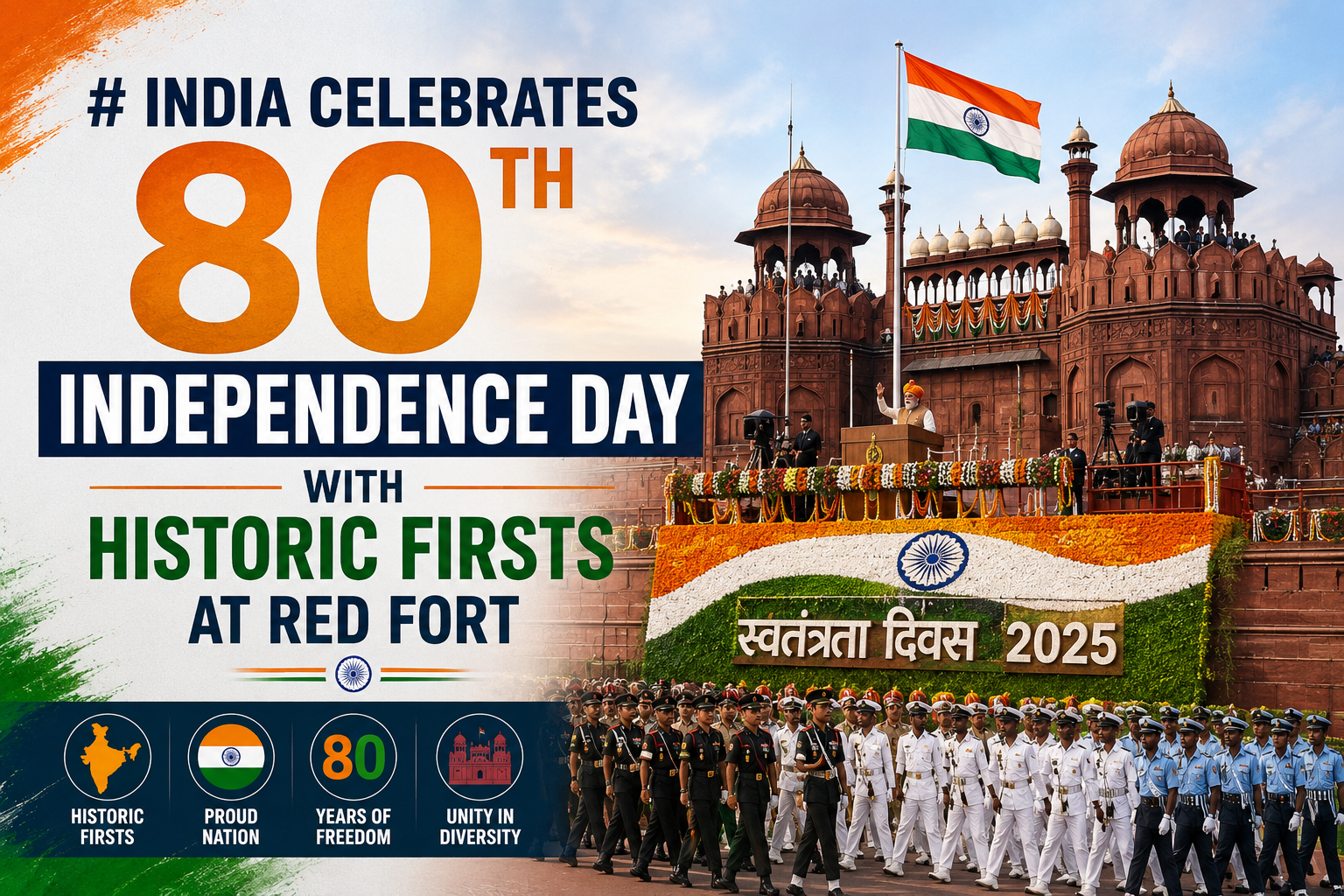
India marked its 80th Independence Day on August 15, 2026, with celebrations that blended tradition, technology, and a clear vision for the decades ahead. From the Red Fort ceremony in New Delhi to flag-hoisting events in remote villages and Indian missions around the globe, the day carried a sense of occasion that went beyond the annual routine.
This year stood apart for several reasons. The celebrations introduced historic firsts at the Red Fort, rolled out ambitious policy announcements, and brought together nearly 5,000 special guests from every corner of the country. Here is a closer look at what made the 80th Independence Day memorable.
Vande Mataram Echoes at Red Fort for the First Time
In a moment that stirred deep emotion across the country, the national song Vande Mataram was rendered at the Red Fort during the main Independence Day ceremony for the very first time. The occasion also marked 150 years since Bankim Chandra Chattopadhyay composed the song, which became an anthem of resistance during the freedom movement.
The twin themes for this year, “150 Years of Vande Mataram” and “Yuva Shakti for Viksit Bharat@2047,” brought the legacy of the freedom struggle face to face with modern aspirations. Displays across the Red Fort highlighted both these themes, connecting the sacrifices of the past with the energy of India’s young population.
PM Modi’s 13th Consecutive Address From the Red Fort
Prime Minister Narendra Modi delivered his 13th consecutive Independence Day address from the Red Fort, making it one of the longest unbroken streaks for any Indian leader at the historic venue. Wearing a traditional red tie-and-dye turban, he opened his speech by expressing solidarity with families affected by floods, landslides, and natural calamities across the country.
The flag-hoisting ceremony followed its time-honoured format, synchronized with a 21-gun salute by the gunners of the 1721 Field Battery (Ceremonial) using indigenous 105 mm Light Field Guns. The Guard of Honour comprised personnel from the Army, Navy, Air Force, and Delhi Police.
Shakti Ki Sapt Dhara: 7 Pillars for a Developed India
The centerpiece of the Prime Minister’s speech was the unveiling of “Shakti Ki Sapt Dhara,” a 7-pillar roadmap for India’s development journey toward becoming a developed nation by 2047. The 7 focus areas are manufacturing, agriculture and food processing, technology and innovation, Gati Shakti (infrastructure connectivity), Raksha Shakti (defence production), green and blue economy, and India’s soft power.
On manufacturing, the Prime Minister emphasized competitiveness, quality, and skill. This push for self-reliance gains added significance at a time when global trade dynamics are shifting and India finds itself navigating complex transshipment pressures. On defence, he pointed to a nearly 4-fold increase in defence production over the past 12 years and stressed the goal of becoming a global supplier of defence equipment. In a notable first, all equipment used during the Red Fort ceremony was indigenously built in India, underlining the Atmanirbhar (self-reliant) defence push.
On soft power, he highlighted yoga, ayurveda, holistic healthcare, handicrafts, culture, films, animation, gaming, and digital content as areas where India can deepen its global footprint.
AI Training for 1 Crore Youth and Free Online Coaching
Among the biggest announcements of the day was a plan to train 1 crore (10 million) young Indians in artificial intelligence skills within the next year. The Prime Minister described this era as one defined by robotics, AI, quantum technology, space, and data centres, and said India must position itself as a global hub of innovation.
He also announced free online coaching for competitive examinations, aimed at easing the financial burden on students from economically weaker and middle-class families. Instead of traveling to expensive coaching hubs, students would be able to access preparation material and guidance through digital platforms. These 2 announcements together signaled a strong youth-focused policy direction, pairing access to education with future-ready skills.
Har Ghar Tiranga 2026: A Global Flag Relay
The Har Ghar Tiranga campaign, now in its 5th year, ran from August 9 to 17, 2026, and carried special significance this time around. Dedicated to the 150th anniversary of Vande Mataram, the campaign encouraged citizens to hoist the tricolour at homes, offices, and public buildings.
A unique addition this year was a global flag relay. Indian missions and posts across the world hoisted the national flag in succession from east to west, following the path of the rising sun. As dawn broke across different time zones, the tricolour went up in country after country, creating a symbolic chain of unity spanning continents. The campaign was set to conclude on August 17 with a grand musical concert in New Delhi.
Digital Bhashini Translates the Speech in 22 Languages
Technology played a visible role in making the celebrations more inclusive. The AI-based translation platform Digital India Bhashini provided real-time translation of the Prime Minister’s speech into over 22 Indian languages. The goal was to ensure every citizen, regardless of their mother tongue, could understand the vision laid out from the Red Fort.
Military Bands Across 343 Locations
In the days leading up to August 15, military and security-force bands performed at 343 locations across India between August 8 and 15. These performances brought patriotic music to cities, towns, and smaller communities alike, expanding the festive atmosphere well beyond the capital.
Nearly 5,000 Special Guests at the Red Fort
Continuing a tradition of recent years, nearly 5,000 special guests were invited to witness the Red Fort ceremony. The invitees included women entrepreneurs, young innovators, farmers, grassroots workers, and beneficiaries of various government schemes. The idea behind this practice is to recognize ordinary citizens whose contributions drive progress at the community level.
A Day That Looked Both Backward and Forward
India’s 80th Independence Day managed to strike a balance between honouring the sacrifices that won freedom 79 years ago and setting the course for the next 2 decades. The themes of youth empowerment, indigenous technology, and self-reliance ran through every element, from the Vande Mataram rendition to the AI skilling announcement.
Schools, colleges, government offices, and local communities across the country observed the day with flag-hoisting ceremonies, cultural programmes, and patriotic songs. The Indian diaspora joined in from the United Kingdom, the United States, the Gulf nations, Australia, and beyond, with community gatherings and cultural performances.
As the celebrations wind down, the announcements made today, especially around youth skilling and the Sapt Dhara framework, will face the test of execution in the months ahead. But for now, the 80th Independence Day left the country with a renewed sense of purpose and pride.