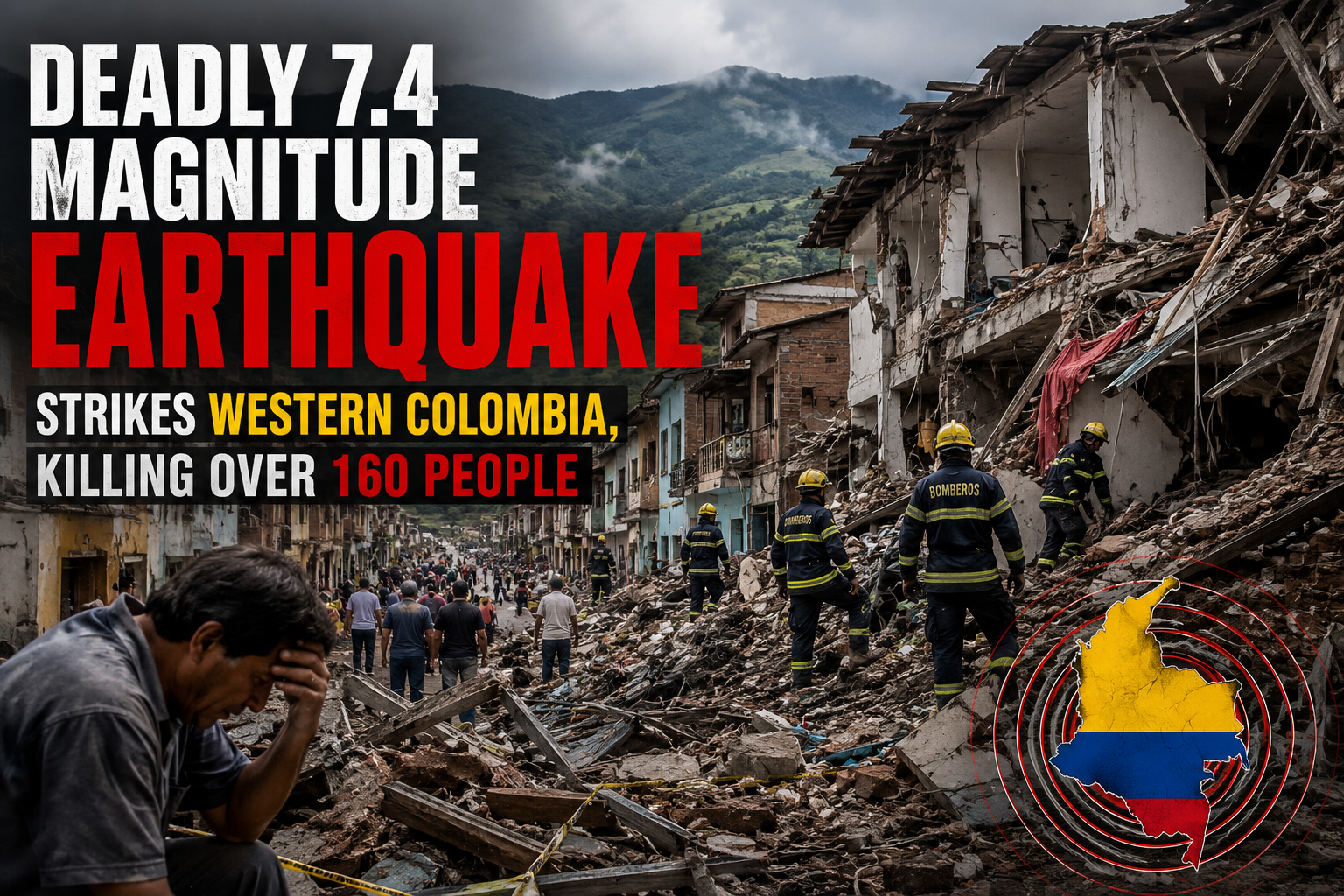
A devastating 7.4 magnitude earthquake ripped through western Colombia on Monday, August 10, 2026, leaving a trail of destruction across several major cities and killing at least 164 people. The death toll continues to climb as rescue teams dig through collapsed buildings, flattened homes, and shattered infrastructure in what Colombian authorities have called the strongest seismic event recorded in the country this century.
Epicenter and Scale of Destruction
The earthquake struck at 7:34 a.m. local time, with its epicenter located near San Jose del Palmar in the remote Choco region, approximately 400 kilometers west of the capital Bogota. The United States Geological Survey (USGS) measured the quake at a depth of 107 kilometers, and at least 21 aftershocks followed within hours of the initial tremor, including a notable 5.0 magnitude aftershock that rattled an already terrified population.
The Colombian Geological Service confirmed the earthquake was the largest seismic event recorded in the nation during the 21st century. Shaking was felt across neighboring countries, including Venezuela, Ecuador, and Panama, underscoring the immense energy released by the quake.
City by City: The Human Cost
The hardest hit areas span Colombia’s famous coffee-growing heartland, with 5 capital cities placed under red alert, the country’s highest disaster threat level. Pereira, the capital of the Risaralda region, bore some of the most devastating losses, with authorities reporting 66 deaths. Entire residential blocks were reduced to piles of concrete and twisted steel. Video footage verified from the city’s airport showed the terminal violently swaying during the quake, with large chunks of the ceiling collapsing as terrified passengers scrambled for cover.
In Cali, Colombia’s third-largest city with a population of roughly 2.2 million, at least 85 people were killed and 30 buildings collapsed outright. Mayor Alejandro Eder took to social media urging residents to remain calm and report damage immediately. A nighttime curfew was imposed from 8 p.m. to 6 a.m. after reports of looting emerged in the chaos that followed the quake.
Manizales, another major city in the coffee-growing belt, suffered its own symbolic wound when one of the towers of the Cathedral Basilica of Our Lady of the Rosary partially collapsed. The neo-Gothic cathedral, standing at roughly 119 meters tall, is recognized as the tallest cathedral in South America. Cracks spread across its facade, and part of a side tower crumbled, sending debris into the streets below.
The Choco region, where the epicenter was located, remains difficult to assess fully. Much of the area is only reachable by boat or plane due to dense jungle terrain, and authorities have deployed engineers, search dogs, and military personnel to reach communities that may have been cut off entirely.
Hospitals Overwhelmed, Health System Under Strain
Among the most alarming developments was the partial collapse of a hospital in Cali, where the pediatric and neonatal sections caved in on themselves. Hospital director Irne Torres Castro confirmed that some patients were trapped inside while roughly 600 others had to be treated on the rubble-strewn street outside. 7 health institutions across the affected region were forced to suspend operations entirely.
Remaining emergency rooms were overwhelmed within minutes as victims arrived with crush injuries, fractures, and trauma wounds. Health workers in both Pereira and Cali set up makeshift outdoor tents to treat the injured, while Colombia’s disaster management agency deployed specialized Urban Search and Rescue units from Bogota, Medellin, and Yopal to assist local teams.
Government Response and International Aid
Colombia’s newly inaugurated President Abelardo De La Espriella, who had only assumed office days before the disaster, declared a national state of emergency. Speaking to journalists on Monday evening, the president announced that 1,000 members of the security forces would be deployed to Cali by dawn and emphasized that the government had mobilized its full military and police apparatus for the response.
The disaster prompted a swift international response. The U.S. State Department announced a commitment of $15.5 million for earthquake relief, directed toward emergency shelter, food, protection, and structural assessments. Humanitarian organizations, including the International Rescue Committee (IRC), confirmed their teams were actively monitoring the situation and preparing to deploy resources.
7 airports across western Colombia suspended operations, including those in Armenia, Cali, Manizales, Pereira, Quibdo, Buenaventura, and Cartago. Roads, telecommunications networks, water supply systems, and energy infrastructure all sustained significant damage in the worst-affected zones.
Rescue Efforts Continue Into Second Day
As night fell on Monday, emergency teams aided by police, soldiers, and civilian volunteers worked through the darkness with excavators and bare hands, hunting for survivors beneath the rubble. In Pereira, rescue workers reported being in voice contact with a young boy trapped beneath a collapsed bakery while cranes were brought in to remove unstable sections of damaged buildings overhead.
Civilian volunteers played a critical role in the immediate aftermath. Carmen Yasmin Garcia, a 43-year-old Cali resident, described how her volunteer group managed to free 7 people from a collapsed building but remained desperately trying to reach 4 others still trapped inside.
By Tuesday morning, rescue operations had carried into a second day with no signs of slowing. Officials warned that the death toll was expected to rise further as teams reached more remote communities and continued clearing debris in urban areas. Over 2,700 people were reported missing as of Tuesday, and an estimated 5,000 homes were damaged or destroyed across the affected region.
Historical Context
The disaster has drawn immediate comparisons to a devastating 1999 earthquake that struck the same coffee-growing region, killing more than 1,000 people and leveling the city of Armenia. More recently, back-to-back earthquakes in neighboring Venezuela in June 2026 killed over 6,000 people, highlighting the ongoing seismic vulnerability of nations along South America’s Pacific coast and the Andean fault systems.
Colombia’s Pacific coastline sits along the Ring of Fire, the horseshoe-shaped belt of seismic faults encircling the Pacific Ocean where the vast majority of the world’s earthquakes and volcanic eruptions occur. The Choco region near the epicenter is one of the country’s poorest and most isolated, raising concerns about the long-term recovery prospects for communities already facing deep economic challenges.
As the search for survivors continues and the full scope of the disaster gradually comes into focus, the resilience of Colombian communities and the speed of international support will be critical in determining how quickly the affected regions can begin to rebuild.