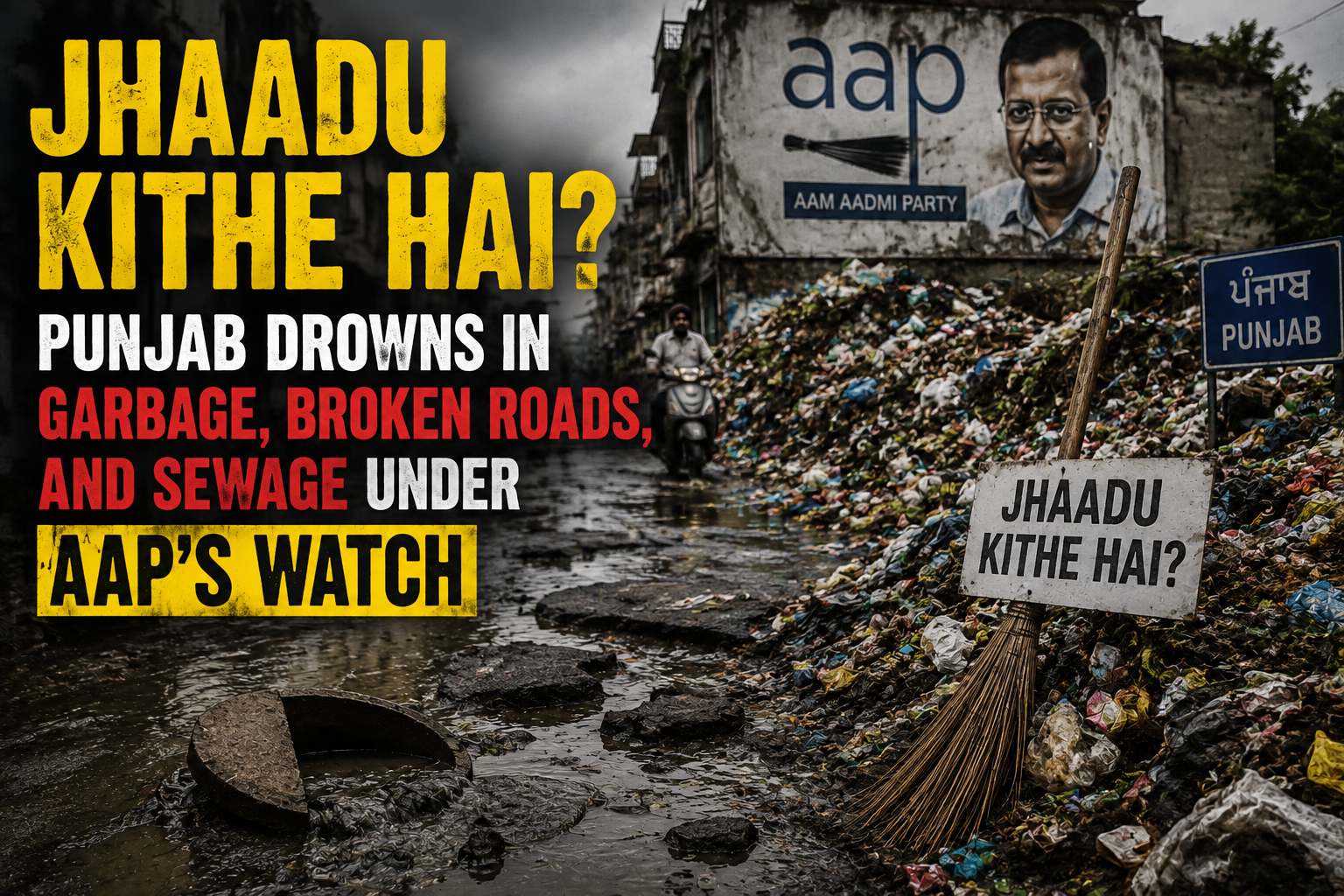
When the Aam Aadmi Party swept Punjab in 2022, the broom on its party symbol carried a powerful message. This government would clean up the mess left behind by decades of misrule.
4 years later, the irony could not be sharper. Punjab’s streets are buried under mountains of garbage. Its roads are crumbling into dangerous obstacle courses. Raw sewage flows openly through residential colonies.
The state that was promised a transformation is instead witnessing an infrastructure collapse. It touches every city, town, and village in Punjab.
The Punjab Garbage Crisis: A 3-Week Strike That Exposed the Rot
In mid-2026, over 30,000 sanitation workers across Punjab went on a pen-down strike. The reason was simple. The AAP government had failed to deliver on its promise of regularizing their employment.
The fallout was immediate and devastating. Garbage collection came to a grinding halt in nearly 120 of Punjab’s 167 urban local bodies.
Within days, massive heaps of rotting waste appeared outside markets, near hospitals, beside schools, and along residential streets. The Malwa, Doaba, and Majha regions were all affected.
A Waste Management System Running on Borrowed Time
However, the Punjab garbage crisis was not simply a consequence of the strike. It exposed a system that had been failing for years.
Punjab generates roughly 4,376 tonnes of solid waste every day. Only a fraction of it gets properly processed. By late 2025, the state had accumulated an estimated 84 lakh metric tonnes of legacy waste. Barely half of that had been addressed through bio-remediation efforts.
In other words, the strike did not create the waste management problem. It simply ripped away the thin cover that had been hiding it.
The “Jhaadu Kithe Hai?” Campaign
The opposition Congress party launched a biting campaign called “Jhaadu Kithe Hai?” (Where is the broom?) from Sangrur. That happens to be the home turf of Chief Minister Bhagwant Mann himself.
The campaign invited citizens to photograph and share images of garbage littering their neighborhoods. A satirical song released alongside the campaign carried a stinging line. It roughly translates to: the pride and dignity of Punjab is rolling in the dust.
Roads That Kill: Punjab Tops North India’s Pothole Death Count
The garbage crisis represents only one dimension of Punjab’s infrastructure decay. The condition of the state’s road network tells an equally grim story.
According to data presented in Parliament by Union Minister Nitin Gadkari, Punjab recorded 414 pothole-related fatalities between 2020 and 2024. That makes it the deadliest state for such accidents in all of North India.
To put that in perspective, Punjab accounted for nearly 56% of all pothole deaths in the region during that period. Haryana recorded 255 deaths. Delhi had 50. Himachal Pradesh had just 19.
Crumbling Roads Across Punjab
A ground-level tour across Punjab reveals why those numbers are so high. Rural roads, particularly in border areas like Tarn Taran district, have been left in shambles.
The road from Bhakna to Dhand is riddled with deep craters every few metres. Even toll roads like stretches of the Amritsar-Jhabal highway have sections where the top layer has washed away entirely. Near Fatahpur village, the road surface has disintegrated. Near Bohru village, an entire lane sits submerged under sewage overflow.
As a result, residents in these areas feel the current government has simply looked the other way. The AAP government’s Rural Development Fund (RDF) was supposed to maintain and upgrade rural infrastructure. Instead, it has been mired in legal battles and policy confusion.
Sewage on the Streets: Living in “Hell-Like Conditions”
If garbage and potholes represent the visible face of Punjab’s civic failure, the sewage crisis is its most hazardous dimension. Overflowing drains and untreated sewage are daily realities for lakhs of residents across the state.
Amritsar and Ludhiana: Ground Zero
In Amritsar’s Gurwali village, residents describe broken roads and open drains running alongside their homes. Wastewater pools on streets for days. Households discharge sewage directly onto roads because the drainage infrastructure simply does not exist.
In Ludhiana’s Dhandari Khurd area, sewers have been overflowing on and off for years. Local residents have staged multiple protests. However, every time the Municipal Corporation provides only temporary fixes that fail within weeks.
The Numbers Behind the Crisis
The scale of the problem is staggering. Official data shows that Punjab’s 166 urban local bodies generate around 2,128 million litres per day (MLD) of sewage.
The state has 132 sewage treatment plants. Their combined capacity, however, falls short. As a result, a significant portion of untreated sewage gets dumped directly into drains, rivers, and water bodies.
In Ludhiana, the infamous Buddha Nullah continues to pour toxins into the Sutlej River. This persists despite years of tall promises and massive expenditure.
Perhaps the most heartbreaking incident occurred in Sangrur. The family of a retired DSP had to wade through sewage water to perform his last rites. That single episode became a symbol of the indignity Punjab’s residents face daily.
Kharar: 3 Years of Digging, Zero Results
No town captures Punjab’s infrastructure circus quite like Kharar in Mohali district. For 3 straight years, residents of this rapidly growing satellite town near Chandigarh have watched their roads being dug up. Their streets have flooded with sewage. Their daily commutes have turned into endurance tests.
The pattern is predictable. Work starts, gets abandoned midway, and the cycle repeats. Then the next monsoon washes away whatever little progress was made.
The Kharar-Landran Road Disaster
The Kharar-Landran road has become the most visible symbol of this failure. It serves as a vital parallel link to the Chandigarh-Kharar highway connecting Ludhiana and Banur.
The stretch near Shivalik City turns into a swamp after even light rainfall. Sewage from Shivalik City and surrounding housing societies drains directly into the NHAI storm drain. That drain overflows routinely and floods the national highway.
The Kharar Municipal Council deploys pumps as a temporary fix every monsoon. The underlying problem, however, remains untouched year after year.
Shivalik City: Craters, Crashes, and Abandoned Projects
Residents of Shivalik City, Sector 127, have described 1-foot-deep craters on their roads. Vehicles get damaged on a daily basis. 2-wheeler riders regularly fall off while navigating rough patches at night.
Authorities carried out sewage line work for 3 months in the area. Then they abandoned the project midway. This left roads in worse condition than before. After the sewer lines were re-laid, monsoon commutes became even more dangerous because the dug-up surfaces were never properly restored.
Frustration Across Kharar’s Neighborhoods
The frustration extends well beyond Shivalik City. Residents of Chajjumajra, Santemajra, Khunimajra, and Sunny Enclave have been complaining about waterlogged roads and potholes for years.
In Sunny Enclave, residents have been forced to fill potholes themselves out of sheer desperation. Meanwhile, the Nijjar Chowk to Chhajju Majra road was torn apart during sewer and stormwater line installation. The Rs 2.09 crore repair project launched to fix it only confirmed how badly the original work had been bungled.
Political Promises That Ring Hollow
Anandpur Sahib MP Malvinder Singh Kang visited Kharar after mounting public anger over the dismal state of infrastructure. During his visit, residents unloaded their frustrations about broken roads, non-existent sewerage, and waterlogging.
Kang acknowledged the problems and promised resolution within a year. But for Kharar residents who have heard identical promises for 3 years running, those words ring hollow.
The Shivalik Sewage Treatment Plant (STP) is supposed to permanently resolve the sewage overflow. It is still under construction. Pipeline tenders were only recently allotted. Meanwhile, every monsoon brings the same chaos, the same flooding, and the same cycle of outrage followed by silence.
BJP leader Vineet Joshi, the party’s Punjab State Media Head, placed the blame squarely on the AAP-led state government. He cited what he called incompetence, negligence, and corruption. For the residents of Kharar, however, political finger-pointing matters far less than results.
Monsoon Season: When Everything Gets Worse
Every monsoon season amplifies Punjab’s infrastructure failures tenfold. Bathinda residents have been staging protests year after year. They report 4 to 5 feet of rainwater stagnating in their streets with no drainage to carry it away.
The pattern repeats in Muktsar, Zirakpur, Abohar, Jalandhar, and dozens of other towns across Punjab.
The root cause is a fundamental absence of stormwater management planning. Drainage systems in most Punjab cities were designed decades ago. They were built for populations and rainfall patterns that no longer apply.
Despite this, the AAP government has not undertaken any significant overhaul of urban drainage infrastructure in its 4 years in power. Consequently, every monsoon turns streets into lakes. It damages freshly laid roads. It mixes floodwater with sewage, creating a public health emergency that has become so routine it barely makes headlines anymore.
Promises vs. Performance: Where Did the “Badlav” Go?
The AAP government came to power with an aggressive reform agenda. Chief Minister Bhagwant Mann promised a complete overhaul of public services, transparent governance, and an end to corruption. Yet 4 years into his tenure, the most basic civic responsibilities remain unmet.
Punjab is not alone in this pattern. Public anger has been erupting against governance failures across Indian states.
The Settlement Came Too Late
Garbage is not being collected. Roads are not being maintained. Sewage systems are not being upgraded. The sanitation workers who keep cities functional went on strike because the government could not regularize their employment.
When the settlement was finally reached in early August 2026, it included bringing outsourced workers under the contractual system. Their monthly salary was enhanced to Rs 20,500. Contract employees from 2021 were to be regularized. But by that point, the damage to public health and the government’s credibility had already been done.
Environmental groups have been sounding alarms for years. The Public Action Committee (PAC), a group of environmentalists focused on solid waste and sewage disposal, has repeatedly pointed out the irony. The broom on AAP’s flag was supposed to symbolize cleanliness and accountability. Instead, it has become a punchline.
What Punjab Actually Needs to Fix the Garbage Crisis
The solutions are neither mysterious nor impossible. Punjab needs to modernize its waste management infrastructure. This means mechanized processing, proper segregation at source, and formal integration of informal waste workers into the system.
Additionally, the state needs a massive overhaul of its drainage and sewage networks. Cities that have outgrown their colonial-era systems cannot keep relying on infrastructure designed for a fraction of their current population.
Sustained investment in road maintenance is equally critical. Building new roads that deteriorate within a single monsoon solves nothing.
Most importantly, Punjab needs a government that treats these issues as genuine emergencies. Temporary fixes and political spin are not substitutes for clean streets, safe roads, and functioning drains. The residents of Punjab pay taxes and vote in elections with the expectation that basic civic services will function. That expectation is not being met.
As the 2027 Assembly elections approach, voters across Punjab will have to weigh whether the AAP government delivered on the fundamental promise its symbol represents. Right now, the broom appears to be missing in action.