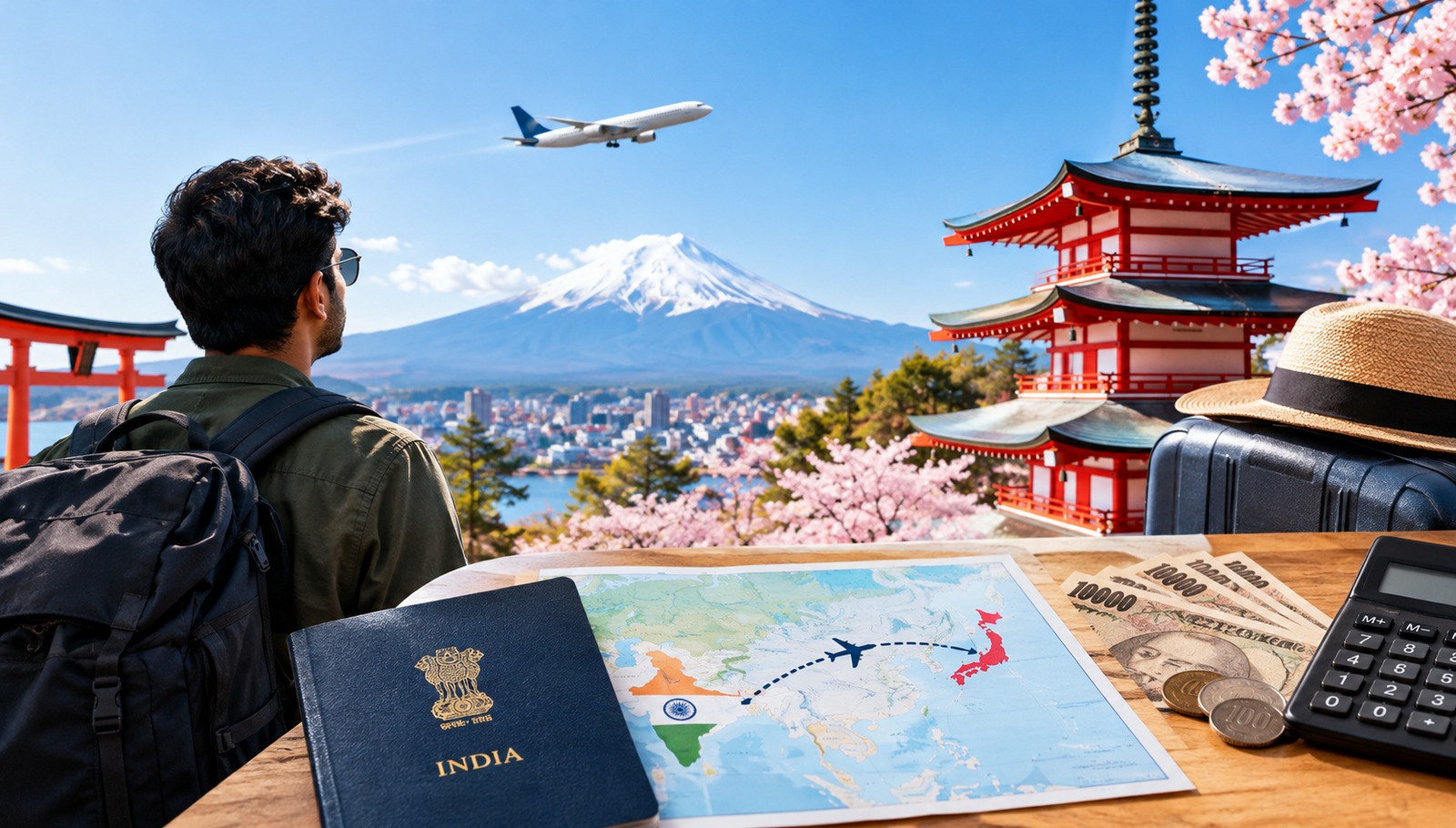
A week in Japan from India costs roughly ₹1,19,000 per person at the lean end and ₹3,26,000 at the comfortable end, flights included. The visa is the cheap part. The rail pass is the line to question. If Japan is still on your shortlist, our complete visa and destination guide for Indian travellers shows where it sits against the alternatives.
Three things changed in 2026 that move your budget. The departure tax tripled to ¥3,000 on 1 July. The nationwide JR Pass went up on 1 October. Tax-free shopping switches to a refund-at-departure system on 1 November.
Every line below is in rupees. I flag which numbers come from official sources and which are planning assumptions to overwrite with your own quotes. Yen converted at ¥1 = ₹0.6045 (ECB reference rate, 26 October 2026).
1. Japan visa for Indians: steps, fees and timeline
Indian passport holders need a visa for Japan. India is not among the 74 countries and regions on the Ministry of Foreign Affairs’ short-stay visa exemption list (page updated 1 September 2025).
What the visa costs
- Visa fee: ₹500 for Indian nationals, single or multiple entry, for applications from 1 July 2026 to 31 March 2027, according to the Consulate-General of Japan in Mumbai. Other nationalities pay ₹8,650 for a single entry visa.
- VFS Global service fee: charged on top. VFS sets the amount, so read it on their page when you apply.
- How to pay: the consulate lists the visa fee as cash only.
Steps, in order
- Pick your dates. Applications are accepted from 3 months before your travel date.
- Fill in the application form. It is on the consulate’s visa page.
- Collect your documents from VFS Global’s Japan checklist. Use their list, not a blog’s, this one included.
- Submit at a VFS centre. The embassy says no prior appointment is needed.
- Wait. Processing takes a minimum of 5 working days after receipt. The embassy warns it can vary significantly and cannot be expedited.
- Set up Visit Japan Web. The embassy links to it from its visa page.
The eVISA, and the one airport rule that trips people up
Japan has issued eVISAs in India since 1 April 2024. It covers single entry tourism of up to 90 days, for Indian and foreign nationals who live in India. You still apply through VFS Global. The difference is that you receive the visa electronically instead of as a sticker.
At the airport you have to show the visa issuance notice on a mobile device, with internet access. The embassy says a PDF, photo, screenshot or printed copy will not be accepted. Charge your phone and keep your data working.
Notes from the embassy
- Pay only the visa fee and the VFS service charge. The embassy says it never asks for payment by phone or email.
- Buy overseas travel insurance. The embassy lists it as recommended.
- Do not bring meat products, vegetables or fruit into Japan.
If you have been refused a visa before, read our piece on why Indian passport holders get rejected before you file. It covers the paperwork patterns behind refusals.
2. Flights from India to Japan: routes and months
Air India flies to Tokyo Haneda from Delhi, and it added a Mumbai–Haneda route from 15 June 2026. It has also announced a Delhi–Osaka (Kansai) nonstop from 2 February 2027. Schedules have shifted this year, so check the frequency before you build a plan around one weekday.
One routing idea is worth pricing: fly into Tokyo and home from Osaka. It drops the Osaka-to-Tokyo Shinkansen ride, which is ¥12,980 (₹7,847) at the advance fare used in the budget below. Compare that with the open-jaw fare difference.
I am not publishing a fare-by-month table. Airfares move daily and no official dataset publishes them. What is fixed is the calendar:
- JR Central’s discounted Hayatoku 21 Shinkansen fare is not sold in busy periods such as Golden Week, Obon and the New Year holiday.
- Cherry blossom in Tokyo, Kyoto and Osaka typically falls between late March and early April, and the date shifts from year to year.
- The departure tax is already inside your ticket price, so you will not see it as a separate charge.
The budget below uses ₹50,000, ₹65,000 and ₹1,10,000 for the return flight. Those are my planning inputs, not quoted fares. Replace them with a live quote for your dates.
3. 7-day Japan trip cost from India at 3 budget levels
This is per person, sharing a twin room, for 7 days and 6 nights on the Tokyo, Kyoto and Osaka route in section 5. Hotels, food, city transport and sights are daily budgets I set. Treat them as a template.
| 7-day Japan trip cost from India (per person) | Budget | Mid-range | Comfort |
|---|---|---|---|
| Return flight (assumption) | ₹50,000 | ₹65,000 | ₹1,10,000 |
| Hotels, 6 nights | ₹25,400 | ₹50,800 | ₹1,08,800 |
| Food and drink, 7 days | ₹14,800 | ₹25,400 | ₹50,800 |
| Shinkansen, Tokyo–Kyoto and Osaka–Tokyo | ₹15,700 | ₹15,700 | ₹15,700 |
| City and airport transport | ₹6,300 | ₹8,500 | ₹14,800 |
| Sights and activities | ₹6,300 | ₹12,700 | ₹25,400 |
| Visa fee (excluding VFS service fee) | ₹500 | ₹500 | ₹500 |
| Total per person | ₹1,19,000 | ₹1,78,600 | ₹3,26,000 |
What sits behind each column
- Budget: ¥7,000 a night for a bed, ¥3,500 a day for food, ¥1,500 a day for city transport, ¥1,500 a day for sights.
- Mid-range: ¥14,000 a night, ¥6,000 a day for food, ¥2,000 a day for transport, ¥3,000 a day for sights.
- Comfort: ¥30,000 a night, ¥12,000 a day for food, ¥3,500 a day for transport, ¥6,000 a day for sights.
- Shinkansen, all columns: ¥12,430 for Tokyo to Kyoto plus ¥12,980 for Tokyo to Shin-Osaka, the advance-purchase Hayatoku 21 adult fares on JR Central’s SmartEX price sheet from 13 March 2026. That is ¥25,410. I rounded up to ¥26,000 to cover the short Kyoto–Osaka hop.
What the table leaves out
- The VFS Global service fee.
- Travel insurance.
- Shopping, gifts and souvenirs.
- A SIM or eSIM, and any foreign-transaction fees your card charges.
If eVISA, visa-free and visa on arrival blur together, our explainer on what each term actually means for Indian travellers sorts them out in a few minutes.
Cherry blossom vs winter: how the bill moves
I have not put a percentage on a peak-season hotel uplift, because no official source publishes one. Do the arithmetic yourself instead:
- Every extra ¥1,000 per person per night adds ¥6,000 over six nights, about ₹3,627.
- If the same room costs ¥10,000 more per person per night in blossom week, the six-night total rises by ¥60,000, about ₹36,272.
- Swap your real hotel quotes into the hotel row. Every other row stays put.
4. The 3,000-yen departure tax, and is the JR Pass still worth it?
Departure tax: what changed
Japan’s International Tourist Tax is now ¥3,000 per departure, from 1 July 2026. It was ¥1,000. At today’s rate that is about ₹1,814 instead of ₹605, a rise of about ₹1,209 per person. A family of four adults pays ¥12,000, about ₹7,254.
- Infants under 2 are exempt, per the Japan Tourism Agency.
- If you leave on eligible tickets issued on or before 30 June 2026, the old ¥1,000 still applies.
- Air and sea carriers normally collect it by adding it to the ticket price.
The JR Pass in 2026
JR Group raised nationwide pass prices from 1 October 2026. The 7-day Ordinary adult pass is now ¥53,000 (about ₹32,041), up from ¥50,000. The 14-day pass is ¥84,000 and the 21-day pass is ¥105,000. JNTO notes that the official JR Pass website was offering pre-October prices for a limited time, so check what it shows on the day you buy.
Now the maths for our route. The two long rides, Tokyo to Kyoto and Osaka back to Tokyo, come to ¥25,410 (about ₹15,361) at the Hayatoku 21 fares. Even at ¥15,420 each way, a Tokyo–Shin-Osaka reserved fare Kyodo has reported, the pair costs ¥30,840 (about ₹18,644). Both are well under ¥53,000.
Two more reasons to skip it here. The pass does not cover Nozomi and Mizuho trains without a supplement. And Hayatoku 21 has rules: you book between one month and 21 days before travel, seats are limited per train, you cannot change the train after booking, and you cannot get off partway. You can board with a traffic IC card or a QR ticket.
So who should buy the pass? Someone whose route stacks long rides on top of Tokyo–Kyoto–Osaka. Add up the actual fares leg by leg first. If the total beats ¥53,000, buy it. If not, don’t.
5. Sample 7-day itinerary: Tokyo, Kyoto, Osaka
This is the route the budget prices: three nights in Tokyo, two in Kyoto, one in Osaka, with two long Shinkansen rides.
| Day | Where | Plan |
|---|---|---|
| 1 | Tokyo | Land, check in, short walk, early night. Sort out your IC card. |
| 2 | Tokyo | Asakusa and Senso-ji in the morning, Ueno in the afternoon. |
| 3 | Tokyo | Meiji Shrine, Harajuku and Shibuya, then Shinjuku in the evening. |
| 4 | Tokyo to Kyoto | Shinkansen ride one. Gion in the late afternoon. |
| 5 | Kyoto | Fushimi Inari early, then Arashiyama or Kiyomizu-dera. |
| 6 | Kyoto to Osaka | Short train hop. Osaka Castle, then Dotonbori in the evening. |
| 7 | Osaka to Tokyo | Shinkansen ride two, then your flight home. |
Day 7 is tight. Book a flight that leaves in the evening, or fly home from Osaka and skip the second ride. If you fly home from Osaka, take ¥12,980 (about ₹7,847) off the Shinkansen row and compare that saving with the open-jaw fare difference.
6. Money tips: cards, IC cards and tax-free shopping
Cards and cash
- Switch on international usage in your bank app before you leave.
- Ask your bank for the foreign-transaction markup in writing. It decides which card you tap.
- Keep some yen in cash for small places that don’t take cards.
IC cards
A Suica-type IC card covers trains and buses in the big cities, and Hayatoku 21 accepts it for boarding. JR East has an English Welcome Suica Mobile app for overseas visitors, but it supports iPhone and Apple Watch only. Welcome Suica cards are sold at selected JR East locations. Android users should plan on a card.
Tax-free shopping from 1 November 2026
The old system took the tax off at the counter. The new one is a refund at departure. Here is how it works, per JNTO and japan-guide:
- Show your passport at the shop. The purchase is logged electronically.
- Pay the full tax-inclusive price, including the 10% consumption tax.
- The minimum is ¥5,000 before tax at the same shop on the same day, unchanged.
- Before check-in, complete the departure procedure at a customs terminal or on Visit Japan Web. A green result means go to check-in. A red result means a customs inspection.
- Buy within 90 days of departure. The old split between general goods and consumables is gone, but consumables must not be used in Japan.
- If you buy several items in one transaction, all must be with you at departure. Otherwise the whole purchase loses the refund.
Get an entry stamp in your passport. Some shops may still look for one, so ask for it right after the automated gate if you use one.
Bottom line
Japan is not cheap from India, but it is predictable. The visa is ₹500 plus a service fee, the departure tax is about ₹1,814, and the Shinkansen on this route beats the rail pass. Everything else is the hotel, the food and the flight, and you control those.
If ₹1,19,000 is more than you want to spend, our guide to the cheapest countries to travel from India is the better place to start.
Sources and last check
Checked on 27 October 2026. Fees, prices and rules can change, so confirm on the official pages before you pay.
- Embassy of Japan in India: visa information and the Consulate-General in Mumbai fee table
- Embassy of Japan: JAPAN eVISA system
- Ministry of Foreign Affairs: short-stay visa exemption list
- JNTO: JR Pass price changes, international tourist tax and tax-free shopping
- Japan Tourism Agency: International Tourist Tax overview
- JR Central SmartEX: Hayatoku 21 and its fare sheet from 13 March 2026
- japan-guide: tax-free shopping rule change
7. FAQ
How much does a 7-day Japan trip cost from India?
Plan on roughly ₹1,19,000 per person at a lean level, ₹1,78,600 mid-range and ₹3,26,000 at a comfortable level, with return flights included. The flight, hotel and food lines drive most of the difference. The visa fee is only ₹500 plus the VFS service fee.
Do Indians need a visa for Japan?
Yes. India is not on the Ministry of Foreign Affairs list of countries with visa exemption for short stays. Indian nationals pay ₹500 for a single or multiple entry visa (applications from 1 July 2026 to 31 March 2027), plus a VFS Global service fee. The consulate says processing takes a minimum of 5 working days after it receives the application.
Is the JR Pass still worth it?
Not for a Tokyo, Kyoto and Osaka trip. The 7-day Ordinary pass costs ¥53,000 (₹32,041) from 1 October 2026. The two long Shinkansen rides on that route add up to ¥25,410 (₹15,361) at JR Central’s advance Hayatoku 21 fares. Add up your own legs before you buy; the pass only starts to compete when a route stacks up many long rides.
What is Japan’s departure tax in 2026?
It is ¥3,000 per person leaving Japan from 1 July 2026, up from ¥1,000. At today’s rate that is about ₹1,814. Infants under 2 are exempt, and airlines normally add it to the ticket price.
Can I get a Japan eVISA from India?
Yes, for single entry tourism of up to 90 days if you live in India. You still apply through VFS Global, but you receive the visa electronically. At the airport you must show the visa issuance notice on a mobile device; PDFs, photos, screenshots and printouts are not accepted.
Is tax-free shopping changing in 2026?
Yes. From 1 November 2026 you pay the tax-inclusive price at the shop and claim the refund when you leave Japan, by completing a departure procedure before check-in. The minimum spend stays at ¥5,000 before tax at one shop on one day.
Can I do Japan as a last-minute December trip?
It is risky. Applications open 3 months before travel and take a minimum of 5 working days, and the embassy says it cannot expedite them. For a December trip with no visa wait, see our list of the 12 best countries for a last-minute December trip.