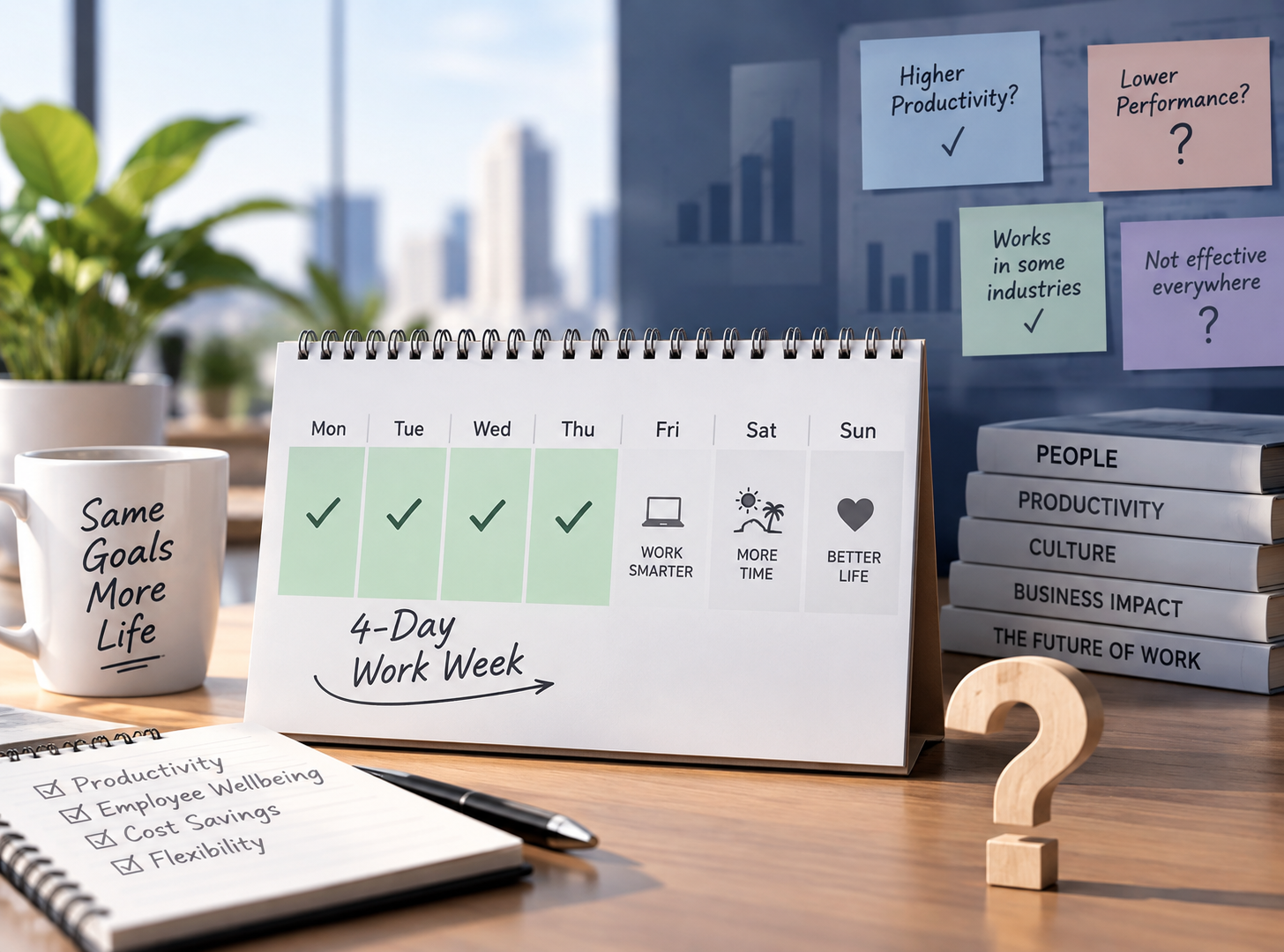
The 4-day work week has been sold to us for years as the future of work. Fewer hours, same pay, happier humans, better output. Then you look at the actual trials and things get complicated. Iceland says it worked. The UK says mostly yes. Japan tried it and quietly stepped back. Some companies inside the same trial report huge wins, others say productivity fell off a cliff. So what is really going on? If you are a founder, a people-ops lead, or just someone tired of Fridays, you need the honest picture — not the LinkedIn version. For a broader take on how modern businesses are being rewired right now, our guide on running a business in the AI era pairs well with this piece.
The Promise vs The Reality
The pitch is simple. Compress the week into four days. Keep pay the same. Trust people to get their work done in less time. The theory is that Parkinson’s Law is real — work expands to fill the time available — and that a shorter week forces a company to cut the fluff. Meetings shrink. Focus deepens. Burnout drops. Everybody wins.
Reality is more interesting. Some sectors handle it beautifully. Others break under the load. And the same company can post different results depending on how they measured it. Let us walk through what the big trials actually found.
Iceland: The Success Story Everyone Quotes
Between 2015 and 2019, Iceland ran what is still the largest public-sector trial in the world. Around 2,500 workers cut their week from 40 hours to 35 or 36 hours without a pay cut. The result: productivity held or improved in most workplaces, wellbeing scores went up sharply, and Icelandic unions used the data to renegotiate contracts. Today, close to 90 percent of the country’s working population is on some form of shortened week.
Why It Worked There
- The trial ran across government offices, hospitals, and social services — work with defined outputs, not creative churn.
- Iceland’s culture already values work-life balance, so managers did not resist as hard.
- Unions and government sat at the same table, giving the change real political cover.
- Most importantly, the trial cut hours, not days. The reduction was modest, around 10 percent.
People kept calling it the 4-day week. What Iceland actually proved was that a slightly shorter week does not tank output. That is a smaller claim than the headline.
The UK Pilot: Mostly Positive, With Caveats
In 2022, 61 UK companies moved 2,900 employees onto a proper 4-day week, 32 hours, no pay cut, 100 percent of the output expected. This was the most rigorous private-sector trial to date. When it ended, 92 percent of the companies said they were sticking with it. Revenue rose slightly on average. Sick days dropped. Resignations fell.
But dig into the data. The companies that thrived tended to be small to mid-sized, in knowledge work — marketing agencies, software teams, consultancies, non-profits. Manufacturing and hospitality struggled. A handful dropped out during the trial. And even inside the winners, some managers admitted they had simply pushed harder on the four working days, not necessarily worked smarter.
What The UK Data Really Says
- Works well in cognitive, output-driven work where hours are not directly tied to revenue.
- Struggles in shift-based operations where a body has to be in a chair.
- Requires ruthless meeting reform to produce actual time savings.
- Only a self-selected sample of companies opted in — survivorship bias is baked in.
Japan: The Trial That Told Us Something Different
Japan is where the story gets uncomfortable. Microsoft Japan ran a famous month-long trial in 2019 and reported a 40 percent jump in productivity per worker. That number went around the world. What did not go around the world was what happened next.
Microsoft Japan did not fully adopt the 4-day week permanently. Other Japanese firms that tried it — Panasonic, Hitachi, some regional banks — quietly reported problems. Client-facing teams struggled to align with counterparts on a normal schedule. Some employees used the extra day to take on second jobs, which defeated the wellbeing argument. And the government’s own push for the model, launched in 2021, has had lukewarm uptake, especially among small and mid-sized firms that make up the bulk of the economy.
Why Japan Is Different
- Deep cultural attachment to visible presence at work — hours signal loyalty.
- Client expectations built around 5- or 6-day availability.
- Smaller firms cannot absorb the coordination cost of staggered schedules.
- The famous Microsoft number was a one-month snapshot, not a long-term outcome.
Japan did not really fail. It just showed us that cultural context matters as much as the policy itself.
Why Companies Inside The Same Trial Report Different Results
This is the part most write-ups skip. Even inside a single national pilot, individual company outcomes vary wildly. A software startup and a call center can be in the same trial and post opposite results. Here is what actually drives the difference. This lens ties directly into how leaders are re-thinking operating models generally — our companion read on running a business in the AI era covers the wider shift.
1. Type of Work Matters More Than Policy
If your team produces cognitive output — writing, coding, designing, strategy — a compressed week can genuinely lift productivity because focus time is the bottleneck. If your team’s output is directly tied to hours in seats — retail, hospitality, customer support, warehouse work — you cannot compress the week without either hiring more people or cutting service.
2. Meeting Culture
Companies that killed unnecessary meetings, standardised async updates, and moved status reporting to written form saw the biggest gains. Companies that kept every meeting and simply squeezed them into four days ended up more stressed, not less. The 4-day week does not fix a broken meeting culture. It just exposes it.
3. Client and Customer Alignment
If your customers still work five days and expect same-day responses, a 4-day week means somebody has to cover the fifth day. Agencies that solved this with rotating rest days did fine. Agencies that just closed on Fridays lost accounts.
4. Manager Buy-In
Mid-level managers make or break the transition. If they secretly measure worth by hours worked, they will push back on people leaving on time. Companies that trained managers on outcome-based measurement outperformed the ones that just announced the new policy on a Slack channel and hoped for the best.
5. How Success Is Measured
Some trials measured self-reported wellbeing. Some measured revenue per employee. Some tracked customer satisfaction. The same company can look like a huge success on wellbeing and a modest failure on financial output, depending on what you weigh. Cherry-picking the metric is why headlines are noisier than the underlying data.
The Failure Cases Nobody Talks About
Advertising agency Wildbit rolled back after 18 months because client work started to slip on Fridays. Kickstarter briefly experimented and paused it during a growth phase. Several UK hospitality trial participants dropped out mid-way. In India, a few tech firms have tried it and mostly abandoned it because Indian client hours span US, EMEA, and APAC — you cannot vanish for a day when half your customers are only just waking up.
The pattern in the failures is consistent: high external dependency, thin teams, and no willingness to redesign the work itself. When companies treated it as a benefit rather than an operating model change, it fell apart.
So Does The 4-Day Week Actually Work?
The honest answer: it works when the company is willing to rebuild how it works, and it fails when leaders treat it as a shortcut. It is closer to a management overhaul than a scheduling change. Companies that succeeded ran the transition like a proper project — audit meetings, restructure workflows, retrain managers, protect deep-work blocks, communicate clearly with clients.
Companies that failed thought they could just close the office on Friday and let the magic happen.
The Bigger Question: Is This The Right Debate?
Some researchers argue we are asking the wrong question. Instead of debating four days versus five, the real question is what kind of work should even exist. AI tools are collapsing the time needed for meetings, drafting, coding, and admin. In many companies, the useful work already fits into three days — the other two are meetings about the meetings. In that world, the 4-day week is a transitional stop, not the destination.
If you are trying to decide whether to run this experiment inside your own company, do not start with the schedule. Start with the work. Cut what is unnecessary. Measure outcomes, not hours. Then ask if you even need five days to hit the number. For a wider view on where work is heading and how leaders are already redesigning around it, our detailed guide on running a business in the AI era — what changes, what does not, and how to stay ahead is worth a read before you touch the calendar.
Bottom Line
The 4-day work week is not a myth and not a miracle. Iceland showed a modest hour cut is safe. The UK showed a proper 32-hour week can work for knowledge companies willing to redesign. Japan showed that culture and client structure decide the outcome as much as the policy does. The inconsistency in results is not a bug. It is the whole story. The companies winning are the ones that treated it as a serious operating change. The ones losing tried to hack the calendar and hoped nobody would notice.