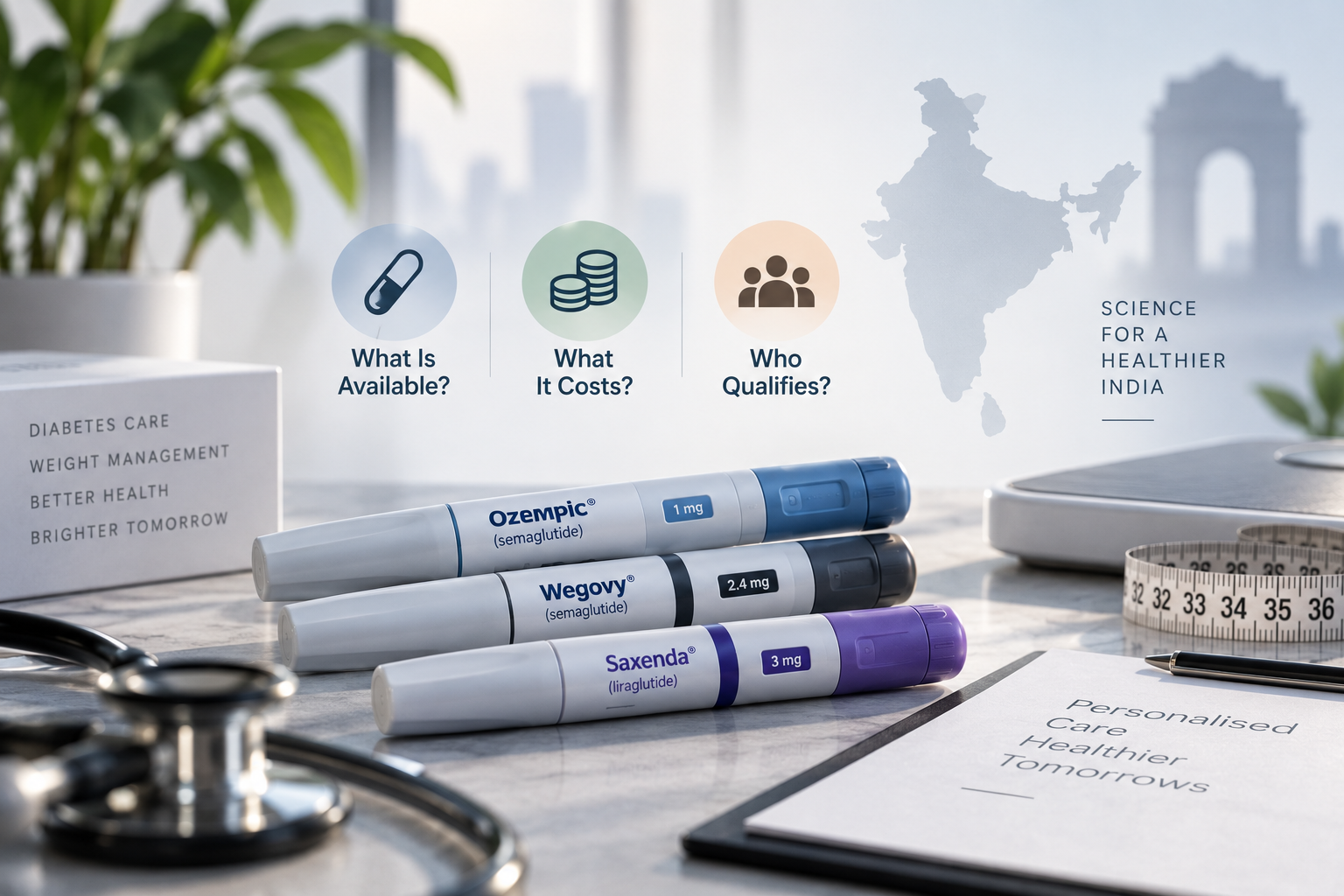
Two years ago, getting a GLP-1 drug in India meant knowing someone who travelled. Today your neighbourhood chemist in Ludhiana or Kochi probably stocks three brands, and the monthly cost has fallen from luxury-car territory to less than what many families spend on groceries in a week. That shift happened fast, and most people still have no idea what is actually on the shelf or what it should cost. If you are weighing this decision as part of a broader push to fix your metabolic health, you need real numbers, not WhatsApp forwards.
Here is the honest, India-specific picture as of September 2026.
What Changed in March 2026
Novo Nordisk’s core Indian patent on semaglutide expired on 20 March 2026. The very next morning, Indian drugmakers launched.
Not two or three of them. More than fifty brands hit the market within weeks, from Sun Pharma, Dr Reddy’s, Zydus, Alkem, Glenmark, Natco, Eris and a long tail of smaller players. It was one of the most aggressive Day-1 generic entries the Indian pharma market has ever seen.
The effect on price was immediate and brutal. Novo Nordisk cut its own Indian prices by roughly 36% effective 1 April 2026, simply to stay in the conversation. A drug that cost ₹17,000 a month in 2025 now has generic equivalents selling under ₹2,000.
India is now, by a wide margin, the cheapest major market in the world for semaglutide.
What Is Actually Available in India Right Now
Two molecules matter, and one of them is far cheaper than the other.
Semaglutide: the one that went generic
Branded originals (Novo Nordisk):
- Ozempic — weekly injection, approved for type 2 diabetes
- Rybelsus — a daily tablet, type 2 diabetes only
- Wegovy — weekly injection at the higher 2.4 mg dose, approved for chronic weight management
Indian generics launched from March 2026:
- Sun Pharma — Noveltreat (weight management) and Sematrinity (type 2 diabetes)
- Dr Reddy’s — Obeda, in a pre-filled disposable pen
- Alkem — Semasize, Obesema, Hepaglide
- Zydus — Semaglyn, Mashema, Alterme
- Glenmark (GLIPIQ), Natco (Semanat), Eris (Sundae)
Tirzepatide: still on patent, still expensive
Mounjaro from Eli Lilly is the other big name. It is a dual GIP/GLP-1 agonist, generally produces more weight loss than semaglutide in head-to-head data, and CDSCO has approved it for both type 2 diabetes and chronic weight management.
It has no Indian generic. Lilly’s patent runs for years yet, so you pay full price.
What It Costs in India: The Actual Numbers
Prices vary by city, chemist and dose. These are the ranges to expect per month in 2026.
Generic semaglutide injections
- Sun Pharma Sematrinity (diabetes): roughly ₹750–₹1,300
- Sun Pharma Noveltreat (weight): roughly ₹900–₹2,000
- Alkem Semasize / Obesema: from about ₹1,800, or around ₹450 a week
- Zydus Semaglyn / Mashema: about ₹2,200 on average
- Glenmark, Natco and Eris vials: some starting near ₹325 a week
- Dr Reddy’s Obeda (pre-filled pen): about ₹4,200
Pen versions cost more than vial-and-syringe versions. That is not a quality difference. You are paying for the device and the convenience of a dial-a-dose injector instead of drawing up your own.
Branded semaglutide
- Rybelsus (oral tablets): roughly ₹3,000–₹5,000
- Wegovy: from around ₹5,660 at starter doses, rising to ₹12,000–₹16,400 at maintenance doses
Mounjaro (tirzepatide)
- 2.5 mg and 5 mg: around ₹14,000–₹16,400
- 7.5 mg and 10 mg: around ₹20,625
- 12.5 mg and 15 mg: around ₹25,781
So the practical spread is enormous. A generic semaglutide plan can run under ₹25,000 for a full year. A high-dose Mounjaro plan can cross ₹3 lakh for the same year. Same category of drug, ten times the bill.
Budgeting Honestly: This Is Not a Three-Month Purchase
Here is the part clinics rarely lead with.
You start low and titrate upward over roughly four to five months, so your early months are cheaper than your later ones. Do not budget off the starting dose.
And when people stop, most regain a substantial share of the weight within a year. Obesity is being treated here as a chronic condition, the same way hypertension is. The realistic financial question is not “can I afford three months” but “can I afford this for two years, and what happens after.”
Factor in the costs that are not the drug itself, too: baseline blood work, HbA1c, thyroid and lipid panels, follow-up consultations every few months, and refrigeration at home. Most Indian health insurance policies do not reimburse GLP-1s prescribed purely for weight loss. Coverage is more likely when the prescription sits inside diabetes management, but read your specific policy rather than assuming.
Who Actually Qualifies
This is where a lot of Indian buyers get it wrong, because they apply Western BMI numbers to Indian bodies.
South Asians develop insulin resistance, fatty liver and type 2 diabetes at significantly lower body weights than white European populations. That is why Indian bodies get evaluated on tighter thresholds: overweight starts around a BMI of 23, and obesity around 25, rather than the familiar 25 and 30.
The Endocrine Society of India’s updated 2025 obesity guidelines put drug therapy on the table at:
- BMI above 27, or
- BMI above 25 with at least one linked condition — type 2 diabetes, hypertension, dyslipidaemia, obstructive sleep apnoea, PCOS or fatty liver
CDSCO’s approved label for semaglutide 2.4 mg in chronic weight management follows similar logic: BMI 27.5 and above, or 25 and above with a comorbidity, regardless of whether you have diabetes.
The approvals have also widened beyond weight. CDSCO has cleared Wegovy for adolescents aged 12 and older weighing above 60 kg, and for non-cirrhotic MASH, meaning fatty liver disease with moderate to advanced fibrosis. That last one matters enormously in India, where fatty liver is quietly epidemic.
You are generally not a candidate if you have a personal or family history of medullary thyroid carcinoma or MEN2, a history of pancreatitis, active severe gastrointestinal disease, or if you are pregnant, trying to conceive, or breastfeeding.
One thing worth understanding before you start: these drugs work best when the rest of your metabolic foundation is not actively working against you. Poor sleep alone wrecks insulin sensitivity and spikes hunger hormones, and the research on sleep and metabolism is far more damning than most people realise. A GLP-1 will suppress appetite regardless. It will not fix a body that is chronically under-slept.
Getting a Prescription: The Real Access Problem
Every GLP-1 in India is a Schedule H drug. Prescription mandatory, no exceptions. A chemist selling you a semaglutide pen without one is breaking the law, and you are absorbing all of the risk.
The catch is that India has very few endocrinologists relative to its population, and they cluster in metros and large private hospitals. In Delhi, Mumbai, Bengaluru or Hyderabad you can usually get an appointment within a couple of weeks. In a tier-3 town you may not have one within a hundred kilometres.
Routes that actually work:
- Diabetologists and consulting physicians. In India these doctors write the overwhelming majority of GLP-1 prescriptions, and many have more real-world experience with them than a general endocrinology OPD.
- Bariatric and metabolic clinics inside large private hospitals. Often the fastest structured route, with dietetics and follow-up bundled in.
- Teleconsultation platforms. Legal and legitimate for a first prescription, but insist on baseline blood work instead of a five-minute video call and a courier.
- Government and medical college hospitals. Slow queues, but genuine expertise and dramatically cheaper consultations.
What to walk away from: Instagram sellers, unlabelled vials, “imported” pens at a suspicious discount, and anyone offering to skip the prescription. Counterfeit and badly cold-chained pens are a documented problem, and with legitimate generics now under ₹2,000 a month, the grey market has no price advantage left to justify the risk.
Side Effects You Should Expect
Most side effects are gastrointestinal and show up during dose escalation: nausea, vomiting, diarrhoea, constipation, reflux, and a loss of appetite that some people find genuinely unsettling. Injection-site soreness is common. Headache, fatigue and muscle aches turn up in a minority.
Serious events are rarer but real: pancreatitis, gallbladder disease, and severe dehydration from persistent vomiting. Report anything severe or persistent to your doctor rather than pushing through it.
The under-discussed one is muscle loss. A meaningful share of the weight lost on GLP-1s is lean tissue, and losing muscle in your forties damages your metabolic rate for decades afterward. Anyone on these drugs should be eating adequate protein and lifting weights, not simply eating less. The evidence on strength training and longevity suggests the required dose is far smaller than most people assume, which makes skipping it very hard to justify.
The Bottom Line
India in 2026 has the widest GLP-1 availability and the lowest prices of any large market on earth. Generic semaglutide turned a medication that was a status symbol two years ago into something a middle-class household can genuinely plan for. Tirzepatide stays premium until its patent lapses.
But cheap does not mean casual. These are powerful metabolic drugs with real side effects, a real relapse rate on discontinuation, and a real risk of muscle loss when used carelessly. Get properly evaluated, get baseline bloods, buy from a licensed pharmacy against a valid prescription, and build the eating and training habits that will still be standing when the prescription eventually ends.
This article is for information only and is not medical advice. Speak to a qualified doctor before starting, stopping or changing any prescription medication.