Every monsoon the same WhatsApp forward goes round: platelets under one lakh means rush to hospital, and papaya leaf juice will bring them back up. The trouble is that platelet count alone doesn’t decide whether dengue turns dangerous. Plasma leakage does, and it shows up as a handful of warning signs, usually around the time the fever breaks. People with diabetes, obesity or high blood pressure (conditions we cover in our evidence-based guide to metabolic health) are on India’s official high-risk list, so these signs matter even more for them.
This guide covers what the WHO and India’s own National Guidelines for Clinical Management of Dengue Fever (2023) actually say, and where the popular home remedies stand against the evidence.
Key takeaways
- The riskiest window is the critical phase. It usually starts after day 3 or 4 of fever and lasts 24 to 48 hours, often just as the fever falls.
- India’s national guideline says platelet counts are unreliable at predicting bleeding. Warning signs and a rising haematocrit tell you more.
- Use paracetamol for fever. Avoid aspirin, ibuprofen and other NSAIDs, which raise bleeding risk.
- Papaya leaf extract raised platelet numbers in small, low-quality trials. Nobody has shown that it prevents shock or death.
1. Dengue 2026: Where Cases Are Rising
Worldwide, dengue cases rose to 14.6 million in 2024, with more than 12,000 deaths, according to the WHO. Between January and July 2025, 97 countries reported over 4 million cases and over 3,000 deaths.
India’s official count from the National Center for Vector Borne Diseases Control (NCVBDC) has fallen for two years running:
| Year | Dengue cases (India) | Deaths |
|---|---|---|
| 2023 | 2,89,235 | 485 |
| 2024 | 2,33,519 | 297 |
| 2025 | 1,21,824 | 131 |
| 2026 (Jan–Jun) | 23,952 | 31 |
Those national totals hide sharp regional differences:
- The South carries the load. Tamil Nadu, Kerala, Karnataka, Andhra Pradesh and Telangana accounted for 63.2% of India’s cases in the first half of 2026.
- Kerala has the most deaths. It reported 4,458 cases but 19 deaths till June, the highest in the country. Tamil Nadu had more cases (7,511) but three deaths.
- Cases jump with the monsoon. WHO South-East Asia data show India’s monthly cases rose from 6,625 in June 2026 to 10,122 in July, a 53% jump.
- 2025’s hotspots: Tamil Nadu (23,407 cases), Maharashtra (14,168), Kerala (10,923), Uttar Pradesh (9,206) and Telangana (8,412).
2. The 3 Phases of Dengue, and Why Days 3–7 Are Critical
Symptoms usually start 4 to 6 days after the mosquito bite, although the incubation period can run from 3 to 14 days. After that, dengue moves through three phases.
Phase 1: Febrile (days 1 to 7)
A sudden high fever (38.5°C or more) lasts 2 to 7 days. It comes with a severe headache, pain behind the eyes, body and joint aches, flushing and vomiting. A rash often appears around day 3 or 4 on the face, neck, chest and abdomen.
Phase 2: Critical (around day 3 to 7)
According to India’s guideline, 5–10% of patients move into this phase. It usually begins after day 3 or 4 of fever and lasts about 24 to 48 hours. Blood vessels start leaking plasma, which concentrates the blood and can lead to bleeding, shock and organ damage.
Here’s the trap. The WHO notes that severe dengue symptoms often come after the fever has gone away. Families see the thermometer drop and relax at exactly the wrong moment. People who are infected for the second time face a higher risk of severe disease.
Phase 3: Recovery (2 to 3 days)
The leaked fluid returns to the bloodstream and symptoms ease. Many people get an itchy rash with small islands of normal skin. Doctors watch this stage closely too, because IV fluids continued past this point can cause fluid in the lungs.
3. WHO Warning Signs: Go to Hospital If You See These
These are the warning signs of severe dengue, combined from the WHO fact sheet and Box 2 of India’s 2023 guideline. Any one of them means the patient should be seen in hospital the same day.
- Severe abdominal pain or tenderness
- Persistent vomiting, especially if the patient can’t keep fluids down
- Bleeding from the nose or gums, blood in vomit, black tarry stools, blood in urine, or unusually heavy periods
- Lethargy, restlessness or drowsiness, or a sudden change in behaviour
- Fainting or giddiness
- Rapid breathing or difficulty breathing
- Pale, cold or clammy skin
- Fluid build-up in the abdomen or around the lungs, or a liver enlarged by more than 2 cm (a doctor finds these on examination or ultrasound)
- On the blood report: a rising haematocrit together with a rapidly falling platelet count
Cold hands and feet, less urine than usual and a weak pulse are early signs of shock. Don’t wait for the next blood test if you notice them.
Who should be extra cautious
India’s guideline lists these groups as high-risk for severe disease:
- Infants and children under 10, especially if malnourished
- Adults over 65
- People with obesity
- Pregnant women, and women who are menstruating or have abnormal vaginal bleeding
- People with diabetes, hypertension, or heart, kidney, liver or lung disease
- People with peptic ulcers, thalassaemia or G6PD deficiency
- Anyone on long-term steroids or NSAIDs
If you manage blood sugar day to day, our piece on why metabolic syndrome is riskier than obesity alone explains why that cluster of conditions keeps showing up on risk lists like this one.
4. Platelet Count Explained: What the Numbers Actually Mean
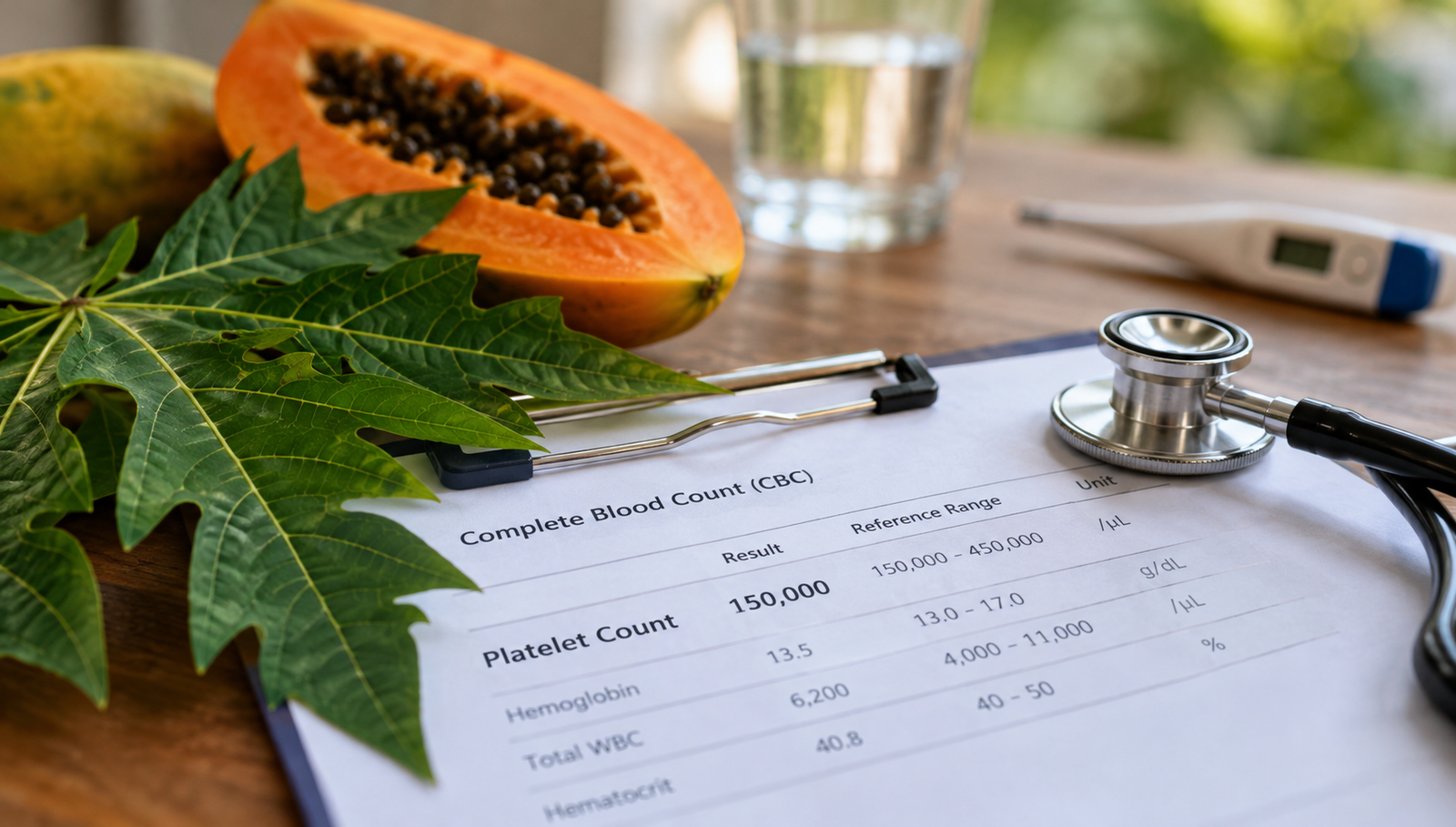
Most labs list the normal platelet count as roughly 1.5 to 4.5 lakh per microlitre. Dengue almost always pushes it down, and watching the number fall day after day is frightening. But India’s guideline is blunt: platelet counts are unreliable at predicting bleeding.
The best evidence comes from a 2017 randomised trial in The Lancet. It enrolled 372 adults with dengue and platelet counts of 20,000 or less. Clinical bleeding occurred in 21% of patients given preventive platelet transfusions and 26% of those given supportive care alone, which is not a significant difference. The transfused group had more adverse reactions, including anaphylaxis, lung injury and fluid overload.
| Platelet count (per µL) | What the guidance says |
|---|---|
| 1.5 lakh and above | Normal range |
| Below 1.5 lakh | Low (thrombocytopenia), which is common in dengue. Watch the trend and the haematocrit. |
| 20,000 or below, no bleeding | Preventive transfusion did not reduce bleeding in the Lancet trial |
| Below 10,000, no bleeding | India’s guideline: a preventive transfusion may be considered, as it may for patients needing emergency surgery |
| Any count, with significant bleeding | Transfusion is a doctor’s decision based on bleeding and clotting tests, not the number alone |
So what should you watch instead? The direction of travel. India’s guideline calls a haematocrit 10% above baseline an early, objective sign of plasma leakage. A falling platelet count together with a rising haematocrit is a warning sign. The guideline recommends a full blood count (CBC) for anyone who has had fever for more than 3 days.
5. Home Care: Fluids, Paracetamol and What NOT to Take
Home care is only for mild dengue: no warning signs, no high-risk condition, and a doctor who has seen the patient and agreed. The national guideline’s advice for these patients is simple.
Do
- Drink plenty of fluids. The guideline names ORS and coconut water.
- Rest in bed.
- Use paracetamol for fever above 100°F. The guideline dose is 10 mg/kg, no more often than every six hours, with an adult maximum of 4 g a day. Check with your doctor first if you have liver disease.
- Sponge with lukewarm water on the forehead, armpits and limbs if fever stays high.
- Get follow-up blood tests as your doctor advises.
Don’t
- Don’t take aspirin, ibuprofen or any other NSAID. The WHO warns that they increase the risk of bleeding. That includes pain-relief combinations, so read the label.
- Skip carbonated drinks. The guideline says so specifically.
- Don’t push fluids too hard in infants. The guideline flags over-hydration in young children as a risk too.
- Don’t ask for antibiotics. Dengue is a viral infection. Doctors use antibiotics only when they suspect a separate bacterial infection.
What about your usual tea or coffee? The guideline doesn’t mention either one. Treat your daily cup as a habit rather than your hydration plan, and if you’re curious what that cup does, here’s what really happens to your body when you drink coffee every day.
6. Myths vs Evidence: Papaya Leaf, Kiwi, Goat Milk and More
| Myth | What the evidence says |
|---|---|
| Platelet count decides how serious dengue is | India’s guideline calls it unreliable at predicting bleeding. Warning signs and the haematocrit trend matter more. |
| Low platelets always need a transfusion | Preventive transfusion at 20,000 or below didn’t reduce bleeding and caused more reactions |
| Papaya leaf juice cures dengue | It raised platelet counts in small trials, but none measured shock or death (details below) |
| Kiwi raises platelets | We found no clinical trial testing kiwi in dengue patients |
| Goat milk boosts platelets | We found no controlled trial. Raw goat milk can carry brucellosis. |
| Fever’s gone, so the danger’s over | The critical phase often begins as the fever falls |
| You can’t get dengue twice | There are four dengue virus types, and a second infection carries a higher risk of severe disease |
What the papaya leaf research actually found
A 2019 systematic review and meta-analysis in BMC Complementary and Alternative Medicine pooled nine controlled studies, six of them from India. Here’s what it found:
- Seven of the nine studies reported higher platelet counts in patients taking papaya extract.
- In three studies, hospital stays were about two days shorter.
- No study measured plasma leakage or death, the outcomes that actually matter in dengue.
- The reviewers rated the evidence low quality with a high risk of bias. Seven studies didn’t explain how they randomised patients.
- Three studies reported nausea and vomiting as side effects. That’s awkward, because persistent vomiting is itself a warning sign.
The authors concluded that routine use of papaya extract for dengue “cannot be recommended” on current evidence, and called for a large placebo-controlled trial. Papaya leaf may nudge the number on the lab report. It hasn’t been shown to keep anyone out of the ICU, and it should never delay a hospital visit when warning signs appear.
7. FAQ
At what platelet count is dengue dangerous?
There’s no single cut-off that makes dengue dangerous. India’s national guideline says platelet counts are unreliable at predicting bleeding. It suggests a preventive transfusion may be considered below 10,000 per µL only when there’s no bleeding. Warning signs, and a rising haematocrit alongside falling platelets, are better signals of danger.
What are the warning signs of severe dengue?
Severe abdominal pain, persistent vomiting, bleeding from the gums or nose, blood in vomit or stool, lethargy or restlessness, fainting, rapid breathing, and pale or cold skin. On a blood report, a rising haematocrit with a rapidly falling platelet count is also a warning sign. These signs often appear around the time the fever subsides.
Does papaya leaf juice increase platelets?
Small, low-quality trials suggest papaya leaf extract can raise platelet counts. A 2019 meta-analysis found that no study measured shock, plasma leakage or death, and concluded that routine use can’t be recommended. It’s not a substitute for monitoring and medical care.
The Bottom Line
Stop staring at the platelet number. Keep the patient drinking, give paracetamol and nothing stronger, and watch closely from day 3 onwards, especially once the fever drops. If any warning sign appears, go to hospital that day, whatever the platelet count says.
Dengue isn’t only a monsoon problem at home, either. It’s common across tropical Asia and Latin America. If you’re planning a trip there, our complete visa and destination guide for Indian travellers will help you plan, and you should pack mosquito repellent along with your passport.
Medical disclaimer: This article is for general information and is based on WHO and Government of India guidelines. It isn’t a substitute for a doctor’s advice. If you suspect dengue, consult a doctor, and go to hospital at once if any warning sign appears.
Sources
- World Health Organization, Dengue and severe dengue fact sheet
- World Health Organization, Guidelines for clinical management of arboviral diseases: dengue, chikungunya, Zika and yellow fever (2025)
- NCVBDC, National Guidelines for Clinical Management of Dengue Fever 2023
- NCVBDC, Dengue situation in India
- Rajapakse S. et al., Carica papaya extract in dengue: a systematic review and meta-analysis, BMC Complement Altern Med, 2019
- Lye D.C. et al., Prophylactic platelet transfusion plus supportive care versus supportive care alone in adults with dengue and thrombocytopenia, The Lancet, 2017