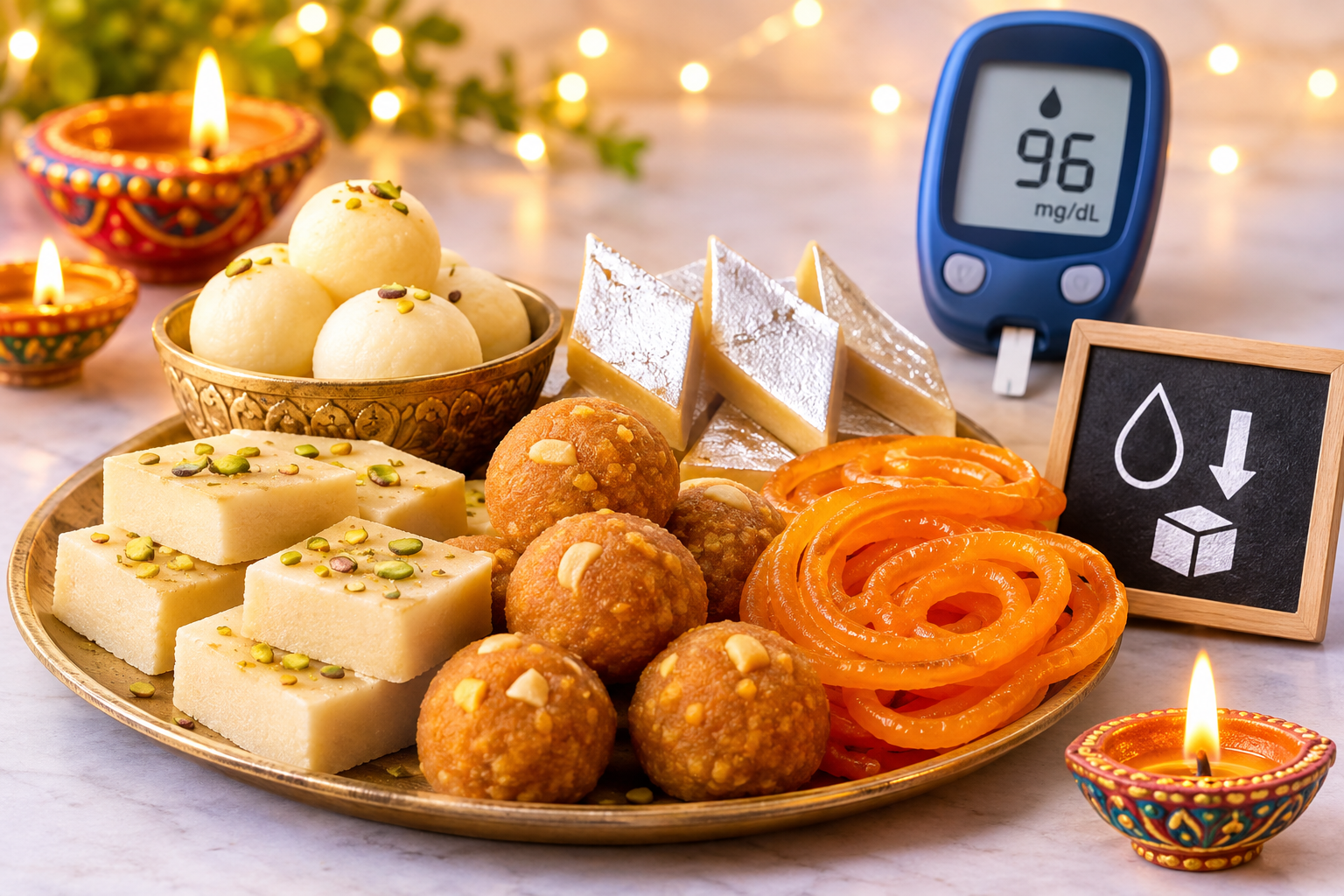
Yes, most people with diabetes can have a small piece of Diwali mithai, as long as it replaces some of the starch in the meal instead of being added on top. Kaju katli and peda come to about 10 g of carbohydrate a piece, while a katori of gajar halwa or two gulab jamuns can pass 35 g.
If you fasted through Navratri, our guide to Navratri fasting with diabetes covered vrat foods. This one covers the sweets: nine common mithai compared by estimated carbohydrate per piece, and the rules that matter more than the choice of sweet, which are how much, when, and in what order you eat it.
The short answer: yes in small portions, with five rules
- Pick the smallest piece. Cut a ladoo or barfi into quarters. One quarter of a besan ladoo is about 5 g of carbohydrate.
- Eat it after a meal that has vegetables and protein, not on an empty stomach or with tea alone.
- Count it as part of the meal. About 10 g of carbohydrate is roughly half a roti, so leave out some rice or roti instead of adding the sweet on top.
- Walk for 10 to 15 minutes afterwards if you can.
- Check your glucose about 2 hours after the first bite and compare it with the target your doctor gave you.
India has an estimated 101 million people with diabetes and 136 million with prediabetes, according to the ICMR-INDIAB survey estimates for 2021 published in The Lancet Diabetes & Endocrinology in 2023. So at almost any Diwali gathering someone is quietly deciding whether to take the plate. The rest of this page explains why those five rules work and where the common advice goes wrong.
How a sweet raises blood sugar: carbohydrate, form, order and movement
Carbohydrate is the main driver. Refined sugar is essentially all carbohydrate, so every gram of sugar in a sweet counts, whether it is in the syrup, the khoa or the coating. Fat from ghee and nuts, and protein from milk solids or besan, can slow digestion a little, but they do not cancel the sugar. They also add calories.
Form matters. Sweets soaked in sugar syrup, such as jalebi and gulab jamun, combine sugar with refined flour or milk solids and have almost no fibre to slow absorption. Dense, nut-based or milk-based pieces tend to deliver less carbohydrate per bite, simply because a small piece holds less sugar.
Order matters. In a small crossover study of 15 people with prediabetes, the same meal was eaten in three different orders. When vegetables, or protein and vegetables, were eaten before the carbohydrate, the glucose peak was more than 40% lower than when carbohydrate came first (Shukla et al., Diabetes, Obesity and Metabolism, 2019). The study was small and did not test mithai, so treat it as a sensible habit rather than a guarantee.
Movement matters. A 2022 meta-analysis of seven one-day trials found that breaking up sitting with light walking lowered after-meal glucose and insulin compared with sitting, and did so more than standing did (Buffey et al., Sports Medicine). Ten to fifteen minutes is a practical target, not a number from that paper.
If big after-meal spikes are a regular pattern for you, not just a festival problem, our guide to metabolic health explains the wider picture of blood sugar, insulin resistance and weight.
Mithai compared: estimated carbohydrate in one piece
The table and chart below rank nine common sweets by estimated carbohydrate in one typical piece. They are my calculations from published ingredient values and assumed shop-style recipes, not lab measurements of finished sweets, so I give ranges instead of single figures.
| Sweet (typical piece) | Est. carbs | Est. energy | Likely effect per piece | Why |
|---|---|---|---|---|
| Kaju katli (about 20 g) | 9 to 12 g | about 100 kcal | Lower | Mostly cashew, which has far less carbohydrate than sugar. Calorie-dense, so stick to one piece. |
| Peda or kalakand (about 25 g) | 10 to 13 g | 85 to 100 kcal | Lower | Milk solids bring protein and fat along with the sugar. |
| Date-nut ladoo, no added sugar (about 30 g) | 12 to 16 g | about 140 kcal | Moderate | Dates are about 75% carbohydrate by weight, so “no added sugar” is not low carb. |
| Jalebi (about 30 g) | 15 to 20 g | about 120 kcal | Higher | Refined flour, fried, then soaked in syrup. Little protein or fibre. |
| Gulab jamun in syrup (about 40 g) | 15 to 22 g | 130 to 150 kcal | Higher | A syrup-soaked piece. Two pieces reach 30 to 44 g. |
| Soan papdi (one 30 g cube) | 18 to 22 g | about 145 kcal | Higher | Sugar plus refined flour in a small cube, so the carbohydrate is concentrated. |
| Besan ladoo (about 40 g) | 18 to 23 g | about 195 kcal | Moderate | Besan adds some protein and fibre, but the ghee and sugar make it heavy. |
| Gajar halwa (1 katori, about 100 g) | 18 to 28 g | 190 to 230 kcal | Moderate to higher | Depends on how much sugar and khoa went in. Serve it in a small bowl, not a katori. |
| Motichoor ladoo (about 40 g) | 20 to 26 g | about 185 kcal | Higher | Fried besan pearls bound with sugar syrup; the most carbohydrate per piece here. |
How I estimated these figures
- Ingredient values (available carbohydrate, energy and fat per 100 g) come from the National Institute of Nutrition’s Indian Food Composition Tables 2017 (IFCT 2017) for cashew, khoa, Bengal gram (as a stand-in for besan), refined flour, dates, almond, milk, carrot and ghee. Refined sugar is counted as 100% carbohydrate, as in USDA FoodData Central.
- Recipe proportions are my assumptions of typical halwai-style mixes: for example kaju katli at two parts cashew to one part sugar, and peda at two parts khoa to one part sugar. Finished sweets are not in IFCT, so no source gives a measured value for them.
- For scale, a phulka made from 30 g of atta has about 19 g of carbohydrate (IFCT 2017). That is why one kaju katli is close to half a roti, and one gulab jamun is close to a whole one.
A useful yardstick: the added-sugar limit
The ICMR-NIN Dietary Guidelines for Indians 2024 advise keeping added sugar to about 5% of daily energy for people over two. On a 2,000 kcal day that is 100 kcal, or about 25 g of sugar. By my recipe assumptions, a gulab jamun carries about 14 g of sugar and a jalebi about 11 g, so two gulab jamuns use up more than the whole day’s allowance. That limit is for the general population, not a diabetes prescription, but it shows how fast syrup-soaked sweets add up.
Is “sugar-free” mithai safe for diabetes?
Not automatically. The words “sugar-free” or “no added sugar” say nothing about the carbohydrate that is left, and the ICMR-NIN 2024 guidelines specifically caution that sugar-free labels can mislead and tell buyers to read the full pack information.
- Dates, figs and raisins: dried dates have about 75 g of available carbohydrate per 100 g and black raisins about 71 g (IFCT 2017). A 30 g date-nut ladoo works out at roughly 12 to 16 g, close to a kaju katli in carbohydrate per gram, though with more fibre.
- Jaggery or gur: jaggery has about 85 g of available carbohydrate per 100 g, against about 100 g for refined sugar. The saving is small, so a jaggery sweet still counts in full.
- Sweetener-based mithai: the sweetener replaces sugar, but the khoa, flour, nuts and ghee remain. Check the carbohydrate and calories on the label, not just the front of the box. The same ICMR-NIN guidelines advise against relying on sweeteners over the long term.
- Refined flour and ghee: maida has about 2.8 g of fibre per 100 g against 11.4 g for atta, so it is digested faster. Ghee has no carbohydrate but about 9 kcal a gram, which matters if you are also managing weight or cholesterol.
Seven rules for eating mithai with diabetes
- Eat it after a meal, not before. A sweet on an empty stomach or with sweet tea meets no protein, fibre or fat to slow it down.
- One small piece, not a plate. Cut it into halves or quarters and eat it slowly. Decide the portion before you sit down.
- Swap, do not add. About 10 g of carbohydrate is roughly half a roti or a few spoons of rice. Leave that much out of the meal.
- Eat vegetables and protein first, then the starch, then the sweet. This is the order that cut the glucose peak in the study above.
- Walk for 10 to 15 minutes after the meal. A slow walk around the colony is enough.
- Check your glucose 2 hours after your first bite. Many diabetes teams use a general target of under 180 mg/dL at one to two hours after the start of a meal, as in the American Diabetes Association’s Standards of Care, but your own target may differ. If you use a continuous glucose monitor, watch the curve for the next two to three hours.
- Never skip meals or medicines to “save room”. If you take insulin or a sulfonylurea, eating less than usual while taking your usual dose can cause low blood sugar. Spread the sweets over the festival days instead of saving them for Diwali night.
Hosting and gifting: swaps that still feel festive
- Serve sweets cut into small squares on small plates, with a bowl of unsalted roasted nuts next to them. Almonds have only about 3 g of available carbohydrate per 100 g (IFCT 2017).
- Add something savoury and protein-rich to the table, such as paneer tikka or roasted chana, so guests with diabetes are not left with only sweets.
- Offer fresh fruit, plain curd or a small portion of kheer made with less sugar as an alternative to mithai, and let guests choose.
- When gifting to a relative with diabetes, ask first. A box of plain nuts or a non-food gift is usually kinder than a kilo of barfi.
- Never comment on what someone with diabetes puts on their plate. They are usually well aware of it.
Who needs extra caution, and when to get medical help
Extra planning is worth it if you have type 1 diabetes or take insulin (carbohydrate counting and dose timing are individual), are pregnant or have gestational diabetes (targets are stricter), are an older adult prone to low blood sugar, or have kidney disease or a recent hospital admission. In each case ask your doctor or dietitian before the festival, not after.
Skip the sweet if your reading before the meal is already above the limit your doctor gave you, or if you feel unwell. Seek urgent medical help for repeated vomiting, stomach pain, fast or deep breathing, fruity-smelling breath, severe thirst or confusion, which can be signs of dangerously high blood sugar or ketoacidosis. Call your doctor if readings stay above your target for a couple of days after the festival.
Frequently asked questions
Can diabetics eat Diwali sweets?
Most people with diabetes can eat a small portion of mithai if it is planned: one small piece after a meal, counted as part of the meal’s carbohydrate, and followed by a walk. Your own plan depends on your medicines, your recent readings and your doctor’s advice.
Which Indian sweet is best for diabetics?
By estimated carbohydrate per piece, a small kaju katli or a milk-based peda or kalakand comes lowest, at roughly 9 to 13 g. That does not make them safe in any amount. The better choice is the smallest piece of whatever you enjoy, and avoiding syrup-soaked sweets such as jalebi and gulab jamun if you can.
Are sugar-free sweets safe for diabetics?
Not automatically. Sugar-free sweets can still contain carbohydrate from dates, khoa, flour and nuts, plus plenty of ghee. The ICMR-NIN 2024 guidelines caution that sugar-free labels can mislead, so read the carbohydrate and calories on the pack.
How much mithai can a diabetic eat?
A common starting point is one small piece of about 10 to 15 g of carbohydrate, eaten in place of some starch in a meal, not on top of it. Your dietitian may set a different carbohydrate allowance, so follow that if you have one.
Is jaggery better than sugar for diabetes?
Only slightly. IFCT 2017 lists jaggery at about 85 g of available carbohydrate per 100 g against about 100 g for refined sugar, so a jaggery sweet still raises blood sugar and needs to be counted.
Should I check my sugar after eating sweets?
Yes, at least the first time you try a particular sweet. Check about 2 hours after the first bite and compare it with your doctor’s target. Writing down the result tells you which sweets your body handles better.
Sources and method
- ICMR-INDIAB study, Lancet Diabetes & Endocrinology, June 2023 (estimates for 2021: 101 million with diabetes, 136 million with prediabetes).
- National Institute of Nutrition, Indian Food Composition Tables 2017 (IFCT 2017), read through the open-source @ifct2017/compositions data package.
- USDA FoodData Central, for refined sugar.
- ICMR-NIN, Dietary Guidelines for Indians 2024 (added sugar at about 5% of energy; caution on “sugar-free” labels and long-term sweetener use).
- American Diabetes Association, Standards of Care in Diabetes 2026, nutrition and glycaemic target sections.
- Shukla AP et al., food order and postprandial glycaemia in prediabetes, PubMed 30101510.
- Buffey AJ et al., interrupting prolonged sitting with standing and light walking, Sports Medicine 2022, PubMed 35147898.
Method: I calculated carbohydrate, energy and fat per piece from IFCT 2017 values multiplied by assumed ingredient weights for each sweet, then rounded to ranges. Recipes differ between shops and homes, so a piece from your halwai may differ by a quarter or more. I did not use brand names, and the “likely effect” column is a comparison of carbohydrate per piece and sugar form, not a glycaemic index measurement. Diwali falls on Sunday 8 November 2026. Pre-meal and post-meal targets are individual, so use the ones your doctor gave you.
Planning the festival days? Our guide to the Diwali 2026 puja dates and timings gives the dates from Dhanteras on 6 November to Bhai Dooj on 11 November, so you can spread your sweets across them.