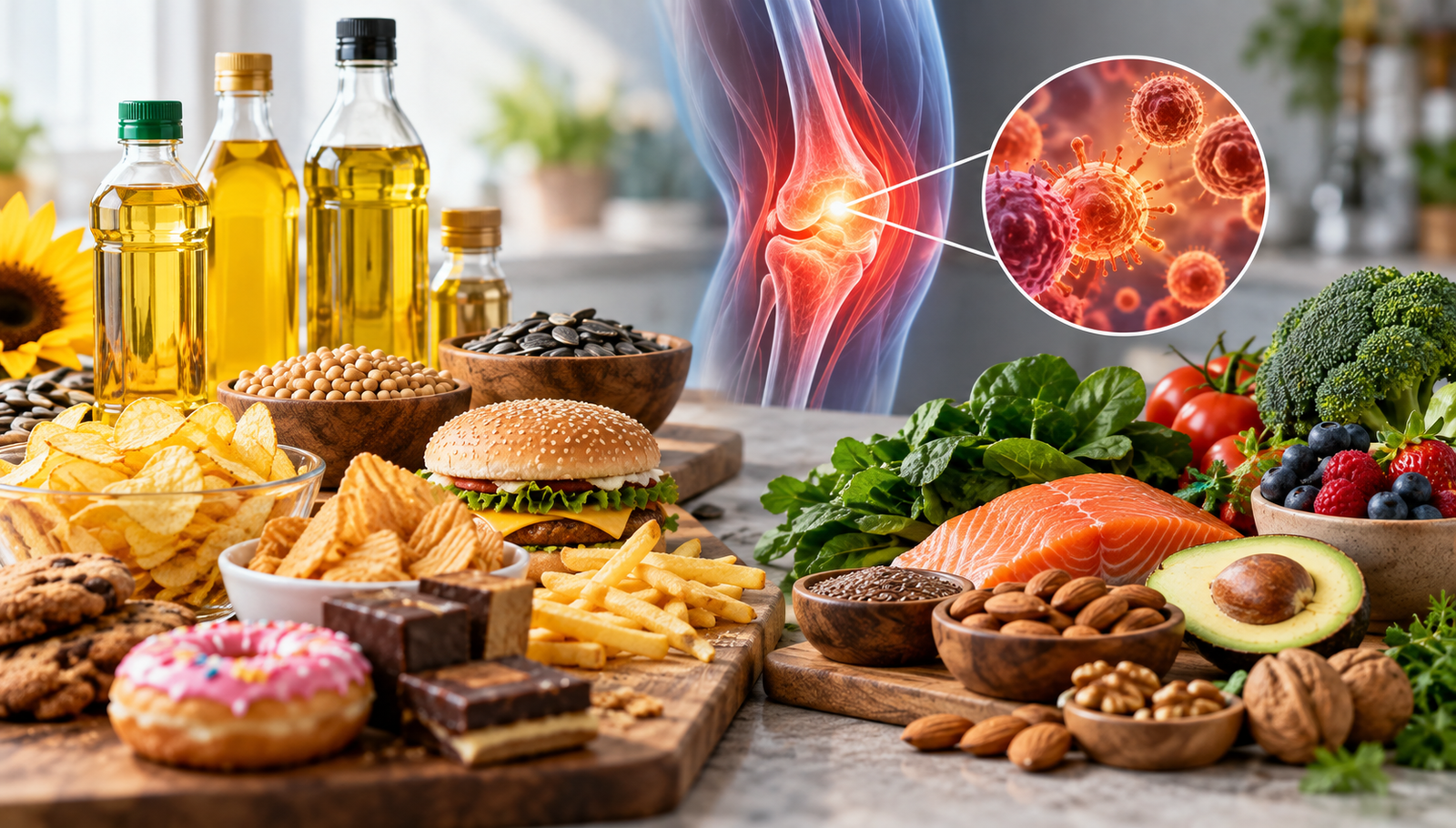
Few food debates get as heated as this one. Scroll for five minutes and someone will tell you seed oils are “toxic,” another person will say ultra-processed food is the new tobacco, and a third will insist both are fine because a calorie is a calorie.
This piece doesn’t take a side first and look for studies later. It looks at the seed oils, ultra-processed food and inflammation evidence from randomised controlled trials, the studies where researchers actually change what people eat and measure what happens. If you want the bigger picture of how diet, blood sugar, and body fat fit together, start with our evidence-based guide to metabolic health. Here, we zoom in on the three words everyone argues about.
Why Randomised Trials Matter More Than Headlines
Most scary nutrition headlines come from observational studies. Researchers follow thousands of people, ask what they eat, and look for patterns. That’s useful for spotting questions. It’s poor at answering them.
People who eat lots of packaged snacks also tend to sleep less, move less, smoke more, and earn less. Statistics can adjust for some of that, never all of it.
A randomised controlled trial (RCT) fixes the problem by assigning diets at random. It has its own limits:
- They’re short. Weeks or months, not decades.
- They’re small. Feeding trials often involve 20 to 60 people.
- They measure markers. Things like CRP or LDL cholesterol, not always heart attacks or deaths.
Still, when the question is “does this food cause that effect,” RCTs are the best tool we have. So let’s see what they show.
Seed Oils: The Case Against Them
Seed oils (sunflower, soybean, corn, safflower, rice bran, canola) are rich in linoleic acid, an omega-6 fat. The worry goes like this: your body can turn linoleic acid into arachidonic acid, which is a building block for some inflammatory signalling molecules. More omega-6 in, more inflammation out.
Critics point to two old trials that were re-analysed years later:
- Sydney Diet Heart Study (1966 to 1973). Men who had already had a heart event were told to swap saturated fat for safflower oil. When researchers recovered the original data in 2013 and published it in the BMJ, the safflower group had higher death rates.
- Minnesota Coronary Experiment (1968 to 1973). Corn oil replaced saturated fat in institutional diets. Cholesterol went down, yet there was no survival benefit, and a 2016 BMJ re-analysis found higher mortality in participants over 65.
These are real trials with real signals. They deserve attention, not dismissal.
Seed Oils: The Case For Them
Here’s the context that usually gets cut from the reel. Both trials have serious problems. The Sydney study’s margarine likely contained trans fats, which are clearly harmful. The Minnesota trial had huge dropout, with most participants on the diet for about a year or less.
Meanwhile, other trials pointed the opposite way. The Oslo Diet-Heart Study and the Los Angeles Veterans Administration trial both replaced saturated fat with vegetable oils and saw fewer heart events.
When you pool everything, the picture gets calmer:
- A 2018 Cochrane review of omega-6 trials concluded that increasing omega-6 fats probably makes little or no difference to deaths or heart disease. No clear benefit, no clear harm.
- A 2020 Cochrane review found that cutting saturated fat lowered cardiovascular events by about 17%, with the strongest effect when it was replaced by polyunsaturated fats (the kind in seed oils).
What About Inflammation Specifically?
This is the heart of the seed-oil claim, and it has been tested directly. A systematic review by Johnson and Fritsche in 2012 looked at 15 RCTs in healthy adults. Raising linoleic acid intake did not increase inflammatory markers such as CRP, IL-6, or TNF-alpha.
Why doesn’t the theory hold? Because the body tightly regulates the conversion of linoleic acid to arachidonic acid. Eating more of the first doesn’t meaningfully raise tissue levels of the second.
Bottom line on seed oils: The trial evidence does not support the idea that seed oils, eaten as part of normal cooking, drive chronic inflammation. It also doesn’t prove they are a health food. They look roughly neutral to modestly helpful, especially when they replace butter, ghee, or vanaspati.
The Caveat That Actually Matters in India
How the oil is used matters more than which seed it came from. Oil reheated again and again, like in a street-side kadhai that fries samosas all day, breaks down into oxidised compounds and aldehydes. FSSAI even caps total polar compounds in cooking oil at 25% for this reason.
So if you want one practical change, it isn’t “ditch sunflower oil.” It’s “stop eating food fried in oil that has been reused for days.”
Ultra-Processed Food: Where the Trials Are Stronger
Ultra-processed food (UPF) is usually defined by the NOVA system: industrial formulations with ingredients you wouldn’t find in a home kitchen, like emulsifiers, flavour enhancers, and modified starches. Think packaged biscuits, instant noodles, sugary cereals, soft drinks, and most ready-to-eat snacks.
Here the randomised evidence is thinner in volume but sharper in results.
The NIH Inpatient Trial (Hall et al., 2019)
Twenty adults lived in a metabolic ward at the US National Institutes of Health for four weeks. For two weeks they ate an ultra-processed diet, and for two weeks an unprocessed diet, in random order. Both diets offered matched calories, sugar, fat, fibre, and salt. People could eat as much as they wanted.
The results were striking:
- On the ultra-processed diet, people ate about 500 extra calories a day.
- They gained roughly 0.9 kg in two weeks, and lost about the same on the unprocessed diet.
- They ate faster on the ultra-processed diet, which may explain part of the overeating.
That’s the strongest causal evidence we have that ultra-processing itself, not just the sugar or fat in the food, pushes people to eat more.
Eating pattern isn’t the only thing that drives appetite, of course. Short sleep does something remarkably similar, raising hunger hormones and cravings for exactly these foods. We covered that research in how sleep affects your metabolism.
The UPDATE Trial (UK, 2025)
A longer test came from University College London, published in Nature Medicine. Fifty-five adults followed two diets for eight weeks each. Both met UK healthy-eating guidelines. One was built from minimally processed foods, the other from ultra-processed versions (think supermarket ready meals and breakfast bars that tick the nutrition boxes).
Weight loss on the minimally processed diet was about double: roughly 2% of body weight versus about 1%. The researchers also noted better control of food cravings on that diet.
The takeaway is subtle but important. Even when a processed diet “looks” healthy on the label, it seems easier to overeat.
Emulsifiers and the Gut
What might link UPF to inflammation? One candidate is additives. In a small 2022 RCT (the FRESH study), healthy volunteers ate an additive-free diet with or without carboxymethylcellulose, a common emulsifier. Those getting the emulsifier showed changes in gut bacteria and reduced beneficial metabolites, and a few had bacteria moving closer to the gut lining. In animal studies, that kind of shift triggers low-grade inflammation.
It’s early human evidence from a tiny sample. Worth watching, not worth panicking over.
So Does Ultra-Processed Food Cause Inflammation?
Honest answer: probably indirectly, and the direct proof is still limited.
Here’s the chain the evidence supports:
- RCTs show UPF makes people eat more and gain weight.
- Excess body fat, especially around the organs, is a well-established driver of chronic low-grade inflammation.
- Additives like emulsifiers may add a gut-level effect on top, though this is still being tested.
Notice what’s missing: strong trial evidence that seed oils are the villain inside ultra-processed food. Many UPFs do contain seed oils, which is why the two get blurred together online. But the trials point to the whole package, meaning energy density, speed of eating, and engineered palatability, rather than one ingredient.
What the Science Suggests You Actually Do
Skip the ingredient witch-hunt. These moves line up with the trial data:
- Cook more of your meals from basic ingredients. This matters far more than which oil you pour into the pan.
- Use oil fresh and don’t reuse it repeatedly. Mustard, groundnut, sunflower, or olive are all reasonable choices in normal amounts.
- Limit packaged snacks and sugary drinks first. These are the easiest calories to overeat.
- Eat slower. Speed was one of the clearest differences in the NIH trial.
- Don’t swap seed oils for large amounts of ghee or butter just because a video said so. The trial data doesn’t back that trade.
Food is only one lever for inflammation. Muscle is metabolically active tissue that helps with blood sugar control and, over time, lowers inflammatory markers. Our breakdown of the strength training sweet spot for longevity shows how little weekly time it takes.
The Verdict
Seed oils have been put on trial, repeatedly, and the charge of causing inflammation doesn’t stick. Ultra-processed food has faced fewer trials, but the ones we have show a clear effect on overeating and weight gain, which is a proven route to inflammation.
If you’re going to worry about one of them, worry about the packet, not the bottle of oil.