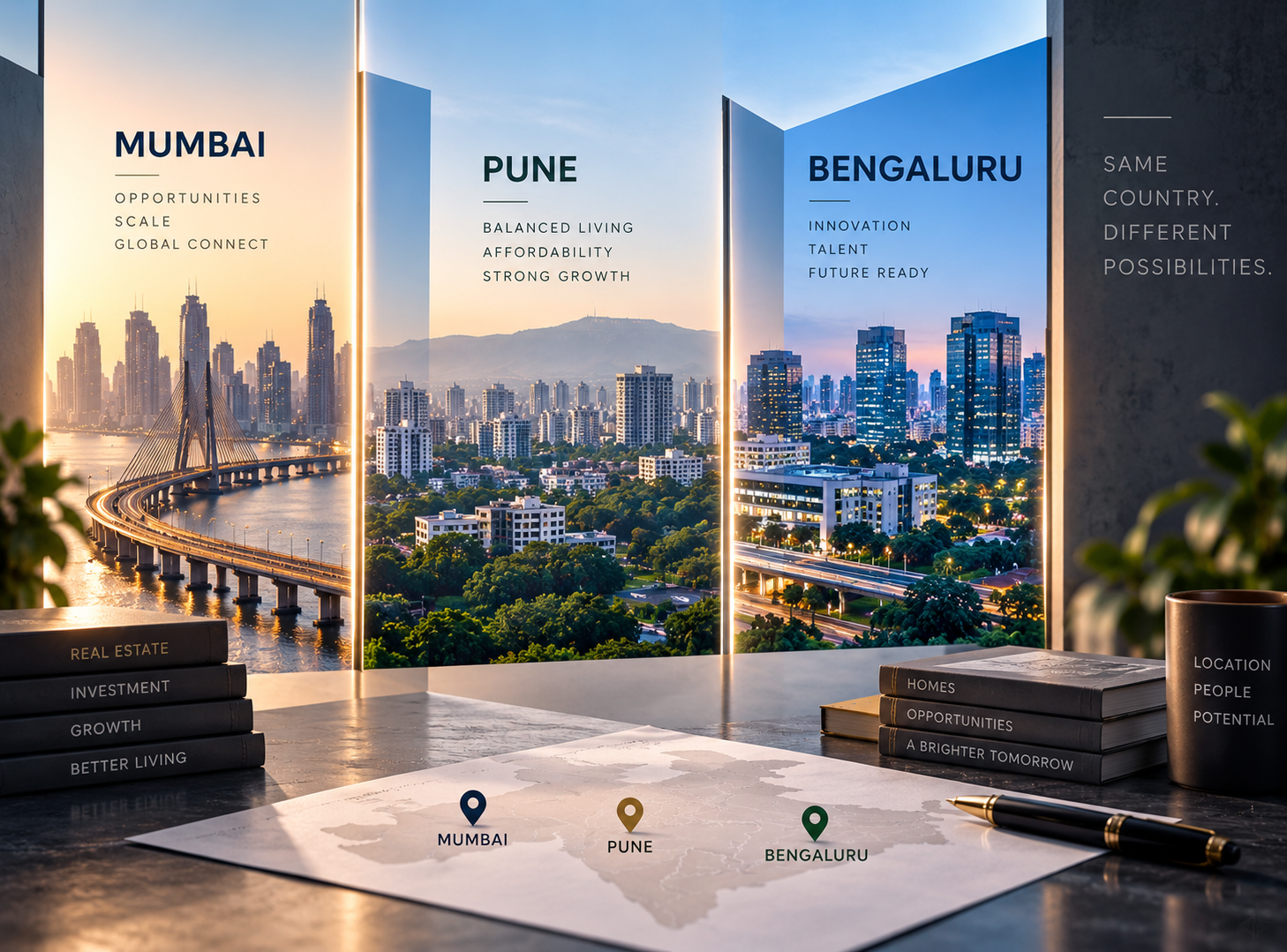
If you have ₹80 lakh to ₹2 crore ready and you are staring at three tabs on your browser — one for a Mumbai flat, one for Pune, one for Bengaluru — you are not alone. This is the most googled dilemma of every Indian professional in their 30s right now. Before we get into the weeds, if you want the bigger picture on how the entire market is behaving this year, our 2026 real estate guide for India lays out the fundamentals you should keep in mind before comparing cities.
Now let us settle the Mumbai vs Pune vs Bengaluru property debate the honest way — with numbers, ground reality, and a bit of common sense.
The Quick Verdict First
- Buy in Mumbai if you already earn there, hate commuting, and want a legacy asset that will not double but will not crash either.
- Buy in Pune if you want the best balance of price, lifestyle and rental demand — the sweet spot for first-time buyers in 2026.
- Buy in Bengaluru if your income is tech-linked and you are comfortable betting on the outer belts (Sarjapur, Devanahalli, Whitefield extension).
That is the TL;DR. If you want to understand why, keep reading. The rest of this post is what actually changed between 2024 and 2026.
Price Per Sq Ft in 2026: The Real Numbers
Forget the glossy brochures. Here is what buyers are actually paying this year in the most-searched pockets.
Mumbai (MMR)
- South & Central Mumbai: ₹45,000 – ₹90,000 per sq ft
- Western Suburbs (Andheri, Goregaon, Malad): ₹22,000 – ₹35,000 per sq ft
- Thane & Navi Mumbai: ₹12,000 – ₹18,000 per sq ft
- Panvel, Dombivli, Kalyan: ₹7,500 – ₹11,000 per sq ft
Pune
- Koregaon Park, Kalyani Nagar, Baner: ₹14,000 – ₹22,000 per sq ft
- Hinjewadi, Wakad, Balewadi: ₹9,500 – ₹13,000 per sq ft
- Kharadi, Viman Nagar: ₹11,000 – ₹15,000 per sq ft
- Hadapsar, Undri, NIBM: ₹8,000 – ₹11,500 per sq ft
Bengaluru
- Indiranagar, Koramangala, HSR: ₹15,000 – ₹24,000 per sq ft
- Whitefield, Sarjapur Road: ₹9,500 – ₹14,000 per sq ft
- Electronic City, Bannerghatta: ₹7,500 – ₹10,500 per sq ft
- Devanahalli, North Bengaluru: ₹6,500 – ₹9,500 per sq ft
The 3-Year Trend
Between 2023 and 2026, prices moved roughly like this:
- Mumbai: +18% in premium pockets, +28% in Thane/Navi Mumbai
- Pune: +32% overall, with Kharadi and Hinjewadi leading at 40%+
- Bengaluru: +38% average, with Sarjapur and North Bengaluru corridors hitting 50%+
Translation — Bengaluru rose fastest, Pune caught up quietly, Mumbai is the slowest but the most stable.
Rental Yield: Where Your Property Actually Pays You Back
This is where most Mumbai buyers get a rude shock. A ₹2.5 crore 2BHK in Andheri rents for maybe ₹65,000–₹80,000 a month. Do the math and the yield sits at 2.8–3.2%. Your fixed deposit does better.
Here is the 2026 rental yield picture:
- Mumbai: 2.5% – 3.2% (premium areas), 3.5% – 4% (Thane/Navi Mumbai)
- Pune: 3.8% – 4.8% — the highest of the three
- Bengaluru: 3.5% – 4.5% (higher in Whitefield & Sarjapur because of tech tenants)
Pune wins on paper. But Bengaluru’s tenant quality is unbeatable — corporate leases, longer stays, quicker turnover. And if you are curious whether property still beats other asset classes at all, this deep dive on whether real estate is still worth it in 2026 is worth 10 minutes of your time before you sign anything.
Infrastructure Pipeline: Who Is Actually Building?
Metro lines, ring roads and airports do not just move traffic — they move property prices. Here is what is landing between 2026 and 2028.
Mumbai
- Mumbai Metro Line 3 (Colaba–SEEPZ) fully operational
- Mumbai Trans Harbour Link already live — cutting Navi Mumbai commute by 40 minutes
- Navi Mumbai International Airport phase 1 operational late 2026
- Coastal Road extension pushing Western Suburb access
Impact: Navi Mumbai and Panvel are the smart plays. Central Mumbai is priced in.
Pune
- Pune Metro Line 3 (Hinjewadi–Shivajinagar) operational — huge for IT corridor
- Ring Road (129 km) under active construction
- Pune–Bengaluru expressway alignment finalised
- Purandar Airport making slow but real progress
Impact: Hinjewadi-Mahalunge and areas around Ring Road exits are the value picks.
Bengaluru
- Namma Metro Phase 2 largely done, Phase 3 approved
- Peripheral Ring Road slowly picking up steam
- Suburban rail phase 1 rolling out
- Kempegowda Airport terminal 2 fully operational — driving north Bengaluru
Impact: Devanahalli and Sarjapur remain the strongest appreciation plays for the next 5 years.
The WFH Factor Nobody Priced In Correctly
By 2023 everyone assumed WFH would gut city property prices. It did the opposite — but selectively.
What actually happened by 2026:
- Hybrid became the default. 3 days in office, 2 at home.
- This killed demand for tiny 1BHKs near office districts.
- It exploded demand for 3BHKs with a study room, 40 minutes from office.
- Tier 1 suburbs (Thane, Wakad, Sarjapur outer) became the biggest winners.
Mumbai was hurt the most by this shift because it is the least WFH-friendly (small apartments, expensive space). Pune and Bengaluru — where a 3BHK is still under ₹1.5 crore in good areas — absorbed the demand.
If you are buying purely for self-use in a hybrid setup, Pune and Bengaluru give you the bigger home, better air quality, and shorter drive to a decent office day.
The Real Cost of Ownership: Beyond Sticker Price
Same ₹1.5 crore does not buy you the same life in these three cities.
- Mumbai ₹1.5 cr: 1BHK, 550 sq ft, 45-minute commute, ₹1.2 lakh society fees a year
- Pune ₹1.5 cr: 3BHK, 1,300 sq ft, 25-minute commute, ₹80,000 society fees
- Bengaluru ₹1.5 cr: 3BHK, 1,450 sq ft, 35-minute commute (on a good day), ₹90,000 society fees
That is the same money, three completely different lives.
So Where Should You Actually Buy?
Buy Mumbai If…
- You already work and earn in Mumbai
- You are buying in Navi Mumbai or Thane for appreciation, not yield
- You value legacy and liquidity over returns
- You have ₹2 crore+ and can put down 30%+
Buy Pune If…
- You are a first-time buyer with ₹80 lakh to ₹1.5 crore
- You want the best rental yield of the three
- You are okay being 90 minutes from Mumbai when needed
- You prefer weather and lifestyle over hustle
Buy Bengaluru If…
- Your job or your tenant pool is tech
- You can hold for 7-10 years
- You are picking Sarjapur, Devanahalli or Whitefield extension
- You accept the traffic trade-off for future appreciation
Red Flags To Watch In All Three Cities
- Unregistered builders: Always verify RERA registration. No exceptions.
- Under-construction discounts that look too good: Usually the builder is short on cash.
- Peripheral land plays: Great story, 10-year lockup, low liquidity.
- Ready-to-move premium above 25%: Rethink.
Whichever city you pick, do not rush the paperwork phase. Bad due diligence is what turns a dream home into a decade-long regret — this quick read on 7 mistakes first-time homebuyers should avoid is one of the most-shared pieces on the site for a reason.
Final Take
If you forced me to rank them for a 2026 buyer with no city bias — Pune first, Bengaluru second, Mumbai third. Pune offers the cleanest mix of affordability, yield, and infrastructure momentum. Bengaluru gives the highest upside if you can pick the right micro-market. Mumbai is a store of value, not a growth bet.
But cities do not buy property. People do. Match the city to your income, your job, and how you actually want to live. The numbers will follow.