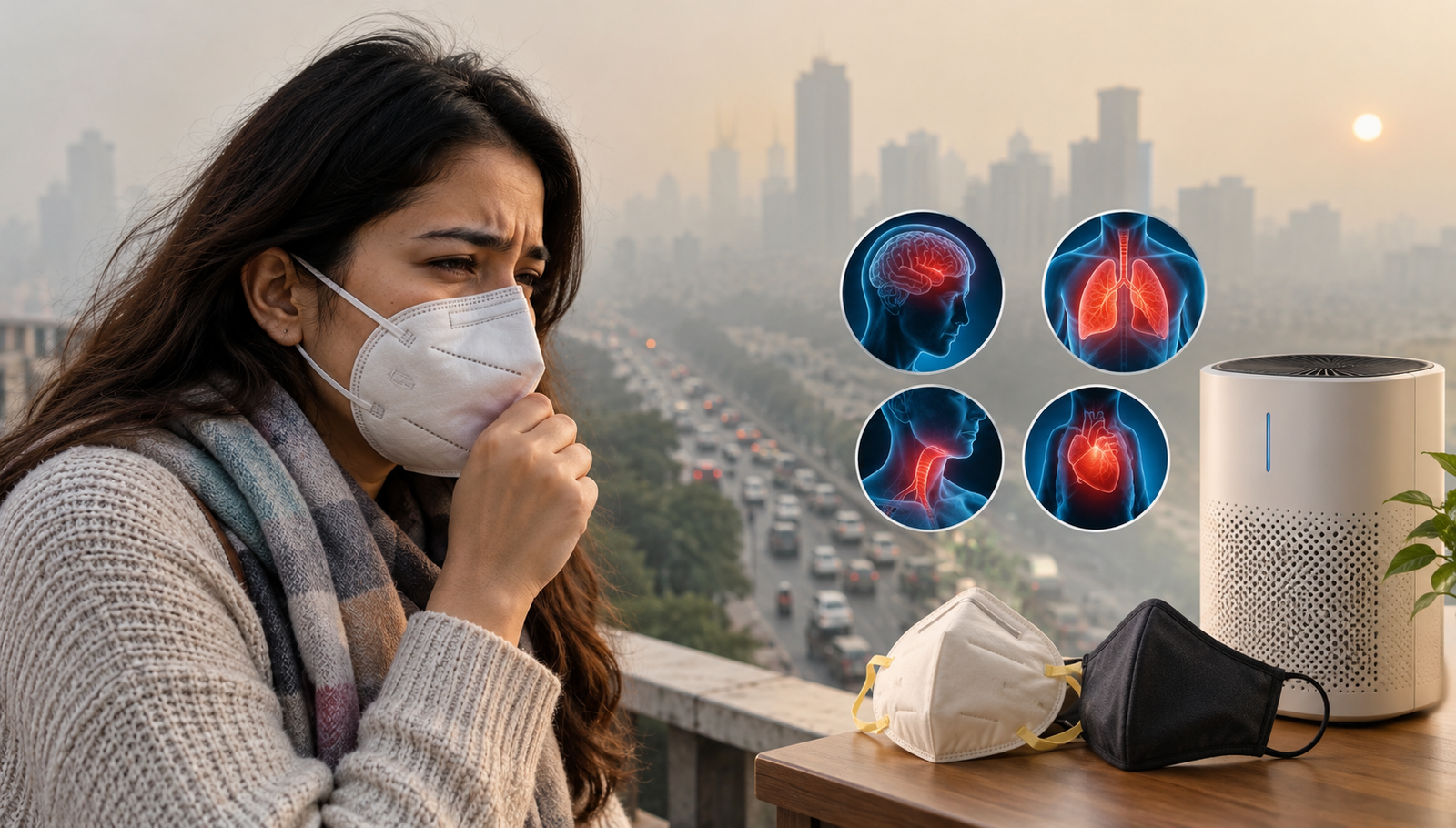
Your phone says the AQI is 312. Most of us glance at it and carry on. But 300 isn’t an ordinary bad day: on India’s official scale, it’s the line where “Poor” turns into “Very Poor”.
This guide covers the AQI health effects that research actually supports, who should worry most, and which masks and purifiers are worth buying. Air is the part of health you can’t fully control, unlike the habits in our evidence-based guide to metabolic health, so it helps to know the facts. No brands, no affiliate links.
What AQI 300+ means: PM2.5 explained simply
India’s National Air Quality Index, run by the Central Pollution Control Board (CPCB), goes from 0 to 500 in six bands. Here is how they line up with PM2.5, the pollutant most people mean when they talk about smog.
| AQI band | AQI | PM2.5, 24-hour (µg/m³) | CPCB health statement (paraphrased) |
|---|---|---|---|
| Good | 0–50 | 0–30 | Minimal impact |
| Satisfactory | 51–100 | 31–60 | Minor breathing discomfort for sensitive people |
| Moderate | 101–200 | 61–90 | Discomfort for people with asthma or heart disease, children and older adults |
| Poor | 201–300 | 91–120 | Breathing discomfort on prolonged exposure; discomfort for people with heart disease even after short exposure |
| Very Poor | 301–400 | 121–250 | Respiratory illness on prolonged exposure, more pronounced in people with lung and heart disease |
| Severe | 401–500 | Above 250 | Respiratory effects even in healthy people, serious impact on people with lung or heart disease |
PM2.5 is particulate matter 2.5 micrometres or smaller across. WHO says particles that small can pass from the lungs into the bloodstream and affect all major organs.
The maths is worth knowing. If PM2.5 is the pollutant driving your AQI, a reading of 300 means a 24-hour average of about 120 µg/m³. That is 8 times the WHO’s 24-hour guideline of 15 µg/m³, and double India’s own 24-hour standard of 60 µg/m³.
Two quirks of the number. CPCB’s AQI is the worst single pollutant’s sub-index, so a 300 can come from PM10 rather than PM2.5. And the real-time AQI uses a running 24-hour average, so a sudden spike takes time to show up.
AQI health effects: what short-term exposure does to lungs, heart and brain
EPA’s summaries of the evidence on particle pollution list a long chain of effects:
- Lungs: eye and airway irritation, reduced lung function, bronchitis and asthma flare-ups.
- Heart: worsening heart failure and other cardiovascular disease, plus nonfatal heart attacks and irregular heartbeat.
- Death: premature death in people with heart or lung disease.
What Indian data shows
A 2024 Lancet Planetary Health study tracked daily deaths in ten Indian cities from 2008 to 2019. Every 10 µg/m³ rise in the two-day average of PM2.5 was linked to 1.4% higher daily mortality. The authors estimated that 7.2% of all daily deaths were attributable to PM2.5 above the WHO guideline.
Two details matter. The effect per 10 µg/m³ was about twice as steep on days below India’s standard (2.7%), so “moderate” days aren’t free. And these are population figures: deaths rise across millions of people, which is not the same as your own odds on a bad day.
The brain, and the bigger picture
The brain evidence comes mostly from long-term exposure, not one bad week. The State of Global Air 2025 report attributes 626,000 dementia deaths in 2023 to air pollution. WHO says most outdoor air pollution deaths come from heart disease and stroke, about 68% in 2019.
Overall, the same report puts air pollution at 7.9 million deaths worldwide in 2023, about 1 in 8 deaths and the second leading risk factor for early death after high blood pressure. India and China each had more than 2 million.
What the research doesn’t show is that one day at 300 leaves lasting damage in a healthy adult. EPA’s smoke guidance says most healthy adults and children recover quickly from smoke exposure, but evidence on repeated multi-day exposure is limited. If your city stays high for days, treat that as a reason to act, not to panic.
Who is most at risk: kids, elderly, asthma and heart patients
CPCB is blunt about this. At “Poor”, people with heart disease can feel discomfort after short exposure. At “Very Poor”, the effect may be more pronounced in people with lung and heart disease. The groups to watch:
- Asthma and lung disease: CPCB flags them from the “Moderate” band, and EPA lists aggravated asthma as an effect.
- Heart patients: named by CPCB at every band from “Moderate” up.
- Children and older adults: WHO calls air pollution one of the greatest environmental risks to child health, and CPCB and EPA both name older adults.
- Pregnant women: EPA’s smoke guidance lists them as at greater risk, and WHO notes prenatal exposure to high pollution is associated with developmental delay at age three.
Many people don’t know they are in the heart-risk group. If your waist, blood pressure, sugar and triglycerides are drifting up, our explainer on why doctors call metabolic syndrome more dangerous than obesity alone covers what that cluster means. If you have asthma, EPA suggests keeping a written asthma action plan.
Masks that work: N95 vs cloth vs surgical
The short version: only a respirator that seals to your face does the job.
| Mask | Seals to your face? | What the evidence says |
|---|---|---|
| NIOSH-approved N95 | Yes, if size and fit are right | Certified to filter at least 95% of 0.3 µm test particles. EPA says a closely fitted one can reduce personal exposure. |
| Surgical mask | No, it sits loose | EPA: designed to capture particles from the wearer, not a respirator, little or no protection from smoke particles. Lab test: 38.5% fitted filtration. |
| Cloth mask or bandana | No | CDC: not designed to seal, and lacks filter material for smoke particles. Lab test: consumer masks ranged from 26.5% to 79%. |
| Single-strap paper dust mask | No | EPA: not a respirator, little or no protection from smoke particles. |
Getting the fit right
Fit is the whole game. CDC’s NIOSH gives these tips:
- Pick a size that covers your nose and sits under your chin.
- Put one strap at the base of your neck and the other at the crown of your head.
- Press the noseclip firmly so it moulds to your nose.
- Facial hair can make a respirator leak, so be clean-shaven where it seals.
- Do a seal check every time. If you can’t get a good seal, try another model or size.
A particulate respirator filters particles, not gases. CDC says that if you have a heart or lung problem, talk to your doctor before wearing one, and remove it and move to cleaner air if you feel dizzy or have trouble breathing.
For children, the agencies differ. CDC says children aged 2 and over can wear a respirator that fits over the nose and under the chin, but notes the risks and benefits aren’t fully known. An older EPA smoke guide says respirators aren’t made to fit children. For kids, cleaner indoor air is the safer first move.
Air purifiers: CADR maths for your room size
If you are cleaning only one room, make it the bedroom. It is where you spend the longest unbroken stretch, and sleep does real work for your metabolism, as we covered in our look at sleep and your metabolism.
CADR (clean air delivery rate) tells you how much filtered air a purifier delivers, and it is the number to buy on. EPA says to multiply the room’s length by its width, then compare that with the unit’s rated room size. Its chart assumes an 8-foot ceiling:
| Room area (sq ft) | Minimum CADR (cfm) | Approx. CADR (m³/h) |
|---|---|---|
| 100 | 65 | 110 |
| 200 | 130 | 220 |
| 300 | 195 | 330 |
| 400 | 260 | 440 |
| 500 | 325 | 550 |
| 600 | 390 | 660 |
Quick formula: area in sq ft × 0.65 gives the minimum CADR in cfm, or × 1.1 for m³/h. A 12 × 15 ft bedroom is 180 sq ft, so you need about 117 cfm, or roughly 200 m³/h. Some purifiers list cfm and others m³/h, so check the unit.
- Use the smoke CADR if listed. EPA treats the tobacco smoke rating as the proxy for the smallest particles.
- Tall ceilings need more. Above 8 feet, size up.
- Buy above the minimum. CADR is typically rated at the highest fan speed, so allow extra if you plan to run the unit lower to keep the noise down.
- Skip ozone. EPA says to avoid units that intentionally produce ozone, which irritates the lungs. CADR also covers particles only, not gases.
Is an air purifier worth it?
It helps, within limits. EPA says studies of portable HEPA cleaners found small improvements in cardiovascular and respiratory health and in some allergy or asthma symptoms, but the gains were often modest. A purifier doesn’t replace source control or clean-air ventilation, and EPA’s smoke guidance says room cleaners work better the more often they run. Replace filters on the maker’s schedule.
10 daily habits that cut exposure
- Check the AQI before you plan the day. Levels can vary through the day, so time necessary trips for cleaner hours.
- Skip outdoor workouts on high-AQI days. CPCB says Severe air can affect people even during light activity.
- Keep windows and doors shut when the air outside is worse than inside.
- Make one “clean room” with a right-sized purifier running in the room you use most.
- Wear a fitted N95 for stretches you can’t avoid. EPA says adults who must stay outdoors for long periods benefit most.
- Close the car vents. Keep windows shut and run the AC on recirculate.
- Don’t add smoke indoors. No smoking inside, and go easy on incense and candles.
- Avoid ozone-generating “purifiers”.
- Cut your own emissions. On Very Poor and Severe days, CPCB asks people to minimise travel, use public transport, bikes or walking, carpool, and minimise diesel generators.
- Plan ahead if you have asthma or a heart condition. Keep your medicines stocked and agree a plan with your doctor.
FAQ
Is AQI 300 dangerous for healthy adults?
It isn’t harmless, but the risk differs from that of people with heart or lung disease. CPCB’s statement for “Very Poor” (301–400) is respiratory illness on prolonged exposure, more pronounced in people with lung and heart disease. Healthy people are named explicitly only at “Severe” (401+). The bigger concern is repeated days: Indian research finds daily deaths rise with PM2.5 across the population, including on lower-pollution days.
Do N95 masks work against pollution?
Yes, if the mask is NIOSH-approved, the right size and sealed to your face. NIOSH certifies N95 material to filter at least 95% of 0.3 µm test particles, and EPA’s smoke guidance says a closely fitted N95 can reduce personal exposure. Surgical and cloth masks aren’t designed to seal, so don’t count on them.
What size of air purifier do I need for my room?
Multiply room length by width in square feet, then by 0.65 for the minimum CADR in cfm (or by 1.1 for m³/h). A 200 sq ft room needs at least 130 cfm, about 220 m³/h. EPA’s chart assumes an 8-foot ceiling, so go higher for taller rooms or if you will run the unit on low.
The bottom line
An AQI above 300 is a signal to change your routine, not to panic. Seal the room, run the purifier, wear a fitted N95 when you must be outside, and protect the people most at risk. Bring your workout indoors on those days too. Strength training is the easiest to move, and our guide to the strength training sweet spot shows how short a weekly routine can be.
This article is for general information and is not medical advice. If you have a heart or lung condition, talk to your doctor about a plan for high-pollution days.
Sources: CPCB NAQI; State of Global Air 2025; WHO air quality guidelines 2021; WHO fact sheet; Lancet Planetary Health 2024; EPA air cleaners guide; EPA PM health effects; EPA smoke guide; CDC NIOSH; JAMA Intern Med 2021.