
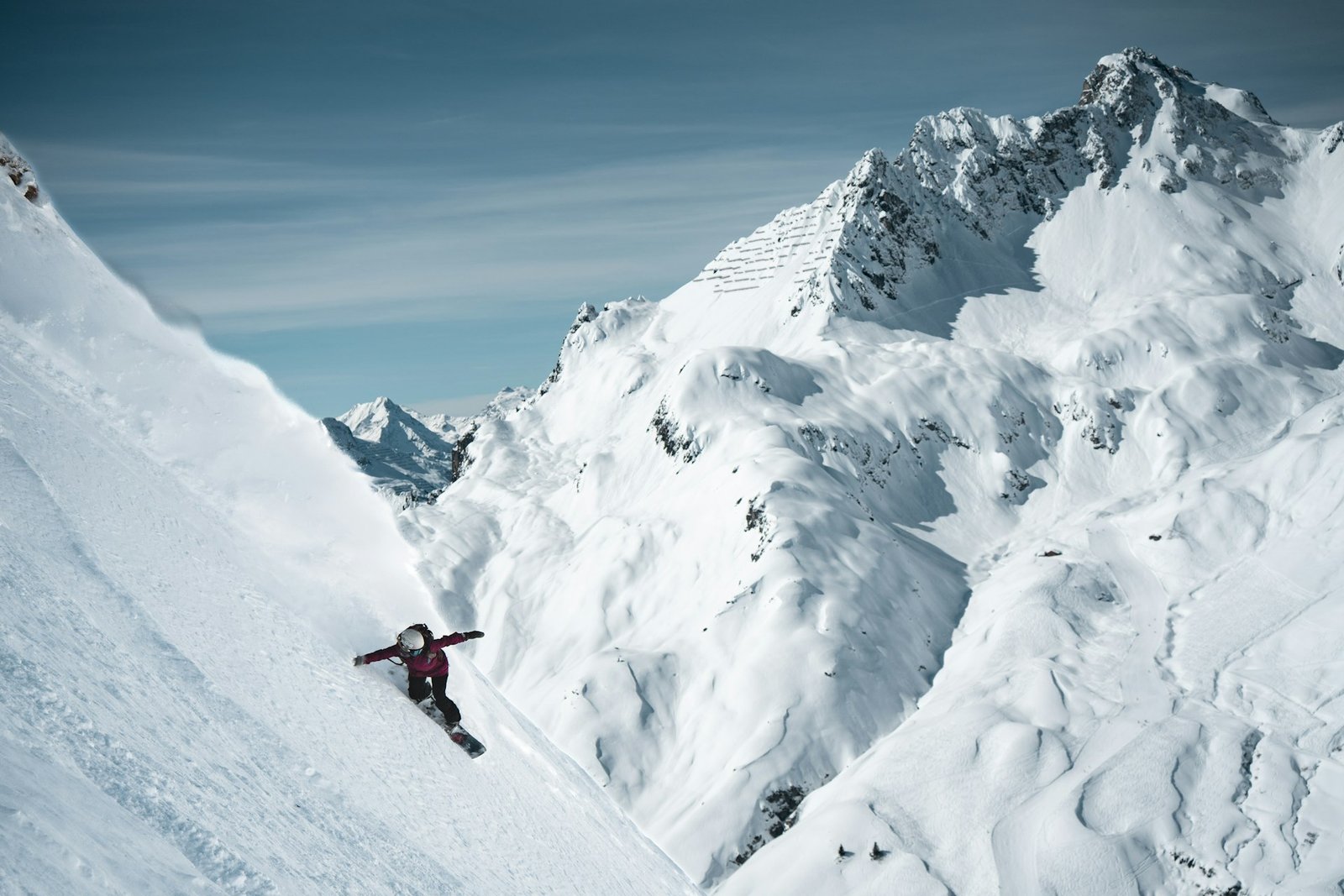
There’s a particular kind of quiet you only get at 2,500 metres on a January morning. It arrives before the lifts fill up, before the first group lesson snakes past, when the only sound is your edge cutting a clean line through fresh snow. Austria does that morning better than almost anywhere in Europe, and it does the evening that follows even better: a wood-panelled dining room, a plate of kaiserschmarrn, boots drying by the fire.
For riders weighing up where to spend their winter budget, Austria makes an unusually strong case. It combines serious terrain with an infrastructure that actually works, and it does so at prices that still undercut comparable weeks in Switzerland or the top-tier French resorts. Here’s what’s worth knowing before you book.
Why Austria works so well for riders
Austria’s reputation was built on skiing. The Arlberg technique that shaped modern alpine skiing was developed here more than 100 years ago. But the country adapted to snowboarding faster and more enthusiastically than most of its neighbours, and today it has some of the best-maintained snowparks on the continent alongside vast, lift-linked freeride terrain.
3 things stand out. First, connectivity: Austrian ski areas tend to be joined into large circuits, so you can ride from village to village without ever taking a bus. Second, altitude has been addressed intelligently, with glacier skiing and high-alpine sectors that hold snow well into spring. Third, and this matters more than people expect, the villages are genuine year-round communities rather than purpose-built concrete resorts. You’re staying somewhere with a history, not a car park with hotels attached.
Where to ride
St. Anton am Arlberg is the obvious starting point. It anchors the Ski Arlberg area, Austria’s largest linked domain, with well over 300 km of marked pistes plus a huge network of signposted ski routes and open freeride terrain. St. Anton earned its reputation on steep, ungroomed north-facing bowls and on an après-ski scene that is genuinely legendary. Since the Flexenbahn lift connection opened, you can ride a continuous circuit through to Lech, Zürs and Warth-Schröcken, the last of which records some of the heaviest average snowfall in the Alps.
Mayrhofen, in the Zillertal, is the park rider’s pick. Its snowpark is consistently ranked among the best-shaped in Europe, with lines for every level. It is also home to the Harakiri, a groomed run with a gradient touching 78%, steep enough that you’ll want your edges sharp.
Ischgl offers high-altitude reliability and a cross-border link into Samnaun in Switzerland. Sölden has 2 glaciers, which means credible riding from late autumn. Saalbach-Hinterglemm is the friendliest of the big circuits: rolling, sunny, and easy to cover a lot of ground on.
What luxury actually means up here
The phrase luxury ski holidays conjures marble bathrooms and champagne, but in the Austrian Alps the meaning is more practical, and more interesting.
It means a chalet or hotel with a proper wellness area (sauna, steam room, outdoor pool), because 6 hours in a hardboot leaves you needing it. It means a boot room where your gear is dried overnight. It means ski-in, ski-out access that saves you 40 minutes of walking every day. It means half-board arrangements where the kitchen is run by someone who trained seriously, and where the wine list has been chosen by a person rather than a distributor.
Most of all, it means time. The real premium on an Austrian winter trip is not the thread count. It is a private guide who knows which aspect held the snow after Tuesday’s wind, and who gets you there before anyone else does.
Timing, and getting there
The core season runs from early December to mid-April, with glacier areas opening earlier. Late January and early February typically deliver the most reliable snow depths and the coldest, driest conditions. March trades some snow quality for longer, warmer days and noticeably lighter crowds outside the school holiday weeks. Avoid the Christmas and New Year window and the mid-February half-term period if lift queues bother you.
Access is one of Austria’s quiet advantages. Innsbruck, Munich, Zurich and Salzburg all serve the main ski regions, and the rail network is excellent. St. Anton has its own station on the Arlberg line, with direct services from Zurich, Innsbruck and Vienna. For many trips, the train genuinely beats the transfer.
Beyond the marked runs
If your only plan is laps on groomed pistes, you’re using maybe 30% of what’s available. Splitboard touring has grown enormously in the Austrian Alps and opens terrain that lifts will never reach. Guided off-piste days are the standard way to access the good stuff safely, and safety is not optional here. Anyone going beyond the ropes needs a transceiver, shovel and probe, the training to use them, and ideally a qualified local guide reading the avalanche bulletin for you.
On rest days there’s snowshoe hiking through silent larch forest, night tobogganing down floodlit runs, paragliding off the shoulder of the mountain, and thermal spas that will fix whatever the Harakiri did to your legs.
Making it painless
This is where planning earns its keep. Coordinating chalets, lift passes, guides, rentals, transfers and restaurant tables across a region you don’t know, in a language you may not speak, is where good trips quietly become stressful ones.
It’s worth working with people who are actually based in the mountains. Alpenature is a boutique ski travel agency headquartered in St. Anton am Arlberg, with more than 20 years on the ground. The team builds custom itineraries around how you actually want to ride, handling accommodation, instruction, equipment and the unglamorous logistics, with a strong emphasis on eco-conscious, locally rooted experiences. That local knowledge is the difference between a week that runs smoothly and one you’ll talk about for years.
Snowboarding in Austria rewards riders who plan properly. Get the details right, and the mountain takes care of the rest.