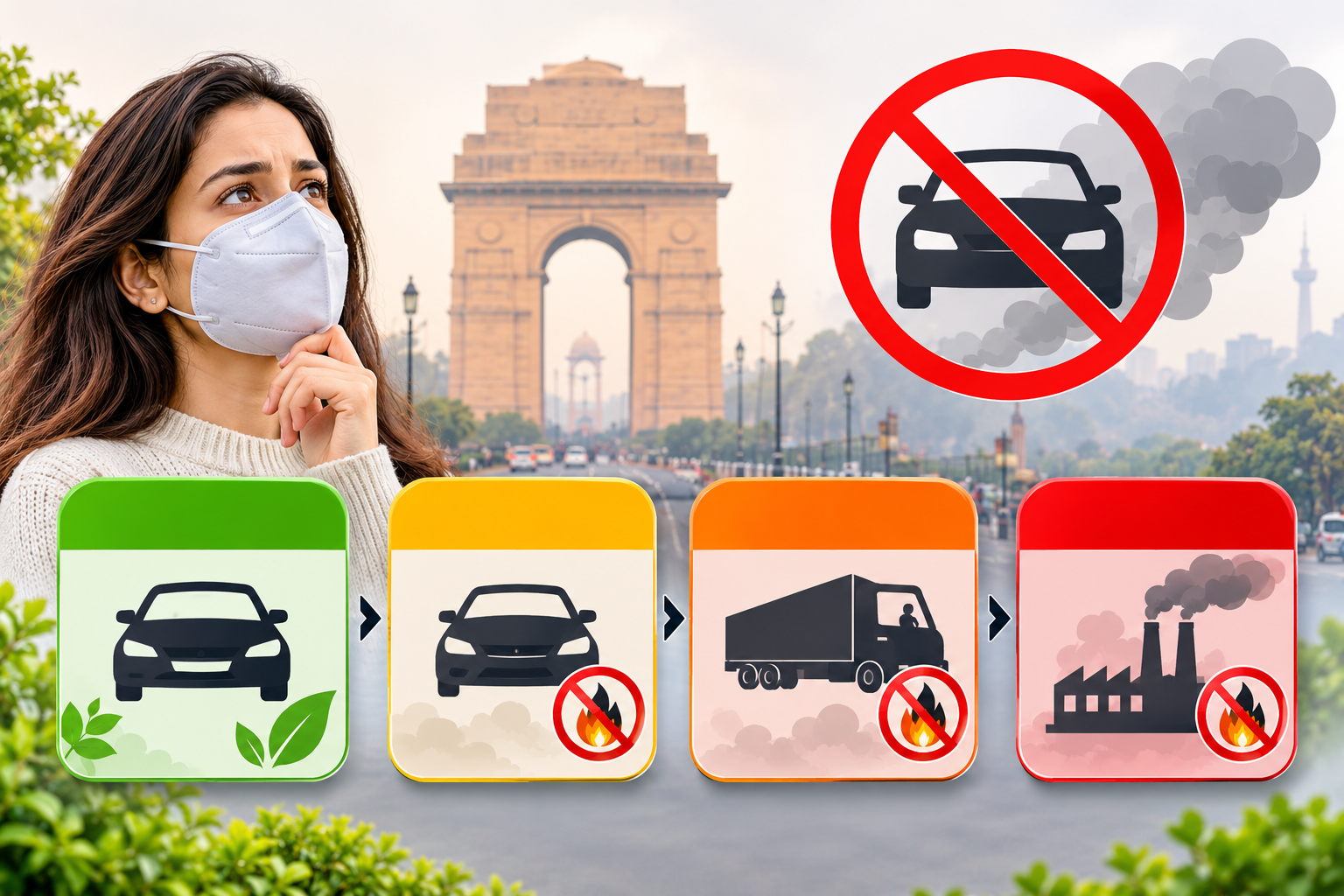
GRAP, the Graded Response Action Plan, is the set of curbs that Delhi-NCR switches on as air quality worsens. It has four stages based on Delhi’s AQI: Stage I ‘Poor’ (201 to 300), Stage II ‘Very Poor’ (301 to 400), Stage III ‘Severe’ (401 to 450) and Stage IV ‘Severe +’ (above 450). On 17 November 2026 Stage III was revoked; Stages I and II remain in force.
GRAP in Delhi-NCR Now: Status on 20 November 2026
| Item | Status |
|---|---|
| Schedule in force | The revised GRAP schedule of 29 September 2026, issued under CAQM Direction No. 104 |
| Stages in force | Stage I (since 21 October) and Stage II (since 2 November). Stage III was invoked on 6 November and revoked on 17 November. |
| Separate order running to 20 November | CAQM’s order of 30 October 2026: dust-generating demolition and outdoor construction restricted across the NCR, with exemptions, and government and private offices to run with up to 50% of staff attending physically in Delhi and five nearby districts, from 5 to 20 November. The last day is 20 November, so check the CAQM website for any extension or new order. |
| Delhi’s AQI on 17 November | 204, from the CPCB daily bulletin quoted in CAQM’s release |
| Forecast on 17 November | IMD and IITM expected the AQI to stay in the ‘Poor’ or ‘Very Poor’ category in the coming days |
| Where to check | The stage in force on the CAQM website; the AQI on the SAMEER app |
The CAQM website publishes every GRAP order. As of 20 November 2026, the latest GRAP order on its home page is the revocation of Stage III on 17 November 2026.
GRAP at a Glance: What Changes for You at Each Stage
| Stage | Construction | Vehicles | Schools and offices | Other |
|---|---|---|---|---|
| I (201 to 300) | Dust-control rules enforced; projects of 500 sq m or more not registered on the portal not permitted to work | PUC checks; polluting and overaged vehicles targeted; buses from other states must be electric, CNG or BS-VI diesel | No change | Open burning, coal and firewood in tandoors and DG-set use enforced |
| II (301 to 400) | More inspections of dust control at sites | Higher parking fees | Office timings staggered in Delhi and four districts | Daily road sweeping and sprinkling; electric heaters for security and sanitation staff |
| III (401 to 450) | Dust-generating work restricted across the NCR, with exemptions; stone crushers and mining closed | BS-III petrol and BS-IV diesel cars restricted in Delhi and five districts; older diesel goods vehicles restricted or barred from entering Delhi | Hybrid classes up to class V; governments decide on 50% office strength | — |
| IV (above 450) | Ban extends to highways and other linear public projects | Heavy trucks barred from entering Delhi, except LNG, CNG, electric and BS-VI diesel | Hybrid classes up to IX and XI | States may consider college closures, closing non-emergency commercial activity and odd-even |
How GRAP Played Out in October and November 2026
| Date | What CAQM did | Delhi AQI in the order |
|---|---|---|
| 29 September | Issued the revised GRAP schedule (Direction No. 104) | Not applicable |
| 21 October | Invoked Stage I | 244 at 2 pm; 179 the day before |
| 30 October | Ordered precautionary measures for 5 to 20 November | Not applicable |
| 2 November | Invoked Stage II | 324; 261 the day before |
| 6 November | Invoked Stage III | 382 daily average; forecast to slip into ‘Severe’ |
| 17 November | Revoked Stage III; Stages I and II and the 30 October order stay | 204 |
Stage III was invoked at an AQI of 382, which is below its band of 401 to 450. The schedule allows this: stages are invoked in advance of the AQI reaching the projected level, when the IMD and IITM forecast says the higher levels are likely to last longer. On 6 November, the forecast was for the AQI to slip into the ‘Severe’ category.
How GRAP Works
- Delhi’s AQI sets the stage. The four bands are Stage I ‘Poor’ (201 to 300), Stage II ‘Very Poor’ (301 to 400), Stage III ‘Severe’ (401 to 450) and Stage IV ‘Severe +’ (above 450).
- Stages can start early. Actions are invoked in advance on the day-to-day forecast by IMD and IITM when higher levels are likely to last. If the AQI breaches a threshold under extreme weather or an episodic event, that stage is invoked with immediate effect for actions that can be started immediately.
- The measures stack. Actions from earlier stages continue, so Stage III is in addition to Stages I and II, and so on.
- The Sub-Committee on GRAP decides. It meets often, issues the orders that invoke or revoke a stage, and reviews what agencies have done. The Commission can add exceptions and extra measures, as its 30 October order did.
- Most actions are directions to agencies. The schedule names who must act beside each action: municipal bodies, transport departments, traffic police, pollution control boards, state governments and others.
CAQM’s Direction No. 104 says the revised schedule governs GRAP in the NCR and that each stage’s measures apply as and when that stage is invoked by order. It also records that in the November 2025 revision certain measures were advanced from higher stages to earlier ones.
Stage I: ‘Poor’ Air Quality (AQI 201 to 300)
- Dust and construction: dust-control rules enforced at construction and demolition sites. Work is not permitted on projects of 500 sq m or more that are not registered on the state or Delhi government web portal for remote monitoring of dust control. Mechanised sweeping and water sprinkling on roads.
- Waste and burning: the ban on open burning of biomass and municipal solid waste enforced with the maximum environmental compensation, and strict vigil on fires at landfills and dump sites.
- Vehicles and traffic: PUC norms enforced and visibly polluting vehicles impounded or fined; the ban on overaged diesel and petrol vehicles enforced. Inter-city and inter-state buses from Haryana, Uttar Pradesh, Rajasthan and the adjoining states are not allowed to ply in Delhi-NCR unless they are electric, CNG or BS-VI diesel.
- Industry, fireworks and tandoors: more inspections of industries; approved fuels only in industries, brick kilns and hot mix plants; court orders on firecrackers enforced; the ban on coal and firewood in tandoors at hotels, restaurants and open eateries enforced.
- Diesel generator sets: not to be used as a regular source of power. Portable sets below 19 kW (23 kVA) are generally not permitted, except for prescribed emergency services such as lifts, hospitals, railways and metro.
Stage II: ‘Very Poor’ Air Quality (AQI 301 to 400)
- Roads: mechanised or vacuum sweeping with water sprinkling of identified roads every day, preferably at night or early morning, and daily water sprinkling with dust suppressants before peak traffic on heavy-traffic corridors.
- Hotspots and sites: focused action in identified pollution hotspots and more inspections of dust control at construction and demolition sites.
- Parking: higher parking fees to discourage private transport.
- Winter burning: resident welfare associations must provide electric heaters, with an electricity point, to security, sanitation, horticulture and other staff so that they do not burn biomass or waste.
- Office timings: state governments to stagger timings for public offices and municipal bodies in the National Capital Territory of Delhi and the districts of Gurugram, Faridabad, Ghaziabad and Gautam Buddha Nagar. State governments may decide the same for other NCR areas, and the Central Government may decide for its offices.
Stage III: ‘Severe’ Air Quality (AQI 401 to 450)
- Construction, earthwork and structure: strict restrictions across the NCR on earthwork including boring and drilling; piling; all demolition; laying of sewer, water, drainage and electric cabling lines by open trench; and brick and masonry work.
- Construction, finishing and plants: restrictions on ready-mix concrete batching plants; major welding and gas cutting (minor welding for mechanical, electrical and plumbing work is permitted); painting, polishing and varnishing; and cement, plaster, coatings and tile, stone and flooring work, except minor indoor repairs.
- Roads and materials: restrictions on road construction and major repairs (pothole repair is permitted); on loading, unloading and transfer of dust-generating materials such as cement, fly ash, bricks, sand and crushed stone; and on vehicles carrying construction material or waste on unpaved roads.
- Work that still continues: less polluting construction continues under dust rules. Even the restricted activities are permitted for projects of railways, metro, airports and inter-state bus terminals, national security and defence, hospitals, linear public projects such as highways, roads, flyovers, power transmission, pipelines and telecom, sanitation and water supply projects, and ancillary activities.
- Stone crushers and mining: stone crushers closed across the NCR, and all mining and associated activities closed across the NCR.
- Cars: strict restrictions on BS-III petrol and BS-IV diesel light motor vehicles, or older, in Delhi and in Gurugram, Faridabad, Sonipat, Ghaziabad and Gautam Buddha Nagar. Persons with disabilities may use such vehicles if they are specifically adapted and used only for their personal use.
- Goods vehicles: strict restrictions on Delhi-registered diesel BS-IV and older medium goods vehicles in Delhi, and no entry into Delhi for diesel BS-IV and older medium goods vehicles and light goods vehicles registered outside Delhi.
- Schools: classes up to class V in hybrid mode, physical and online where online is feasible, in Delhi and in Gurugram, Faridabad, Ghaziabad and Gautam Buddha Nagar. Other NCR areas may consider it. The choice of online mode rests with students and guardians.
- Offices: NCR state governments and the Delhi government to decide on public, municipal and private offices working at 50% strength with the rest working from home, and the Central Government may decide on work from home for its employees.
Stage IV: ‘Severe +’ Air Quality (AQI above 450)
- Trucks: entry of heavy goods vehicles into Delhi stopped. LNG, CNG, electric and BS-VI diesel trucks are permitted. Delhi-registered diesel BS-IV and older heavy goods vehicles are banned from plying in Delhi.
- Construction: the Stage III construction ban extended to linear public projects such as highways, roads, flyovers, overbridges, power transmission, pipelines and telecom.
- Schools: hybrid classes extended to classes VI to IX and XI in Delhi and the same four districts.
- Further measures states may consider: closing colleges and educational institutions, closing non-emergency commercial activities, and running vehicles on an odd-even basis of registration numbers.
What Citizens Are Asked to Do
The schedule carries a Citizen Charter for each stage. CAQM’s 17 November release asked citizens to follow the charters for Stages I and II:
- Check the AQI on the SAMEER app and the stage of GRAP in force on the CAQM website.
- Keep engines tuned and tyre pressure right, keep PUC certificates up to date, do not idle your vehicle, and do not ply end-of-life or visibly polluting diesel or petrol vehicles.
- Prefer public transport, pooling or electric vehicles, and use technology to take a less congested route even if slightly longer.
- Avoid dust-generating construction activities from October to January, clean kitchen chimney filters regularly, and avoid outdoor smoke-generating cooking and heating and any open burning of waste or biomass.
- Avoid DG sets except for essential activities, celebrate festivals in an eco-friendly way without firecrackers, and report polluting activities on the 311, Green Delhi or SAMEER apps.
- People whose positions allow it may work from home.
The Stage III charter adds walking or cycling for short distances, combining journeys, postponing private gatherings that increase traffic and outdoor exposure, not using coal or wood for heating, and following hybrid schooling and work from home when instructed.
The Stage IV charter asks citizens to limit non-essential outdoor activity. Children, pregnant women, the elderly and people with respiratory, cardiovascular, cerebrovascular or other chronic diseases are asked to avoid outdoor activities and stay indoors as much as possible, and to wear a mask if they must go out. Our guide to what happens to your body when the AQI crosses 300 covers masks and purifiers.
The 30 October Order: Precautionary Curbs for 5 to 20 November
This order is separate from the GRAP stages. CAQM issued it as a precaution, citing air quality data for November 2018 to 2025 that show a recurring pattern of high pollution in early to mid-November, sometimes reaching the ‘Severe’ and ‘Severe +’ categories. For 5 to 20 November 2026 it directs:
- Dust-generating demolition and outdoor construction restricted across the entire NCR, except projects for railways, metro, airports, inter-state bus terminals, hospitals, water supply and sanitation, national security and defence, and projects of national importance. The restriction also applies to linear public projects such as highways, roads, flyovers, overbridges, power transmission, pipelines and telecom.
- State government and private offices to operate with up to 50% of staff attending physically, and the rest working from home, in Delhi and in the districts of Gurugram, Faridabad, Sonipat, Ghaziabad and Gautam Buddha Nagar, except industrial establishments and essential services where this is not feasible.
CAQM’s 17 November order says this order continues. It sets those dates and ends on 20 November, so check the CAQM website for any extension or new order.
Frequently Asked Questions
Which GRAP stage is in force in Delhi now?
As of 20 November 2026, Stages I and II. CAQM revoked Stage III on 17 November, when Delhi’s AQI was 204. Its 30 October order on construction and office staffing runs to 20 November, so check the CAQM website for an extension. The stage can change at any time.
What are the AQI levels for each GRAP stage?
Stage I is ‘Poor’, 201 to 300. Stage II is ‘Very Poor’, 301 to 400. Stage III is ‘Severe’, 401 to 450. Stage IV is ‘Severe +’, above 450. These are Delhi’s AQI. A stage can be invoked early when the IMD and IITM forecast says higher levels will last.
What is banned in GRAP Stage III?
Stage III restricts dust-generating construction and demolition across the NCR, with exemptions for projects such as railways, metro, hospitals and highways. It closes stone crushers and mining and restricts BS-III petrol and BS-IV diesel vehicles of the types listed. Classes up to class V go hybrid, and governments decide on 50% office strength.
What is the difference between Stage III and Stage IV?
Stage IV stops the entry of heavy trucks into Delhi, except LNG, CNG, electric and BS-VI diesel ones, and bans Delhi-registered BS-IV and older diesel heavy goods vehicles. It extends the construction ban to highways and other linear projects and adds hybrid classes up to IX and XI. States may consider odd-even and closures.
Does GRAP ban private cars?
Not outright. In Stage III, BS-III petrol and BS-IV diesel light motor vehicles, or older, face strict restrictions in Delhi and five districts. Stage IV lists odd-even registration among emergency measures that states may consider. Earlier stages focus on PUC checks and on overaged and visibly polluting vehicles.
Where can I check which stage is in force?
The CAQM website publishes the orders that invoke and revoke each stage. The Citizen Charter in the GRAP schedule advises checking the AQI on the SAMEER app and the stage of GRAP in force on the CAQM website.
Sources and Method
- CAQM website (Commission for Air Quality Management in NCR and Adjoining Areas): where the orders below are published.
- Graded Response Action Plan for the NCR, revision of 29 September 2026, CAQM: stages, AQI bands, schedule of actions and Citizen Charters. Read as a PDF and not linked.
- Direction No. 104 dated 29 September 2026, CAQM: the revised GRAP schedule issued under Section 12 of the CAQM Act, 2021. Read as a PDF and not linked.
- CAQM orders of 21 October 2026 (Stage I), 2 November 2026 (Stage II) and 17 November 2026 (revocation of Stage III), and the order of 30 October 2026 on precautionary measures for 5 to 20 November. Read as PDFs and not linked.
- CAQM press releases of 6 November 2026 (invocation of Stage III) and 17 November 2026 (revocation of Stage III). Read as PDFs and not linked.
Method: I read each document on 19 November 2026 and kept only what it states. I did not use news reports for the stages or the AQI bands, because reports disagree on them. Several orders are scanned copies, so I checked the dates, AQI figures and district names in the Stage I, Stage II and 30 October orders against the page images. The stage in force is as of the last GRAP order on the CAQM home page, which I checked again on 20 November 2026.
More explainers on air quality and health are in our Health section. This page is general information, not legal or medical advice. The orders on the CAQM website decide what applies on any day.