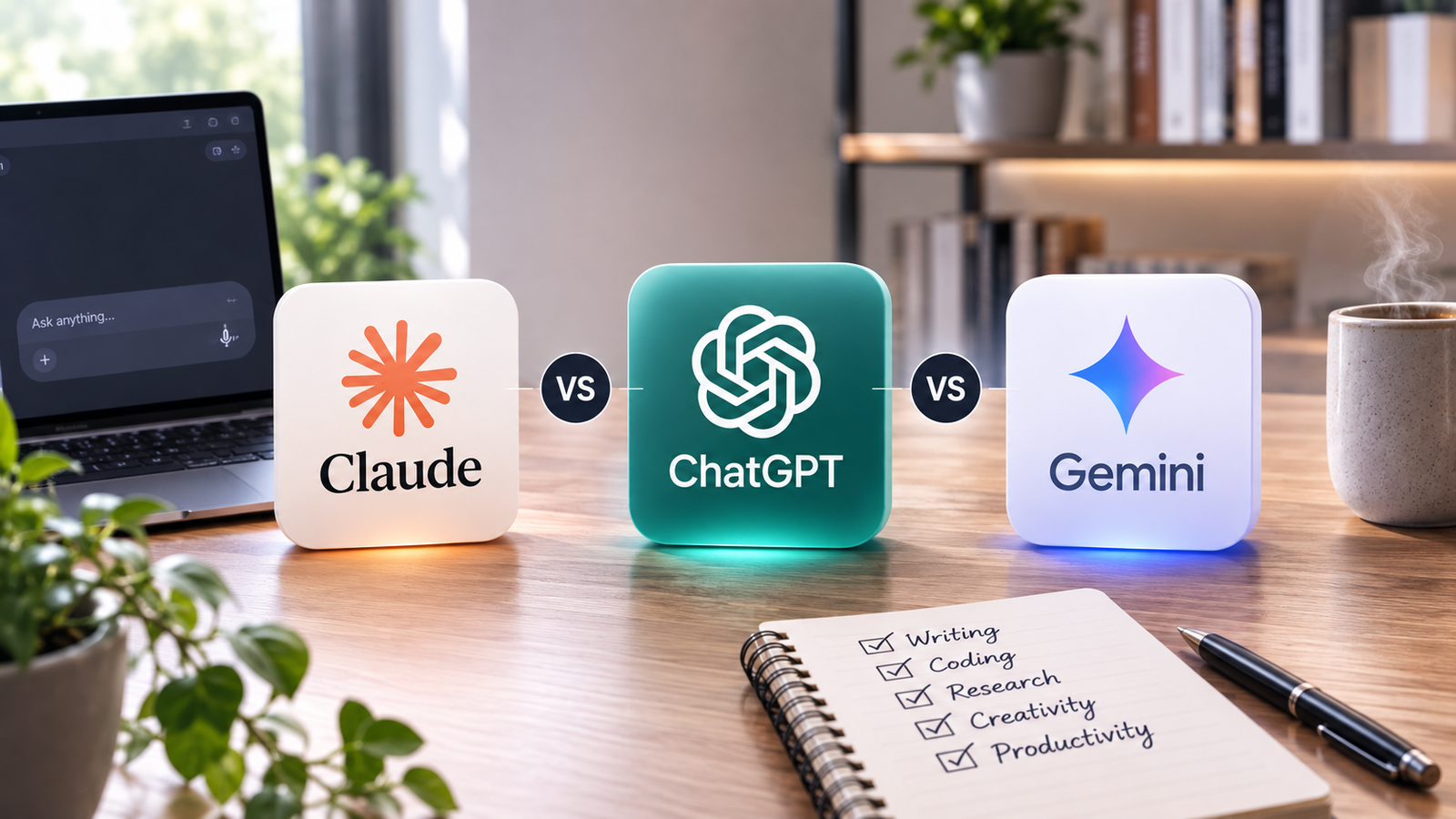
You have probably searched some version of this question before. Maybe you typed it into one of these very tools, which is a little ironic if you think about it. The Claude vs ChatGPT vs Gemini comparison keeps popping up because millions of people are trying to figure out where to invest their time, money, and trust.
Here is the problem with most comparisons: they give you benchmark scores and pricing tables, then leave you to figure out the rest. That is not how real decisions work. You want to know which AI will actually handle your contract review without inventing fake legal citations. Which one will not hallucinate a stock ticker that does not exist. Which one will not confidently tell you to skip the emergency room when you should be calling 911.
This is that comparison. Concrete use cases, real failures, and honest recommendations. No rankings pulled out of thin air.
If you are new to the AI tools landscape, start with our complete guide to AI tools in 2026 for a broader picture before diving into this head-to-head breakdown.
The Quick Answer (Before We Get Into Details)
Each of these 3 tools dominates a different niche in 2026:
- Claude leads in writing quality, deep analysis, coding, and handling long documents. If your work involves processing 50-page contracts or writing nuanced content, Claude is your best bet.
- ChatGPT wins on ecosystem breadth, third-party integrations, and general-purpose versatility. It has the largest user base (roughly 800 million weekly users) and the most mature plugin ecosystem.
- Gemini excels at multimodal tasks, Google Workspace integration, and offers the largest context window at 2 million tokens. If your workflow lives inside Google products, Gemini slots right in.
But that summary barely scratches the surface. The differences that actually matter show up when things go wrong.
Where Each AI Actually Excels
Claude: The Writer and Code Specialist
Anthropic’s Claude has carved out a reputation as the tool professionals reach for when precision matters. Claude Opus models consistently top coding benchmarks like SWE-bench, and the writing output reads noticeably more natural than its competitors.
Claude’s real strength is long-context reliability. With a 1 million token context window and consistently accurate recall across that entire range, it can process an entire codebase or a 200-page legal document without losing the thread halfway through. Gemini technically offers 2 million tokens, but independent tests show quality drops at extreme lengths. Claude stays sharp.
Worth knowing: Anthropic has taken transparency seriously. They now watermark all Claude-generated text with a hidden statistical signature. That is a notable move in an industry where AI-generated content often flies under the radar.
ChatGPT: The Swiss Army Knife
OpenAI’s ChatGPT remains the most widely used AI assistant on the planet. GPT-5.5, which became the default model in May 2026, is an omnimodal generalist that handles text, images, audio, and video in a single conversation.
Where ChatGPT really pulls ahead is the ecosystem. Custom GPTs, plugins, Code Interpreter for data analysis, DALL-E for image generation, advanced voice mode, and deep integrations with tools like Zapier, Canva, and hundreds of others. If you need an AI that connects to your existing workflow without friction, ChatGPT has the widest net.
The Team plan at $25 per user per month is also the most straightforward enterprise option. No complex negotiations required.
Gemini: The Google Native
Google’s Gemini 3.1 Pro is less a standalone chatbot and more an intelligence layer woven into the tools you already use. Gmail, Docs, Sheets, Calendar, Maps, YouTube. If your work lives inside Google Workspace, Gemini does not feel like an extra tool. It feels like your existing tools got smarter.
Gemini also offers the cheapest entry point. A $4.99 tier that no other competitor matches. For API users running high-volume pipelines, Gemini Flash models are the most cost-effective option on the market.
The 2 million token context window is the largest available, though practical performance at that extreme length is less consistent than Claude’s tighter range.
The Claude vs ChatGPT vs Gemini Comparison Nobody Talks About: Real-World Failures
Benchmarks tell you what an AI can do under ideal conditions. Failures tell you what it will do to your career, your health, or your money when you are not paying close enough attention. This is the part of the Claude vs ChatGPT vs Gemini comparison that actually matters for high-stakes decisions.
Legal Use: When AI Invents Case Law
The legal profession has learned this lesson the hard way. As of mid-2026, over 1,500 court proceedings worldwide have involved AI-fabricated content, according to a tracking database maintained by legal researcher Charlotin. That number was 200 just a year ago. New cases appear at a rate of roughly 8 per day.
The incidents are not abstract. In the Mata v. Avianca case, lawyers submitted 6 entirely fictional case citations generated by ChatGPT and were fined $5,000. In 2025, attorneys representing a high-profile client filed a brief containing nearly 30 defective citations, including cases that simply did not exist, and each was fined $3,000. By March 2026, a Sixth Circuit panel hit lawyers with $15,000 fines each plus full reimbursement of opposing counsel fees after finding more than 2 dozen fabricated citations.
The largest known U.S. penalty reached over $110,000, imposed on 2 attorneys whose briefs contained 15 nonexistent cases and 8 fabricated quotations.
A Stanford study found that general-purpose AI tools fabricate legal citations in 30 to 45 percent of legal research responses. Even purpose-built legal research platforms with retrieval augmentation still hallucinate 17 to 34 percent of the time.
Which tool is safest for legal work? None of them are safe for unsupervised legal research. Claude tends to be more conservative in its responses and is more likely to flag uncertainty. ChatGPT is more eager to provide citations, which increases the hallucination risk. Gemini offers strong web grounding through Google Search integration, but grounding does not eliminate fabrication. If you work in law, every single citation needs independent verification regardless of which AI generated it.
Medical Use: When AI Plays Doctor
A 2026 BMJ Open study tested 5 popular chatbots (ChatGPT, Gemini, Grok, Meta AI, and DeepSeek) on 50 health questions spanning cancer, vaccines, nutrition, and athletic performance. The result: 49.6 percent of responses were problematic. Nearly half.
That does not mean these tools get everything wrong. A separate February 2026 study published in Nature Medicine found that AI chatbots answer medical questions correctly about 95 percent of the time under controlled conditions. The gap between 95 percent accuracy and 50 percent problematic responses comes down to how questions are asked. Real users do not phrase things in clean, clinical language. They ask leading questions, include emotional context, and push back when the chatbot says something they do not want to hear.
A Mount Sinai study found that ChatGPT under-triaged 52 percent of genuine emergencies, steering people away from urgent care when they actually needed it. Duke University researchers documented how patients exploit chatbot tendencies toward agreeableness by asking leading questions, causing the AI to validate incorrect self-diagnoses.
Which tool is safest for health questions? Claude is generally the most cautious. It more frequently declines to diagnose, recommends seeing a professional, and adds clear disclaimers. ChatGPT tends to be more detailed in its medical explanations but also more willing to engage with risky questions. Gemini benefits from Google Search integration for sourcing, but sourcing does not equal clinical accuracy. The universal rule: treat every AI health response like a Wikipedia article, not a doctor visit.
Financial Use: When AI Invents Stock Tickers
AI-generated financial misinformation cost traders $2.3 billion in losses during Q1 2026 alone, according to industry reports. FINRA’s 2026 Annual Oversight Report now explicitly flags AI hallucinations as a compliance risk for the financial industry.
The problem is deceptively specific. AI tools can fabricate fund symbols, invent expense ratios, and generate historical return figures that look completely legitimate. A 2026 white paper from a wealth management firm documented instances of all 3 major chatbots producing made-up fund identifiers and inaccurate performance data with the same polished confidence as real information.
A Journal of Financial Planning study published in July 2026 found substantial variation in guidance across AI platforms. Worse, the recommendations changed based on the race and gender of the hypothetical individual in otherwise identical financial scenarios, revealing bias in supposedly neutral advice.
The UK’s Financial Conduct Authority has issued direct warnings to investors about using AI for investment research. Their guidance is blunt: always double-check any financial information against trusted sources. Research also shows that 44 percent of young investors incorrectly believe AI-generated financial information is regulated. It is not.
Which tool is safest for financial research? None of them should be used as a financial advisor. For general financial education and understanding concepts, all 3 perform reasonably well. For anything involving specific numbers, tickers, rates, or investment decisions, verify everything independently. If you want to understand the fundamentals of managing money, our guide to salary and asset allocation covers the principles without relying on AI-generated data.
Pricing: All Roads Lead to $20 (Almost)
At the consumer level, the pricing competition has settled into near parity:
- Claude Pro: $20 per month
- ChatGPT Plus: $20 per month
- Gemini Advanced: $20 per month
All 3 offer limited free tiers. The differences emerge at the edges. Gemini has a $4.99 entry tier that neither competitor offers. ChatGPT Business charges $125 per seat for heavy users running automated workflows. Claude offers metered agent credits for its coding tools.
For API users, the cost calculation changes entirely. Gemini Flash models are the cheapest option for high-volume applications. Claude and ChatGPT flagship models are priced within a dollar of each other per million tokens.
Bottom line: pricing is competitive enough that it should not drive your decision. Choose based on what you actually need the AI to do.
Context Window and Memory: Two Different Things
These get confused constantly, so let us clear it up.
Context window is how much text the model can hold in a single conversation. As of mid-2026: ChatGPT and Claude both sit around 1 million tokens. Gemini leads at 2 million.
Memory is whether the app carries facts about you into a brand new conversation days or weeks later. All 3 now offer some form of persistent memory, but the implementations vary. Claude’s memory is more conservative and user-controlled. ChatGPT’s is more aggressive about remembering details. Gemini’s memory integrates with your Google account data.
For most users, the practical difference between 1 million and 2 million tokens is negligible. You are unlikely to hit either limit in normal conversation. The context window matters more for developers and professionals processing massive documents or codebases.
Coding: Where the Gap Is Clearest
If you write code for a living, the Claude vs ChatGPT vs Gemini comparison has the clearest winner. Claude leads, and it is not particularly close.
Claude Code, Anthropic’s agentic coding tool, has become the go-to for professional developers working with large codebases. Claude Opus models consistently top SWE-bench benchmarks, and the tool’s ability to understand and navigate complex repository structures is unmatched.
ChatGPT with Code Interpreter is strong for data analysis, quick scripts, and prototyping. GPT-5.5 is a capable coding assistant, but it is more of a generalist than a specialist.
Gemini is competent but less focused on development tasks. Its strength in coding comes from integration with Google Cloud tools rather than raw code generation ability.
If you have experienced Claude’s capabilities (and its occasional downtime), you know the trade-off. We covered what happens when Claude goes down and what users need to know during outages.
Who Should Use What: The Honest Recommendation
Choose Claude If:
- You write code professionally and need an AI that understands large codebases
- You process long documents (contracts, research papers, manuscripts)
- Writing quality matters more than feature quantity
- You prioritize safety and conservative, well-hedged responses
- You value transparency in how AI companies handle their technology
Choose ChatGPT If:
- You need the widest range of integrations and plugins
- You work across text, images, voice, and data analysis in the same workflow
- You want the most mature, battle-tested AI assistant with the largest community
- Your team needs a straightforward enterprise plan without complex procurement
- Conversational memory and persistent context across sessions matter to you
Choose Gemini If:
- Your workflow already lives inside Google Workspace
- You need the largest context window for massive document processing
- Cost is a major factor, and you want the cheapest entry point or API pricing
- Multimodal tasks involving Google services (Maps, YouTube, Search) are core to your work
- You want AI assistance embedded invisibly into tools you already use
The Real Takeaway
The gap between these 3 AI tools is the smallest it has ever been. Raw capability is converging fast. The deciding factors in 2026 are not about which model scores 2 percentage points higher on a benchmark. They are about ecosystem fit, failure modes, and which specific task you care about most.
If you are using any of these tools for high-stakes decisions in law, medicine, or finance, the most important advice has nothing to do with which one you pick: verify everything independently. The AI that sounds most confident is not the one most likely to be right. Sometimes it is the one most likely to get you in trouble.