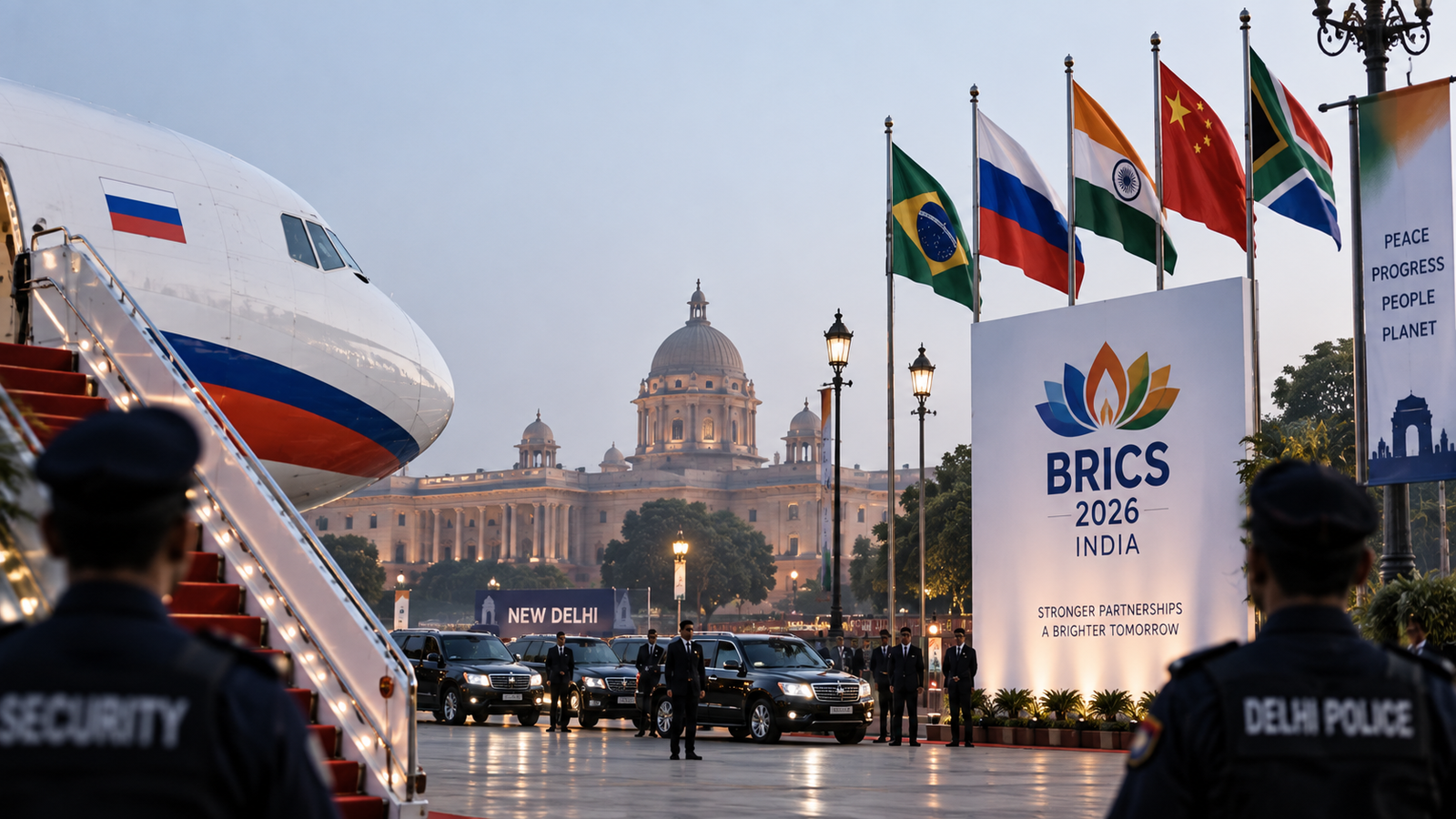
Delhi has slipped into full lockdown mode. World leaders are landing hour by hour for the BRICS Summit, and by Thursday evening the capital already felt less like a city and more like a security perimeter. Russian President Vladimir Putin touched down in the national capital ahead of a much-watched bilateral with Prime Minister Narendra Modi — a meeting that could set the tone for the entire summit.
For anyone flying in or out of Delhi this weekend, the message is simple: expect chaos. Around 15,000 police personnel have been deployed across the city, more than 500 surveillance cameras are running around the clock, and airspace restrictions kicked in from September 11 and stay in force till September 13. The bubble stretches roughly 300 kilometres around Indira Gandhi International Airport, which means flight schedules across northern India are already getting shuffled.
Putin’s arrival and the Modi meeting
Putin’s plane taxied in on Thursday afternoon to the usual carefully choreographed reception — a red carpet, a small honour guard, and a motorcade that had been rehearsed for days. His delegation is compact but heavyweight, with Foreign Minister Sergey Lavrov and senior energy officials in tow.
The Modi–Putin bilateral is scheduled at Hyderabad House, and Indian officials say the two leaders will spend a significant chunk of it one-on-one. Expect the conversation to circle around three big files: crude oil pricing and payment mechanisms, the S-400 delivery timeline, and India’s push to expand rupee–ruble trade settlements. There’s also quiet talk of a fresh defence procurement track, though officials on both sides have been careful not to overpromise before the joint statement drops.
Delhi in security overdrive
If you live anywhere near Lutyens’ Delhi, you already know the drill. Barricades have gone up along the Mother Teresa Crescent–Sardar Patel Marg stretch. Sniffer dogs are sweeping hotel basements. Rooftops around the summit venue at Bharat Mandapam are staffed with spotters, and anti-drone systems have been switched on across a wide arc of central Delhi.
A senior Delhi Police officer, briefing reporters on background, put it plainly: “This is the largest ground deployment we have run this year. Every entry point into New Delhi district is being screened.” Traffic advisories have been issued for Friday and Saturday, with the worst crunches expected between Palam and Rajpath. Metro services on the Yellow and Blue Lines will run, but a few stations near the venue may see intermittent skip-stops depending on movement schedules.
The airspace piece is the one catching most people off guard. From September 11 to 13, a temporary restricted zone within a 300-km radius of IGI Airport will bump general aviation, private charters, and even some scheduled flights. Airlines including IndiGo, Air India, and Vistara have already flagged possible delays and rerouting. If you’re flying, check with your carrier before leaving for the airport — the DGCA’s official advisory has the current NOTAM list.
What’s on the summit table
BRICS 2026 is being read as a critical checkpoint for the bloc. The grouping has almost doubled in size since the Johannesburg expansion, and Delhi’s job as host is to keep the tent from splitting. Expect four themes to dominate the outcome document: cross-border payments that reduce dollar dependence, a joint stance on AI governance, climate finance for the Global South, and a common framework on counter-terrorism.
Modi is also expected to push a “BRICS Digital Public Infrastructure” pitch — essentially taking India’s UPI-and-Aadhaar model global. Brazil and South Africa have signalled interest; China’s position is still being negotiated in the sherpa track.
The Ukraine war will hover over every session even if it never appears on the printed agenda. Western capitals will be watching Modi’s body language during the Putin bilateral very closely, and Delhi is aware of that. Officials have already telegraphed that India will not sign anything that reads as a takedown of NATO — but it will not sign anything that isolates Moscow either.
Business, backchannels, and the tourism knock-on
Hotel occupancy across South and Central Delhi has hit 98%. The Taj, ITC Maurya, Leela Palace, and Oberoi are effectively full, and rack rates have jumped 40–60% for the weekend. Restaurants inside the security cordon are running skeleton menus, and Uber and Ola have both warned users about surge pricing and no-go zones.
For a quick refresher on how India’s diplomatic playbook has shifted over the last two years, this breakdown of India’s foreign policy shift is worth a read — it lines up neatly with the tone Delhi is setting this weekend.
What to watch next
Three things to keep an eye on over the next 48 hours: the wording of the joint declaration on payments (does “de-dollarisation” appear or does the softer “local currency settlement” win?), the choreography around the Modi–Xi handshake, and whether Putin extends his stay for a possible visit to a defence facility outside Delhi.
Whatever the communiqué finally says, the optics are already locked in. Putin is here, the security ring is tight, and Delhi is once again running the diplomacy of a very complicated world — from a city that has, for three days, become the most watched capital on the planet. For live updates as the summit unfolds, keep an eye on the Ministry of External Affairs briefings.